Behind the price tag: Understanding the real cost of clothing
It was a casual conversation on campus. Just one of those moments that stays with you longer than it should.
Behind the price tag: Understanding the real cost of clothing
It was a casual conversation on campus. Just one of those moments that stays with you longer than it should.
We were having tea, talking about trends, outfits, sustainability, the usual mix of fashion and conscience that floats through student spaces these days. Someone mentioned thrifting. Another nodded. And then, without hesitation, someone said, “I can’t wear thrifted clothes. They have bad energy.”
The sentence landed softly. No malice. No intent to offend. Just certainty. People nodded in agreement. Someone laughed. Someone else added something about “aesthetics.” The conversation moved on, but I didn’t.
If you truly care about energy, you wouldn’t shop from the places you do. Clothes made through exhaustion, fear, poverty wages, and stolen lives carry far worse energy. We’ve just been trained not to see it.
Fast fashion has taught us to believe that clothes are disposable, trends are urgent, and newness is essential. But behind this carefully constructed illusion lies a truth that is far less aesthetic: cheap clothes are only possible because someone else is paying the price.
The illusion of cheapness
The global fast fashion industry is projected to reach USD 167.5 billion by 2030. That kind of growth doesn’t come from magic. It comes from scale, and scale requires sacrifice. But not our sacrifice.
Overproduction is not a side effect of fast fashion; it is its foundation. Clothes are designed to wear out quickly. Trends are engineered to last weeks, not seasons. Consumers are kept in a loop of buy, discard, repeat.
Landfills overflow with synthetic fabrics that do not decompose. Microfibres pollute rivers, oceans, and even glaciers. What looks cheap at the checkout is devastatingly expensive elsewhere.
A garment that requires cotton to be grown, harvested, spun, dyed, stitched, transported across continents, packaged, and marketed should not cost less than a meal. When it does, the maths doesn’t add up unless human lives are excluded from the equation.
One of the most persistent myths sustaining fast fashion is the belief in its legality. Brands operate within the law, but the law is often designed to protect profit, not people. Manufacturing is outsourced to countries in the Global South where labour laws are weak or poorly enforced, wages are legally set below living standards, safety violations rarely shut factories down, and workers lack unions or bargaining power. Under these conditions, exploitation is not an accident. It is the business model.
In Bangladesh, the average garment worker earns about one-third of a living wage. Long hours and poverty pay force families into impossible choices, including pulling children out of school to help the household survive. While many brands claim zero tolerance for child labour in factories, exploitation has shifted into more invisible spaces.
There are still over 3.5 million working children in Bangladesh. Many are not officially part of garment supply chains but are the children of garment workers themselves, working at home or in informal jobs because their parents’ wages are not enough to live on. Child labour hasn’t disappeared. It’s just been outsourced, hidden, and renamed.
Statistics tell us scale, but stories tell us truth.
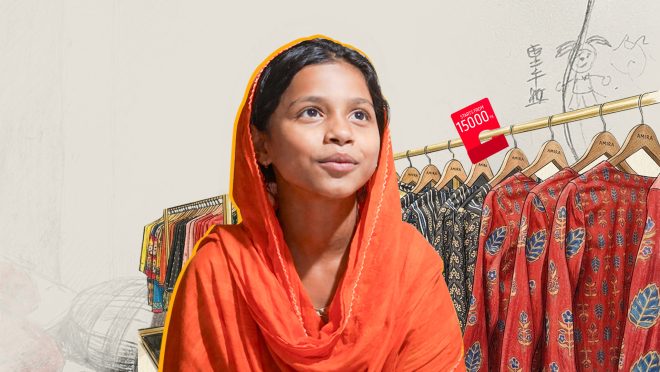
In the documentary film Project Happiness, filmed inside Bangladeshi garment factories, we meet Jui, a 12-year-old child labourer. When asked about her dream, she says she once wanted to become a doctor. That dream, she explains, is no longer possible. She now works in a factory so her sister can stay in school and become one instead.
This is what affordability looks like when you follow the supply chain all the way down.
Globally, the fashion industry employs around 75 million workers, yet less than 2% earn a living wage. UNICEF estimates over 100 million children worldwide are engaged in child labour, many directly or indirectly tied to garment production.
No child should ever have to trade their future for our wardrobes. Childhood should never be exchanged for survival. No child should have to choose between their dreams and their next meal.
Awareness without change
After the Rana Plaza collapse in 2013, which killed more than 1,100 garment workers, the world promised “never again.” Movements like #WhoMadeMyClothes demanded transparency and accountability. Awareness grew. Conversations began. Promises were made.
And yet, more than a decade later, the same structures remain.
Fashion accountability reports, including Remake’s 2024 Fashion Accountability Report, reveal a systemic failure across the industry. Among 52 assessed apparel brands, no major company meets even one-third of basic ethical standards across areas such as traceability, wages and wellbeing, environmental justice, and governance. The highest-scoring brands barely scrape the surface. Ultra-fast fashion brands, luxury houses, and “inclusive” celebrity-led labels often score equally poorly.
Different price tags. Same system functioning exactly as designed. Luxury is not a moral upgrade. Sustainability slogans are not accountability.
What we wear is never neutral
I keep thinking about that moment on campus, how easily the conversation moved on, and how I didn’t. Because once you start looking at the hands behind the clothes, it’s hard to unsee them.
What we wear is never neutral. I think about the hands that stitch brand-new garments through fourteen-hour workdays. I think of rivers turned black by dye runoff. I think about children like Jui, whose childhood was traded for survival. And I realise how selective our spirituality has become. Someone else always absorbs the harm we are simply taught not to look at.
This isn’t about perfection. It never was. It’s about presence. I don’t need constant newness if it requires someone else’s suffering. I don’t need moral purity. I need awareness, intention, and the courage to refuse.
Slow fashion isn’t a trend. It’s a pause. A question. A resistance to systems built on exploitation. An invitation to consume less, care more, even when it’s inconvenient.
If we truly care about energy, values, and alignment, then our choices cannot stop at what feels good to us. Fast fashion is cheap only because someone else pays the real cost with their labour, their health, their childhood, or their future. So the question remains:
What are we choosing to do differently, now that we know the cost?