From hills to plains, coffee finds new ground among Bangladesh’s farmers
From hills to plains, coffee finds new ground among Bangladesh’s farmers
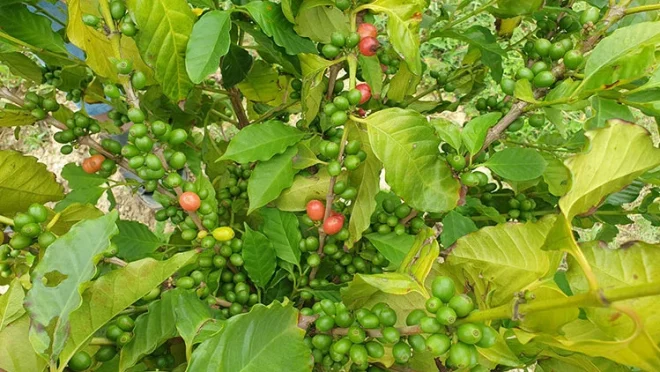
Coffee, once confined to the hills, is now attracting farmers across the plains. The crop was cultivated on just 122 hectares of land in FY21. That figure has since expanded to 2,000 hectares.
Madhupur in Tangail has long been known as the land of pineapples. But in a quiet corner of this fertile region, a different crop is beginning to reshape the agricultural landscape.
Under the shade of tall trees, rows of glossy green coffee plants sway gently in the breeze. The orchard belongs to Md Sanowar Hossain, a former schoolteacher who left the classroom to pursue a new calling in agriculture.
Eight years ago, Sanowar started his journey with only 200 coffee saplings. Today, his older orchard has around 500 trees. Recently, he has begun planting another 1,000 saplings in Madhupur, hoping to expand further.
From experiment to enterprise
Sanowar, who has received national recognition for his contributions to agriculture, now produces nearly one tonne of coffee annually from 50 decimals of land. Over eight years, he has invested around Tk300,000 in his orchard — earning roughly double that amount in returns.
Seeing such success, coffee cultivation is gradually spreading to different parts of the country.
He credits integrated farming as a key factor behind profitability. Coffee farming carries relatively low risk, as other crops can be grown alongside the trees on the same land.
Sanowar grows medicinal plants such as amla, haritaki and bahera alongside coffee. “Integrated farming brings good profits,” he said, adding that coffee also enjoys strong market demand.
A growing taste for coffee
Farmers, researchers and traders say coffee is steadily gaining popularity across Bangladesh. For years, the country relied entirely on imports, but local cultivation is now slowly emerging.

While once confined to the hills, farmers in the plains are increasingly showing interest in coffee farming. Photo: COURTESY
According to the Department of Agricultural Extension (DAE), Bangladesh consumes around 2,000 tonnes of coffee annually. Demand has surged over the past decade, growing at an average rate of about 56%. The domestic market is now worth roughly Tk6 billion a year.
Importers estimate the market size at $25.98 million in 2024, projected to reach $48.97 million by 2030.
Despite this growth, domestic production remains limited — only around 25 tonnes annually, less than 5% of demand.
Spreading beyond the highlands
“Currently, most coffee in Bangladesh is sold as raw fruit or beans. Globally, however, coffee undergoes processing, grinding, blending and packaging. Developing these stages locally could significantly boost profitability — turning a promising crop into a full-fledged industry.” Md Fazlul Kader, managing director, PKSF
Most coffee cultivation still takes place in the hill districts — Bandarban, Khagrachhari and Rangamati — where soil and climate conditions are ideal.
According to DAE data, coffee was cultivated on just 122 hectares of land in the 2020–21 fiscal year. That figure has since expanded significantly.
Md Shahidul Islam, director of the Cashews and Coffee Research, Development and Extension Project from the DAE, said coffee is now grown on nearly 2,000 hectares across the country.
While once confined to the hills, farmers in the plains are increasingly showing interest. Earlier, saplings had to be imported, but nurseries in hill areas are now meeting local demand.
Saplings, pioneers and early adopters
In Chattogram’s Mirsarai, Jamshed Alam has witnessed this shift firsthand. He began selling coffee saplings four years ago, initially importing high-quality plants from abroad. As interest grew, so did demand.
This year alone, he sold around 14,000 saplings.
In Sitakunda, Osman Goni — once an electrician — has also joined the movement. Three years ago, he received 100 free saplings from Young Power in Social Action (YPSA). Today, his trees are bearing fruit.
He expects to earn around Tk100,000 this year and plans to expand further.
Meanwhile, in Panchagarh, Zakir Hossain has started small, planting 50 saplings on 10 decimals of land, hoping to replicate similar success.
Understanding the crop
Coffee trees typically flower between May and June, with harvesting taking place in January and February. The beans require processing before they can be sold or consumed.
Arabica and Robusta are the most widely cultivated varieties in Bangladesh.
Under favourable conditions, yields range between 750 and 1,000 kilograms per hectare, with each tree producing about five kilograms annually. Once fruiting begins, trees remain productive for 20 to 30 years.
In local markets, coffee sells for Tk400 to Tk600 per kilogram.

Coffee trees typically flower between May and June. Photo: TBS
Projects driving expansion
Alongside government efforts, development organisations are playing a key role in expanding coffee cultivation.
A sub-project under the Rural Microenterprise Transformation Project (RMTP) is promoting high-value crops like coffee. Funded by IFAD, PKSF and Danida, it operates in 12 districts, including both hill regions and plains such as Tangail, Naogaon and Dinajpur.
The project provides training, marketing support and services to around 58,000 farmers.
In hill areas, YPSA has distributed 15,000 free saplings among 100 farmers to encourage adoption.
Building a market, not just farms
Md Arifur Rahman, executive director of YPSA, said the hill regions are highly suitable for coffee. With proper planning and market access, farmers’ incomes could rise significantly.
Efforts are now focused on building a complete value chain.

Most coffee in Bangladesh is sold as raw fruit or beans, unlike global markets where it is processed and packaged. Photo: COURTESY
For example, farmers in Sitakunda sell their produce to trader Shamsul Alam Titu. Supported by PKSF, such networks connect growers directly with buyers, ensuring fair prices and reducing intermediaries.
Md Fazlul Kader, managing director of PKSF, emphasised that production alone is not enough.
“Our project aims to maximise value addition while maintaining international standards,” he said.
“Currently, most coffee in Bangladesh is sold as raw fruit or beans. Globally, however, coffee undergoes processing, grinding, blending and packaging.
“Developing these stages locally could significantly boost profitability — turning a promising crop into a full-fledged industry,” Fazlul Kader added.