"Shob ready thakbe!" The tailor’s betrayal
If you have ever stood in front of a mirror two nights before Eid ul-Fitr, wearing an outfit that looks nothing like the design you submitted, silently calculating whether disappointment can be ironed out, then you are not alone.
"Shob ready thakbe!" The tailor’s betrayal
If you have ever stood in front of a mirror two nights before Eid ul-Fitr, wearing an outfit that looks nothing like the design you submitted, silently calculating whether disappointment can be ironed out, then you are not alone.
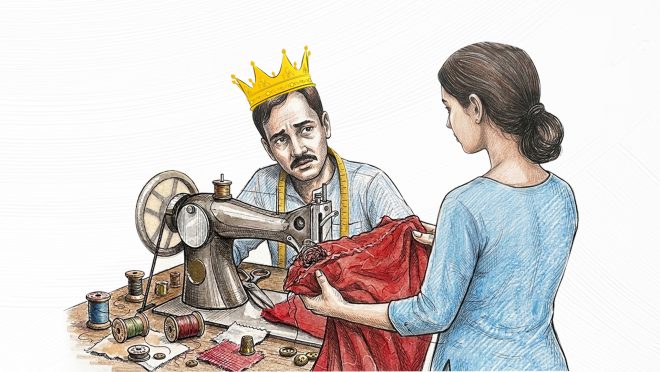
In Bangladesh, three things are guaranteed before Eid: traffic will worsen, shopping malls will overflow, and tailors will say, “Tension niben na, shob time moto hoye jabe.”
It is a seasonal economy built on hope, overcommitment, and verbal promises. Every year, customers hand over fabric with excitement and collect it with quiet devastation, often 48 hours before Eid, when there is no room left to negotiate.
This year, I joined that club.
One week before Ramadan, I gave my fabric to “Jannat Tailors” near Mintu Bazar, Porshinagar. The design reference was clearly shown, explained, even re-explained.
He nodded confidently while flipping through his order notebook. “Apu, kono problem nai. Eid er agey peye jaben.” Measurements were taken. A deadline was promised. Trust sealed.
Two weeks before Eid, I went to collect it.
The outfit was not what I had described. The neckline was different. The cut ignored the reference photo. The finishing looked rushed.
When I pointed it out, the response changed tone: “Design ta onek jotil chilo.”
Then, “Eid er rush e eto detailed kaj kora tough.”
Finally, the subtle reversal: “Apni onek late e diyechen.”
The design that was “no problem” three weeks ago had suddenly become my responsibility.
Across Dhaka, from Porshinagar to Mirzapur, Chintaipur to Old Town, this script repeats itself every Ramadan. The tailoring sector operates largely on informal systems. Orders are handwritten into thick notebooks. Deadlines are verbal. There is no digital tracking, no structured trial schedule, and no formal dispute mechanism. Demand spikes dramatically during Ramadan, compressing months of income into a few intense weeks.
Most small tailoring shops accept more orders than they can realistically complete because refusing customers risks losing future business.
From a business perspective, overbooking becomes a survival strategy. From a customer’s perspective, it becomes heartbreak.
Eid clothing is not an ordinary purchase. It carries social meaning. It appears in family gatherings, Eid selfies, and Facebook posts. When the outfit does not fit properly, the disappointment feels disproportionate but real.
You stand in front of the mirror, adjusting sleeves that are tighter than planned, whispering, “Ektu thik kora jabe?”
The tailor examines it, pulls at the fabric, and delivers the most dangerous sentence in Bangladesh’s pre-Eid vocabulary: “Alter kora jabe… but time lagbe.” Time, of course, is something you no longer have.
And what can you realistically do? A few days before Eid, alternatives are limited. Ready-made options are crowded and overpriced. There is no complaints desk to escalate to. You cannot uncut fabric. You cannot unsee the uneven stitching. So, you pay, leave, and promise yourself you will “never come back again.”
Most of us do come back.
The problem is structural, not merely personal. Seasonal demand overwhelms small operations. Customers often submit fabrics late while requesting complex, designer-inspired cuts. Tailors rarely refuse orders. Verbal commitments replace written clarity. When delivery fails, accountability dissolves into negotiation. Still, some responsibility lies with us.
Submitting clothes at least three to four weeks early reduces risk. Attaching printed design references to the order entry helps avoid “misunderstandings.” Simplifying designs during peak season improves outcomes. Keeping a backup outfit is not dramatic; it is practical risk management.
Yet none of this erases that specific Eid-eve feeling: standing silently in a crowded shop while others argue politely, hearing variations of “Kal ashen,” “Almost ready,” “Ektu adjust kore nin.”
You leave not because you are satisfied, but because you are out of options.
If your tailor ever smiled confidently and said, “Shob ready thakbe,” only for you to discover otherwise, you are not alone.
This situation repeats itself every year. We forgive. We complain. We return. Because in Bangladesh, Eid is incomplete without shemai, new clothes, and at least one tailoring crisis we pretend we did not see coming.