Remembering Samaresh Majumdar
Every year, readers across Bengal and beyond remember the legendary Bengali novelist Samaresh Majumdar on his birthday with admiration and gratitude.
Remembering Samaresh Majumdar
Every year, readers across Bengal and beyond remember the legendary Bengali novelist Samaresh Majumdar on his birthday with admiration and gratitude.
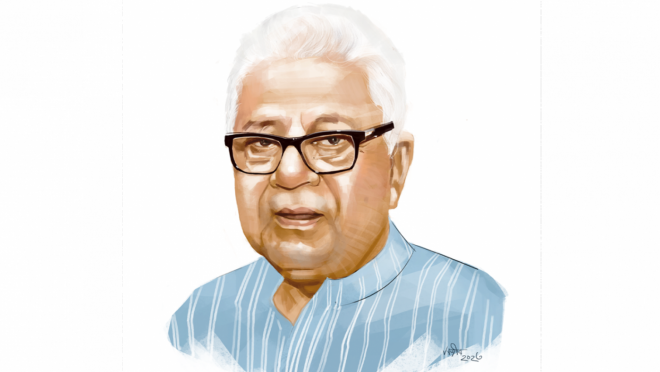
Born on 10 March 1942 in Gairkata in the Jalpaiguri district of North Bengal, Majumdar emerged as one of the most influential literary voices in modern Bengali literature.
His works captured the political unrest, social transformation, and emotional complexities of the late 20th century with remarkable storytelling brilliance. Through his novels, short stories, and essays, he created characters that felt real and resonated deeply with generations of readers.
Samaresh Majumdar spent his childhood in the tea garden regions of North Bengal, an environment that later shaped the landscapes and social realities portrayed in many of his stories, such as the Animesh series of novels. Growing up among the diverse cultures and communities of the region gave him a unique perspective on society.
His exposure to the vibrant intellectual and political climate of Kolkata during the 1960s played a crucial role in shaping his literary consciousness. The era was marked by ideological debates, social movements, and youth activism. These elements later appeared vividly in many of his writings.
Rise to prominence
Samaresh Majumdar began his literary journey by initially writing short stories for magazines. His early works quickly attracted attention for their narrative strength and deep understanding of human psychology. However, it was his famous trilogy, The Animesh Trilogy, that established him as a towering figure in Bengali literature. The trilogy includes Uttaradhikar, Kalbela, and Kalpurush.
These novels revolve around the character Animesh, whose life unfolds against the backdrop of the turbulent political environment of Bengal, particularly the period surrounding the Naxalite movement.
Among the trilogy, Kalbela became especially iconic and earned Majumdar the prestigious Sahitya Akademi Award in 1984. The novel captured the hopes, anger, and idealism of a generation caught in revolutionary politics.
Samaresh Majumdar’s writing style is known for its gripping narrative flow, emotional intensity, and strong social commentary. His stories often explored youth rebellion and political movements, social inequality and injustice, human relationships and psychological conflict, and urban and rural transformation.
One of the most notable aspects of his writing is how seamlessly he aligned personal stories with historical events. His characters are rarely one-dimensional; instead, they are complex individuals navigating moral dilemmas and societal pressures. Majumdar also had an exceptional ability to portray youth struggles.
Memorable characters
Many of Samaresh Majumdar’s characters have become unforgettable figures in Bengali literature. Animesh from The Animesh Trilogy remains one of the most iconic protagonists. His journey reflects the emotional and ideological turbulence of an entire generation.
Another popular creation of Majumdar is the adventurous character Arjun from the detective series. Through Arjun, Majumdar successfully entered the world of adventure fiction, captivating younger readers with thrilling plots and intelligent storytelling. His versatility as a writer allowed him to move effortlessly between political novels, romantic stories, thrillers, and children’s literature.
Over the decades, Samaresh Majumdar created a vast body of work. Some of his notable books include Saatkahon, Ujan, Kalbela, Uttaradhikar, and Kalpurush.
Each of these works reflects different dimensions of society and human emotion. Saatkahon, for instance, is often praised for its powerful portrayal of women’s lives and struggles.
Throughout his career, Samaresh Majumdar received numerous accolades for his contributions to literature. His most notable recognition remains the Sahitya Akademi Award.
Apart from this, he was widely honoured by literary organisations, cultural institutions, and universities across South Asia. His works have been translated into several languages, allowing readers from different regions to experience his storytelling brilliance.
Samaresh Majumdar belongs to a generation of writers who reshaped modern Bengali fiction. Alongside contemporaries such as Sunil Gangopadhyay and Shirshendu Mukhopadhyay, he helped define the literary voice of post-independence Bengal.
What made Majumdar unique was his ability to combine political realism with compelling human drama. His works are often studied not only as literature but also as social documents.
Samaresh Majumdar’s writing often carries poetic sensitivity even within intense political narratives. His reflections on youth, hope, and struggle remain deeply moving. In many of his stories, he highlights the fragile yet resilient nature of human dreams.
His characters often find themselves caught between idealism and harsh reality, yet they continue to search for meaning and dignity.
Readers admire his ability to turn everyday experiences into powerful storytelling moments.
Legacy
Leaving behind a rich literary legacy, he passed away on 8 May 2023. Yet his stories remain alive in the hearts of readers.
His novels continue to be read by students, scholars, and literature lovers across Bengal. Many of his works have been adapted for television and theatre, further expanding his cultural impact.
More importantly, Majumdar’s stories continue to speak to new generations who find in his characters the same questions about identity, justice, and hope that still shape society today.
On his birthday, remembering Samaresh Majumdar is not only about celebrating a writer but also about celebrating a powerful storyteller who chronicled the dreams and struggles of an era. His words captured the spirit of youth, the turbulence of political change, and the timeless complexity of human relationships.
From the tea gardens of North Bengal to the bustling intellectual circles of Kolkata, his journey reflects dedication to literature and truth. Through his tremendous works, Majumdar secured his place among the greatest figures of Bengali literature.
Even years after his passing, his stories continue to inspire readers, reminding us that literature has the power to preserve history, question society, and illuminate the deepest corners of the human heart.