Pi Day: Chasing an infinite number
Every year on 14 March (3/14), maths nerds, teachers, bakers and obsessive thinkers pause to celebrate a number that has no end.
Pi Day: Chasing an infinite number
Every year on 14 March (3/14), maths nerds, teachers, bakers and obsessive thinkers pause to celebrate a number that has no end.
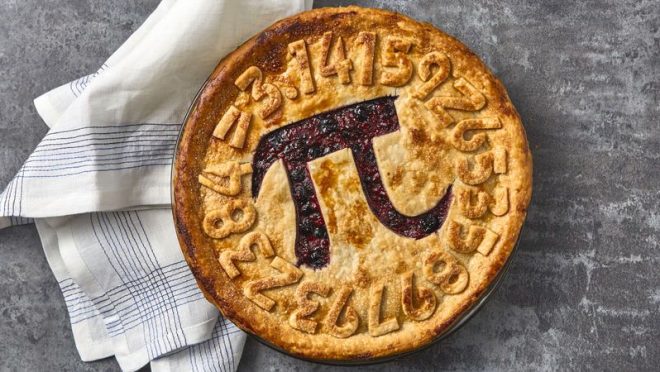
Pi Day, not the pie you are thinking about, is not loud. It does not shout or present itself in a grand parade. Instead, it presents itself as a riddle we have all been holding since childhood and never could quite solve.
3.14159265… that is about as much as my brain can fathom. But the number, like Dhaka’s traffic and moral policing, is simply endless. Pi is the ratio of a circle’s circumference to its diameter, a simple idea with infinite consequences. No matter how big or small the circle is, that ratio never changes. Stretch the circle across a galaxy or shrink it to the size of an atom, divide the distance around it by the distance through its centre, and you always arrive at the same stubborn, irrational number: 3.14159265… continuing endlessly, without pattern or pause.
Pi Day is often reduced to jokes about pie, memory or chalk-dusted classrooms. But strip away the proverbial frosting and you will find something much rawer underneath. Pi is unsettling, never repeating and never settling. You can spend your whole life calculating it and still not come close to scratching the surface of this behemoth of a number.
You see, that is when this starts to feel much more human.
In 1998, filmmaker Darren Aronofsky took the concept of pi and turned it into a fever dream with the movie Pi. The film does not explain pi; instead, it makes the audience feel it in their bones. Shot in harsh black and white and set in claustrophobic Manhattan, the movie follows Max Cohen, a mathematician obsessed with finding patterns in the universe. Especially the kind that might unlock everything: the stock market, God, or even meaning itself.
Max is not chasing maths for fun. He is doing so to solve the greatest mysteries of mathematics, hoping it will become the key to understanding the universe. Watching Pi feels less like watching a movie and more like overhearing your brilliant but slightly unhinged roommate’s inner monologue at 3 am. To put it simply, it is the sound of a brain chewing on the universe until it bleeds. And that is why it still resonates decades later, especially on Pi Day. Because most of us, at some point, have been Max Cohen. Not with equations, but with questions.
Why did this happen?
What does it mean?
Is there a pattern here?
We tell ourselves that maths is clean and emotionless, but pi laughs at that idea. Pi is irrational. Literally. It cannot be written as a fraction and it refuses to behave. For thousands of years, humans have tried to tame it, from ancient Babylonians to modern supercomputers, and every generation has had to accept the same truth: you can get close, but never close enough.
In a world obsessed with optimisation, pi stands there calmly, reminding us that some things do not fit neatly into boxes. Not everything can be solved, monetised, or explained in a thread. Pi simply exists: infinite and indifferent, like time or grief or love.
That is why Pi Day is not really about maths for me. It is about humility.
It is about admitting that the universe is larger than our tools and our brains, and that is okay. Understanding has limits, and pushing against them does not always make you wiser. It can make you lonely, obsessive, even insane, as Pi so brutally shows. Max’s tragedy is not that he fails to understand the universe; it is that he believes he must understand it, even if it costs him his sanity.
On this Pi Day, maybe the celebration is not in memorising more digits or baking another pun-filled pie. Maybe it is sitting with a quiet sense of discomfort. Letting the number trail off without demanding an ending. Recognising ourselves in that endless decimal: inconsistent, unresolved, beautiful precisely because we do not repeat.
Pi teaches us that perfection is not closure. It is continuation.