Influential German philosopher Jürgen Habermas dies at 96
Jurgen Habermas, one of the most prominent philosophers and public intellectuals in post-war Germany, has died at the age of 96. His death was announced on Saturday by his long-time publisher, Suhrkamp Verlag.
Influential German philosopher Jürgen Habermas dies at 96
Jurgen Habermas, one of the most prominent philosophers and public intellectuals in post-war Germany, has died at the age of 96. His death was announced on Saturday by his long-time publisher, Suhrkamp Verlag.
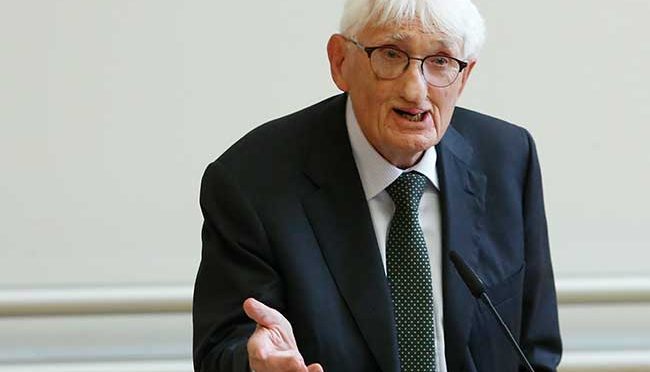
Habermas became widely known for his powerful contributions to philosophy, sociology and political thought. Beginning in the 1960s, he taught philosophy and sociology at Goethe University Frankfurt, where he emerged as a strong voice during a period of intense political and intellectual change.
At the time, he openly supported student protests that were sweeping across West German universities.
He was also closely associated with the Frankfurt School, an influential group of thinkers who examined modern capitalist society through a critical lens. Unlike traditional Marxist thinkers, members of the Frankfurt School developed what became known as critical theory, analysing how culture, media and social institutions could shape and limit public debate.
Habermas was born in Düsseldorf in June 1929 and grew up under the rule of Nazi Germany. His father, who headed the local chamber of commerce, joined the Nazi Party in 1933. As a boy, Habermas was enrolled in the Hitler Youth, although he was too young to take part in the fighting during World War II.
After the war ended, he pursued higher education in philosophy and earned his doctorate from University of Marburg. He later joined the Institute for Social Research in Frankfurt, where he worked alongside leading intellectuals such as Max Horkheimer and Theodor W. Adorno.
The Frankfurt School became known for arguing that modern capitalist societies often weaken citizens’ ability to think critically. According to this perspective, mass culture and consumerism can transform active participants in democratic life into passive consumers.
According to a report by the BBC, Habermas developed this critique further by examining the role of modern media and entertainment. He warned that mass-produced culture could undermine meaningful public discussion by turning communication into a commercial product rather than a space for reasoned debate.
One of his most influential works, The Theory of Communicative Action, presented his central idea that societies are held together not simply by political authority or economic systems but by the human capacity for rational communication. He believed open dialogue and shared reasoning were essential foundations of democratic life.
Habermas also played an important role in major political debates in Germany. During the 1980s he entered a heated dispute with conservative historians over how the Holocaust should be understood, firmly defending the view that it represented a uniquely German historical crime.
Later, during the political changes of 1989 and 1990, he criticised the rapid integration of East Germany into West Germany after the fall of the Berlin Wall. He warned that a rushed reunification could revive dangerous nationalist sentiments and argued for a slower, more cautious approach.
In the following decade, Habermas became a strong supporter of European unity. He believed a politically integrated Europe offered the best safeguard against the return of nationalist rivalries that had once plunged the continent into conflict.