Why the return journey after Eid is becoming deadlier
At least 274 people were killed and more than 1,500 injured in 342 road accidents between 16 and 26 March this year during the Eid-ul-Fitr travel period.
Why the return journey after Eid is becoming deadlier
At least 274 people were killed and more than 1,500 injured in 342 road accidents between 16 and 26 March this year during the Eid-ul-Fitr travel period.
On 27 March, long queues of Dhaka-bound vehicles stretched for kilometres on the highways. By late morning, a 10-kilometre tailback had formed from Koddar Mor in Sirajganj to the west end of the Jamuna Bridge. Vehicles crawled forward at a snail’s pace, delayed further by an accident at the Tangail end.
For many passengers, time lost on the road translated into anxiety and physical strain.
Sultan Hafiz, a banker travelling from Pabna, feared he would miss his daughter’s school deadline despite starting early. Farooq Hossain, a garment factory official, watched a six-hour journey stretch towards twelve, his wife and children falling ill in the heat as they waited.
Abdur Monayem, a businessman from Rajshahi, described the frustration bluntly, “We were stuck in traffic for two hours on the Jamuna side, and then again here. Our vehicle left at 4:40pm. Under normal circumstances, we would have reached before 8:00pm. But we finally arrived around 11:00pm. The congestion stretched all the way to the western end of the Jamuna Bridge, completely gridlocked.”
Keep updated, follow The Business Standard’s Google news channel
Even under normal circumstances, the journey would have been long. But with garment factories reopening on Saturday and government offices on Sunday, transport operators expected passenger pressure to intensify further.
Trains offered a little relief.
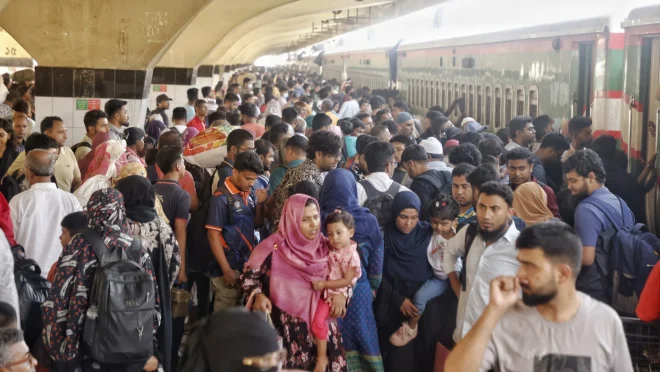
Reports showed severe overcrowding, with many forced to stand for hours or even travel on rooftops. Ticket shortages and unregulated boarding meant trains carried several times their intended capacity.
Anika Mahzabien, a Dhaka University student, recalled, “There were so many people that it became extremely difficult to board. The train returned to Dhaka carrying nearly three times more passengers than its seating capacity, and ordinary passengers suffered greatly because of this.”
The discomfort did not end there. At Dhaka Railway Station, passengers complained of being charged between Tk150 and Tk300 for trolley services that were supposed to be free for the sick and those carrying luggage.
Railway authorities pointed to disruptions caused by fire incidents on the Chattogram and Sylhet routes, which threw schedules into disarray. “Due to schedule disruptions the previous day, our trains entered Dhaka late. As passenger pressure is higher, trains are arriving late and departing with some delay,” an official said on condition of anonymity.
Beyond the inconvenience lies a far more troubling reality: the return journey is becoming deadlier.
According to the Road Safety Foundation (RSF), at least 274 people were killed and more than 1,500 injured in 342 road accidents between 16 and 26 March during the Eid-ul-Fitr travel period. Data from the Bangladesh Passenger Welfare Association paints an even grimmer picture. Between 14 and 27 March, 309 people were killed and 902 injured in 304 road accidents.
“The capacity to carry so many passengers is actually beyond the limits of our entire transport system, whether by rail, road, or water. The only sustainable solution is to move investment outside Dhaka and create employment there, so people do not have to migrate in the first place. Otherwise, this crisis will never go away.” said Md Hadiuzzaman, Former Director, Accident Research Institute
Government data from the Bangladesh Road Transport Authority (BRTA) shows that between 17 and 23 March alone, 92 accidents led to 100 deaths and 217 injuries.
The rise is stark when compared to last year’s Eid-ul-Fitr period, when 249 people were killed and 553 injured in 257 accidents.
A journey defined by tragedies
Statistics, however, only hint at the scale of human loss.
On 25 March, as passengers were returning to Dhaka after the holiday, a bus plunged into the Padma River near the Daulatdia ferry terminal in Rajbari, killing at least 26 people, including five children and 11 women.
Days earlier, a train collided with a bus in Cumilla, leaving 12 dead and 26 injured.
In Tangail’s Kalihati upazila, what began as a routine journey ended in horror. A Dhaka-bound bus from Gaibandha ran out of fuel and was parked by the roadside. As passengers waited, some sat or walked along nearby railway tracks. Around 8:30pm, the Sirajganj Express train ran over them, killing five people, including a child, and critically injuring two others.
The unseen causes
Behind many of these incidents lie systemic failures.

Graphics: TBS
In Tangail, the accident was triggered by a critical issue: fuel shortage. The driver and helper had left to arrange fuel, leaving passengers stranded in a vulnerable location.
“We are told that there is enough oil in pumps, but since the government is not raising the oil prices the pump owners are not selling them to us. In this crossfire between the oil pump owners and the government, we are the ones who are facing the casualties,” Alamgir Hosen, a bus driver, described.
Such disruptions ripple through an already strained system, increasing risk at every step.
Md Hadiuzzaman, a professor of Civil Engineering at BUET and former director of the Accident Research Institute (ARI), believes the root of the problem lies in an overwhelmed system.
“The capacity to carry so many passengers is actually beyond the limits of our entire transport system, whether by rail, road, or water.”
He points to Dhaka-centric development as a key driver. “By concentrating investment in Dhaka, we’ve brought people from all over the country here. Naturally, they will return home during Eid,” he said.
That return, often involving around 1.5 crore people within a few days, places an impossible burden on infrastructure.
“The only sustainable solution,” Hadiuzzaman argued, “is to move investment outside Dhaka and create employment there, so people do not have to migrate in the first place. Otherwise, this crisis will never go away.”
However, Saidur Rahman, executive director of the Road Safety Foundation, linked the high death toll directly to failures in road management.
He also broadened the criticism beyond regulatory bodies. The police, he said, are equally strained, while the Bangladesh Road Transport Corporation (BRTC) has drifted from its public-service mandate.
“BRTC buses were not bought for leasing them,” he said. “This was bought with people’s tax money. This will transport people.”