I think, therefore I am: Teaching the world to doubt everything
Oftentimes, we tend to question our existence in this vast universe. No, I have not been in an existential crisis after watching Interstellar; it is the core idea behind the doubt itself. The fundamental reasoning of this doubt has been talked about in history for quite some time now. Such is the thinker René Descartes.
I think, therefore I am: Teaching the world to doubt everything
Oftentimes, we tend to question our existence in this vast universe. No, I have not been in an existential crisis after watching Interstellar; it is the core idea behind the doubt itself. The fundamental reasoning of this doubt has been talked about in history for quite some time now. Such is the thinker René Descartes.
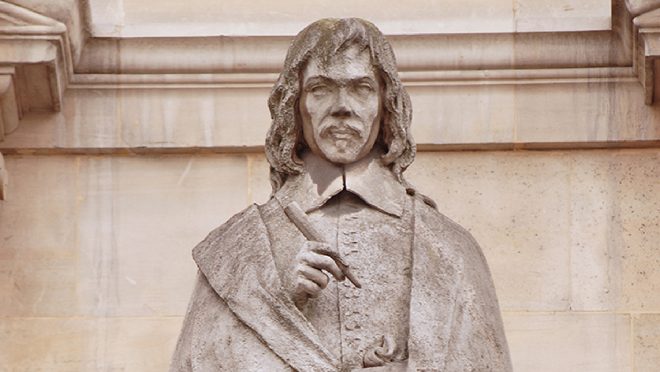
On 31 March 1596, in the small town of La Haye en Touraine in France (now renamed in his honour), René Descartes was born into a world on the cusp of intellectual transformation. Today, he is remembered as one of the founding figures of modern philosophy, a mathematician of extraordinary influence, and a thinker whose ideas reshaped how we understand knowledge, doubt, and even existence itself.
His early life gave little indication of the revolutionary path he would later take. His education at the Jesuit college of La Flèche, one of the most prestigious institutions in Europe at the time, gave him a strong understanding of philosophy, science, and mathematics. Although, in his early stages of life as a student, he struggled with authority and traditional approaches, he initially tried to cope with it. But the thought behind his life’s work, the pillars of his philosophy, had already started to take shape: “How can we be certain that what we know is actually true?”
Out of this process came his most famous conclusion, often summarised in the Latin phrase Cogito, ergo sum “I think, therefore I am.” The idea is simple yet profound: even if we doubt everything else, the very act of doubting proves that there is a thinking mind doing the doubting. In other words, the existence of the self is the one thing that cannot be denied. This insight became the cornerstone of modern philosophy, shifting the focus from the external world to the thinking subject. He is still considered a revolutionary thinker for being able to coin this conclusion.
He also had remarkable achievements in mathematics. He is best known for developing what we now call Cartesian geometry. It links algebra with geometry in a way that makes it possible to describe shapes using equations, an approach that remains fundamental to mathematics and science to this day. The system in which we use “x” and “y” as variables is a direct line of his work.
Much of Descartes’ life was spent travelling across Europe, including time in the Dutch Republic, where he found the intellectual freedom to write and publish his ideas. It was there that he produced some of his most important works, including Meditations on First Philosophy and Discourse on the Method. In these texts, he laid out his approach to reasoning in a clear fashion. We would not have known otherwise.
Now we come to a point where things might get complicated. During the early scientific revolution, new thought or innovation was not always appreciated. It often clashed with radical religious authority, which was constantly paranoid about losing its influence. Descartes was cautious; he intentionally delayed a few of his works or denied publication of some just to avoid controversy. Even so, his ideas challenged long-held beliefs and helped pave the way for later thinkers, including Sir Isaac Newton and John Locke.
In 1649, near the end of his life, Descartes accepted an invitation from Christina of Sweden to join her court in Stockholm. Christina of Sweden was highly ambitious. The move proved difficult. Accustomed to working late into the morning, he struggled with the queen’s demand for early lessons in the harsh Scandinavian winter. Within months, he fell ill and died in February 1650 at the age of 53.
Descartes’ legacy is vast and enduring. In philosophy, he is often called the “father of modern philosophy” because he placed human reason at the centre of inquiry. In science and mathematics, his methods encouraged clarity, precision, and a belief that the natural world could be understood through rational investigation.
On his birthday, René Descartes is worth remembering not only for the ideas he left behind but also for the mindset he championed, the reasons why he is still remembered almost four centuries after his departure.