The floating schools of Chalan Beel
Across the waterways of Chalan Beel, 39 boats move between villages. Of these, 26 are used as floating schools, 10 function as libraries and computer labs, and seven serve as training centres
The floating schools of Chalan Beel
Across the waterways of Chalan Beel, 39 boats move between villages. Of these, 26 are used as floating schools, 10 function as libraries and computer labs, and seven serve as training centres
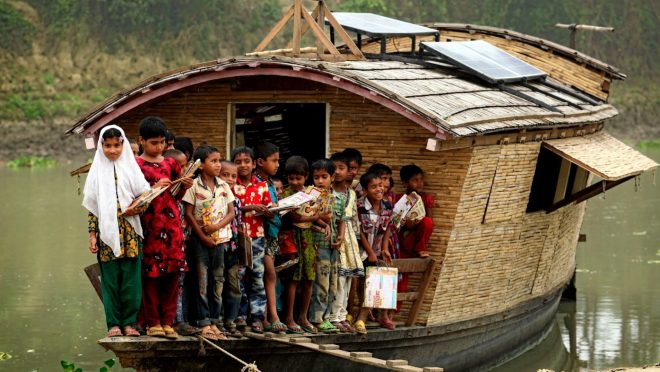
Ten-year-old Rakibul Islam waits at the edge of his village in Bhangura, Pabna. During the monsoon, there is no road to school, no dry ground to walk on. Instead, he watches the water for a familiar shape.
Soon, a wooden boat fitted with solar panels glides closer to the flooded bank. Rakib climbs aboard, notebook tucked under his arm. For him, and thousands like him, school does not close during floods — it floats.
In Chalan Beel, Bangladesh’s largest wetland system that stretches across around 1,150 square kilometres of Sirajganj, Natore and Pabna, education has long been one of the first casualties of the monsoon.
Large parts of the wetland remain submerged for four to six months every year. Conventional schools shut their doors. Libraries, clinics and playgrounds disappear underwater. For children in remote villages, especially girls whose mobility is already restricted, the learning gap can last a lifetime.

Classes run six days a week, in three shifts a day. Each shift lasts around three hours and accommodates about 30 students. Photo: Shidhulai Swanirvar Sangstha
Bangladesh also has the fourth-highest rate of child marriage in the world, and when schools close, the risks multiply.
The floating schools of Chalan Beel were born out of this reality.
Idea shaped by water
Architect Mohammed Rezwan grew up in the country’s northwest. As a child, he saw his own schooling disrupted year after year, and watched friends and relatives drift away from education altogether.
Later, while studying architecture at Buet, Rezwan initially imagined building schools and hospitals for flood-prone areas. Then he confronted a simple truth that brick and concrete would drown.
“I thought of boats,” he said. But no one wanted to invest in such an unconventional idea. In 1998, with just $500 worth of savings from his school scholarship and an old computer, Rezwan founded Shidhulai Swanirvar Sangstha as a non-profit organisation.
He had no experience in writing grant proposals. Instead, he taught himself online, sent hundreds of emails, and submitted proposals to organisations around the world. It took four years to secure enough funding to build the first floating school, which finally set sail in 2002 in Singra upazila of Natore.
Shidhulai is now registered with the NGO Affairs Bureau under the Prime Minister’s Office, and its floating school innovation has been incorporated into Bangladesh’s National Adaptation Plan 2050, official recognition that climate resilience and education must move together.
“The question is, ‘Where will 20 to 30 million climate refugees go?'” Rezwan said, reflecting on the growing climate threat. “Already 948 people are living per square kilometre in Bangladesh, and the northern parts will be flooded in future. Therefore, the ‘floating community’ concept is an appropriate solution for Bangladesh.”
Schools that come to you
Locally known as “noukay school” (school on boat), the floating schools reverse the logic of education delivery. Children do not travel to school; the school travels to them.
Across the waterways of Chalan Beel, 39 boats operated by Shidhulai Swanirvar Sangstha move between villages. Of these, 26 are used as floating schools, 10 function as libraries and computer labs, and seven serve as training centres.

Photo: Shidhulai Swanirvar Sangstha
In some parts of the beel, particularly along the Gumani River in Chatmohar and Bhangura upazilas of Pabna, Gurudashpur and Singra in Natore, and Tarash in Sirajganj, the boats are a common sight.
Each boat is built from local timber by traditional boat builders, using sal wood, bamboo and recycled tin sheets. Flat-bottomed hulls allow them to navigate shallow monsoon waters, while iron beams create column-free interiors.
Curved, layered roofs help deflect heavy rain and maintain balance. Solar panels power lights and computers, and even old kerosene lanterns have been repurposed as solar light casings, combining cultural familiarity with renewable energy.
Classes run six days a week, in three shifts a day. Each shift lasts around three hours and accommodates about 30 students. Teachers navigate narrow waterways, collecting children from riverbanks and flooded homesteads before anchoring at a suitable spot to begin lessons in Bangla, mathematics and general knowledge.
According to programme manager Nazmul Huda, “Currently, classes are being held in 26 boats across the Chalan Beel area. Each boat accommodates three classes, and 30 students attend each boat.”
Senior manager Madhusudan Karmaker adds that around 2,240 to 2,340 pupils are enrolled daily in the floating schools operating in the region.
Since 2002, the impact has accumulated quietly but steadily. More than 22,500 students have graduated from Shidhulai’s boat schools. During severe floods, the same boats double as shelters for displaced families, blurring the line between education infrastructure and emergency lifeline.
“These schools never close, not even during floods,” said teacher Sakhina Khatun, who has worked with Shidhulai for over a decade. “That is what makes them special.”

Photo: Shidhulai Swanirvar Sangstha
Education, in Shidhulai’s model, does not end with children’s lessons. Floating libraries bring books to villages with no permanent reading spaces. Computer labs address the digital divide in areas where electricity is scarce or absent.
“There are not many computer facilities in our village,” said Shumon Mollick, now a student at Dhaka University, from Singra upazila. “We had to go some 20 miles to learn computers. But now, we have this facility on our doorsteps.”
Training boats focus on adult education, particularly for women. Roksana Parvin, a housewife from Singra, attends agricultural training sessions during the monsoon.
“We get training on crop cultivation in submerged land,” she said. “We also learn how to cultivate paddy, jute and vegetables and protect crops from pests without using harmful chemical pesticides.”
Many of the teachers and programme staff come from the same communities the boats serve. Some were once students themselves. Teacher Shaaz Parvine explained that the project deliberately focuses on underprivileged children who might otherwise drop out due to poverty or displacement.

Photo: Shidhulai Swanirvar Sangstha
This continuity has helped the programme gain trust quickly. When the first boat school appeared in Singra in 2002, it spread by word of mouth. “In no time, it became quite popular among the people of Chalan Beel areas, which remain submerged for months,” Shidhulai officials recalled.
Global recognition
In 2025, Shidhulai’s floating schools received one of the world’s highest honours in education, UNESCO’s Confucius Prize for Literacy. Selected from hundreds of nominations, the initiative was recognised for “delivering literacy education to marginalised learners in flood-prone regions through locally rooted innovation.”
The other winners that year were Ireland’s Learn with NALA eLearning platform and Morocco’s Second Chance School and Inclusive Education Programme.
Rezwan received the trophy at the 20th award ceremony in Qufu, China, the birthplace of Confucius.
“Education is not just about reading and writing, it builds peace, equality and tolerance,” Rezwan said. “I hope that with the power of literacy and knowledge, our youth will create a future where no disaster can stop the education of any child.”

Photo: Shidhulai Swanirvar Sangstha
The recognition brought both pride and responsibility.
“We are happy and proud that our floating school has received the UNESCO award,” Rowshan Ara Parveen said. “We will try our best to improve the quality of education in the future with everyone’s blessings.”
Other NGOs in the country have adopted similar approaches, while projects inspired by Shidhulai now operate in parts of Asia, Africa and Latin America. Teacher Sakhina Khatun notes that initiatives in Nigeria, Cambodia and the Philippines trace their roots back to the Bangladeshi experiment.
Rezwan himself is a World Fellow at Yale University, and his work features in exhibitions, documentaries and books on climate adaptation, including Julia Watson’s Lo–TEK: Water. Yet the heart of the project remains stubbornly local.
“I have not had many things during my life, and these children do not have much either,” Rezwan said. “But giving them access to schooling and healthcare, and seeing that replicated around the world, that gives me motivation.”
Despite its success, the scale of need in Chalan Beel continues to outpace resources. With only 39 boats serving a vast wetland and hundreds of scattered villages, Shidhulai acknowledges that the number is not enough. The organisation is working to introduce more boats, integrate digital learning tools and expand mobile clinics, but funding remains a constant challenge.