Gap years, grassroots projects, and a Full-Ride scholarship: A student who did it differently
In Bangladesh, academic success is often tied to speed: finish HSC, sit for admission tests, and move quickly into university. Samiha Tasnim Era chose a different route.
Gap years, grassroots projects, and a Full-Ride scholarship: A student who did it differently
In Bangladesh, academic success is often tied to speed: finish HSC, sit for admission tests, and move quickly into university. Samiha Tasnim Era chose a different route.
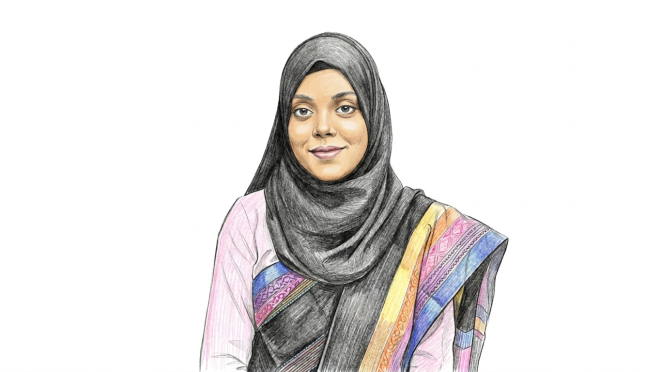
After completing HSC, Era spent two gap years not idling, but building grassroots projects rooted in sustainability and community problem-solving. That decision, and the story it created, eventually brought her a Full-Ride scholarship to Williams College, the number one liberal arts college in the United States.
I sat down with Samiha to understand how stepping away from the traditional admission cycle and embracing an unconventional path led her to a comprehensive financial aid package that covers everything from tuition to travel. Her story is a powerful example for any student wondering if there’s another way.
Rethinking the traditional path
For Samiha, the decision to pursue higher education abroad did not begin as a long-term dream. In fact, when she completed her Higher Secondary Certificate (HSC) in 2023, studying abroad was not even part of her immediate plan.
What troubled her more was the rigid path most students are expected to follow after HSC.
“In Bangladesh, right after HSC everyone usually goes straight into the admission test cycle,” she explained. “Taking time off to explore ideas or work on something meaningful isn’t really encouraged, and gap years are often seen negatively.”
At that point, Samiha already had several ideas she wanted to explore, particularly projects connected to the needs of her community. Jumping immediately into another exam cycle did not feel right.
“I felt a strong urge to spend some time actually working on those ideas instead of immediately forcing myself into another exam,” she said. “So I simply stepped out of that system and took the time intentionally.”
Interestingly, studying abroad emerged only later. As she continued working on independent projects, she discovered that some international education systems actually value exploration, initiative, and unconventional paths.
“That’s when the idea of studying abroad started to make sense,” she reflected. “But honestly, if I had found the same flexibility and opportunities in Bangladesh, I would have been very happy to stay and study here.”
Building ESHAleben
Sustainability is not a subject that Samiha ever learned about in a classroom or textbook, but rather it is a concept that came to her as a result of the environment she lived in.
Samiha lived in a rural area of Pabna, and as a result, she grew up with land, rivers, and farming all around her. She noticed subtle changes in the environment over time.
“When you grow up close to land and water, you automatically become aware of environmental changes around you,” she said. “It wasn’t something I first learned from textbooks. It was something I observed in everyday life.”
As she began working on small community projects, Samiha realised that many of the problems she cared about, whether related to health, waste, materials, or local resources, were closely connected to sustainability.
“There wasn’t one specific moment when it suddenly became important,” she said of sustainability. “It developed naturally from the environment I grew up in and the problems I kept seeing around me.”
Samiha’s sustainability work eventually took shape through a research initiative she founded called ESHAleben.
The initiative brings together several projects she had been experimenting with for years. Its work revolves around four areas particularly relevant to rural communities: energy, soil, water, and health.
The origins of ESHAleben trace back surprisingly early.
“It actually started when I was in seventh grade,” she said. “Growing up in a rural village, many problems were visible in everyday life. Instead of just observing them, I started experimenting with small solutions on my own.”
Over time, those experiments grew into multiple independent projects.
“One of my early projects was related to menstrual health,” she shared. “I developed a sanitary napkin prototype using locally available materials and designed a low-cost vending machine concept, because menstrual stigma and access to products were real issues where I grew up.”
Later, her work expanded. “I’ve been experimenting with biochar made from local materials like water hyacinth and other native agricultural waste. The idea is to see how locally available resources can be turned into something useful for soil health and environmental management.”
Another project she worked on was a bio‑electrochemical system. “It’s an experimental idea where microbial processes can help purify water while also generating a small amount of electricity at the same time. This project later became a finalist in the World Bank Youth Innovation Challenge. It’s still something I’m exploring and learning through experimentation.”
Eventually, she organised all these projects under the umbrella of ESHAleben. “The idea is to build simple, low-cost solutions that work in real conditions for communities like mine,” she explained.
Two gap years of exploration
Samiha chose to take two gap years after completing HSC in 2023; she will begin her studies in Fall 2026.
For many students in South Asia, stepping outside the traditional timeline invites criticism, and Samiha experienced that firsthand.
“Yes, there were definitely moments of uncertainty,” she admitted. “In many South Asian communities, especially for girls, stepping outside the conventional path invites a lot of questions.”
What affected her most was the pressure her family faced from society.
“At times I could sense the helplessness in my parents’ eyes. Not because they didn’t believe in me, but because they had to answer society on my behalf,” she said.
To cope, she created distance from the noise.
“I stayed away from people who constantly made me feel like I was falling behind. I even deactivated social media for a while. I just needed silence and space to focus on the work I believed in.”
Looking back, she believes those two years were crucial.
“They made me more confident and self-aware,” she said. “I know that the major and profession I’m choosing are truly what I want, because I already took the time to explore them.”
Securing a full financial aid package
Samiha’s admission to Williams College came with a comprehensive financial aid package covering virtually all major expenses.
“My financial aid package has zero deficit, so basically I am paying nothing,” she said. The package includes tuition, housing, health insurance, travel support with two funded trips per year, including a round trip to Bangladesh, as well as pocket money, summer storage, visa support, and even initial shopping assistance.
For many Bangladeshi students, the biggest misconception about studying in the United States is the cost.
“A common misconception is that studying in the US always requires a lot of money,” Samiha explained. “In reality, some universities offer very strong financial aid, and sometimes students can study there without paying anything.” However, she cautions, “a full ride scholarship is extremely rare and one should always keep backups.”
So how did she navigate the process to secure such a package?
Samiha traces it back to the choices she made long before applying.
“Eventually I realised that the way I like to work is quite independent,” she said. “I usually start with my own questions or ideas and then try to figure things out from there. When I started learning about different education systems, liberal arts colleges felt like the best environment for that kind of learning.”
Williams first caught her attention because “it’s the number one liberal arts college in the U.S., so naturally I became curious and started reading more about it. But what really made me stay interested was the environment. The location, surrounded by mountains and nature, felt very connected to the kind of environmental work I’m interested in.”
Academically, she was drawn to flexibility.
“I’ve always wanted to work between field realities and data, understanding problems on the ground but also measuring and analysing them. Williams allows me to combine environmental studies with statistics and data science, which fits that approach really well.”
She also noted the Oxford exchange program.
“Getting exposure to both a liberal arts environment and a larger university setting sounded really exciting to me. So when I looked at everything together: the academic flexibility, the environment, and the opportunities, Williams just felt like a place that naturally fit the way I want to learn and work.”
When it came time to apply, her gap years and projects became the core of her story.
“I had to meticulously document my gap years,” she said. That meant clearly outlining the projects under ESHAleben. She also highlighted her fellowship experiences.
“Attending fellowships like the Max Thabisco Edkins Climate Fellowship helped me a lot in networking and enhanced my confidence too.”
Her statement of purpose was not a list of achievements but a narrative. She connected her grassroots experiments to her intellectual curiosity and her desire to continue that work at Williams.
“It’s really just the place where all my work comes together,” she had said of ESHAleben. That coherence carried into her essays.
Unlike many applicants, Samiha did not come from a background of standardised testing.
“I grew up in an environment where studying abroad never existed,” she shared. “There was no exposure to standardised testing culture such as the SAT, and international applications were not part of our academic tradition. As a result, my early academic journey was shaped more by local curriculum performance and independent learning rather than preparation for global admissions systems.” Despite that, her work spoke for itself.
For the financial aid itself, she had to apply through the CSS Profile and submit detailed family income documentation.
One final advice
She believes what made her case compelling was authenticity.
“I think Bangladeshi students should stop trying to create the ‘perfect’ application,” she reflected. “Don’t add sugar to your story. Just keep it real. Your story matters more than anything. You just have to believe it first. If you believe it, others will feel it too.”
Samiha’s journey, from experimenting with small community projects in rural Bangladesh to earning a fully funded place at Williams College, demonstrates how unconventional paths can lead to extraordinary opportunities.
Her story also reflects a huge truth in global education: top institutions increasingly value curiosity, initiative, and purpose over rigid academic timelines.
For students considering similar paths, her message is simple: trust the process, stay authentic, and allow your work to speak for itself.