When schools shape thinking: The quiet divide in Bangladesh’s classrooms
If you bring me and my cousin into the same room and ask us to explain something like photosynthesis, you will probably notice how both of us talk about it quite differently.
When schools shape thinking: The quiet divide in Bangladesh’s classrooms
If you bring me and my cousin into the same room and ask us to explain something like photosynthesis, you will probably notice how both of us talk about it quite differently.
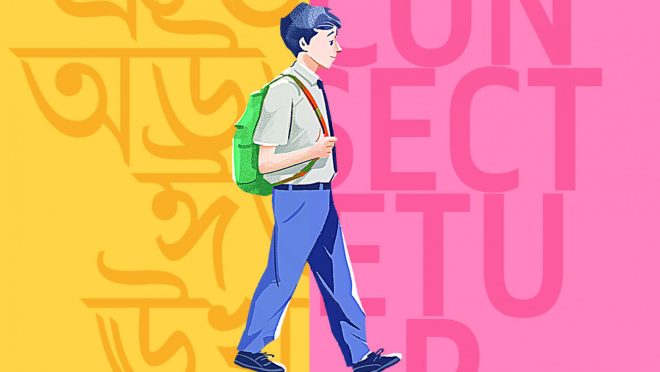
One of us won’t miss out on every single detail that has been said, while the other would just give a simple brief summary about it. The interesting thing is that we both learned the same topic, but in a different way.
This is because I studied in an English-based school, and my cousin comes from a Bangla-medium background. Even though we have grown up together, we’ve always had different tastes in music, movies, and style.
This led me to think about how our education system isn’t just about what we learn, but also how we think and develop to express ourselves.
In Bangladesh, English-medium schools follow international curricula like Edexcel and Cambridge. These schools are usually found in urban areas and often serve students from upper-middle-class or stable families. Students from here are focused on Western content, fluent English communication, and a more global perspective. On the other hand, Bangla-medium schools follow the national curriculum, following our local cultural pattern. They teach Bengali literature and Bangladesh’s history, and most of their learning sources are taught in Bangla. Both are important, yet they create very different kinds of students.
As we move through these systems, they begin to shape our personalities. English-medium students are often encouraged to speak up in class, join debates, give presentations, and think outside the box. Teachers allow students to first understand the information before consuming it all. They’re used to asking questions and challenging ideas in English, which helps build a sense of independence and fluency in expressing their thoughts.
Moreover, in Bangla-medium schools, students are focused on memorisation and exams. Students from there are well aware of subject knowledge, but they get the least chance to practise speaking up or analysing information. Because of this, they might hesitate when it comes to public speaking or communicating in English, not because they lack intelligence, but because they didn’t get that same kind of platform. And when people don’t get the chance to express themselves fully, it can slowly affect how they express themselves, both in school and in life.
Another thing where we don’t often analyse the difference is school events, such as festivals, field trips, and celebrations. In Bangla-medium schools, national holidays like International Mother Language Day, Victory Day, or Independence Day are filled with a lot of emotion and pride. Students take part in parades, write poems in Bangla, sing, and dance to traditional music. Field trips in Bangla-medium schools always aim at education and cultural experiences, like visiting historical sites and institutions. In English-medium schools, national days are indeed celebrated, but they are usually smaller or more formal.
Students may take part in art competitions or speeches, but the emotional connections often feel left out. Their field trips might be to amusement parks, resorts, or more casual places, which are referred to as picnics. Nevertheless, these contrasts might seem small, but they shape how students relate to their culture, their community, and even their sense of identity.
But the gap between these two systems is starting to change. Today, the internet has become a great platform for students from both backgrounds to gain access to the same YouTube channels, online courses, podcasts, and blogs. Bangla-medium students can learn from global teachers or improve their English skills just by watching videos. English-medium students can reconnect with Bengali culture, music, and literature online. Digital media is slowly blending the two worlds together. It is allowing students to go beyond their school walls and shape identities that are more personal, balanced, and open-minded.
In my perspective, students from every country deserve to know about their ethnic roots, as times are changing and so are people. We are no longer the generation that follows traditional methods; innovation and rapid development are taking over and will soon replace them. Whether you are a student from English or Bangla medium, you deserve a kind of learning that prepares you for real life.
I truly believe that if schools focus more on things like public speaking and building a connection to our culture, we would grow up with a stronger sense of identity and purpose. In English-medium schools, students often miss that connection with our country’s values, which later on can create a distance from it. And in Bangla-medium schools, while students work hard and study deeply, they don’t always get the space to think freely or speak up in class.
Over time, this can make it hard for us to adjust in the real world. That’s why I think the government and education boards really need to look at how things are changing and find better ways to support all students, because one day, we’ll be the ones leading this country.