Garbage, growth, and glory: The traumatising story behind my Environmental Science degree
If in my first-year when I had my textbooks marked up with highlights and was full of grand dreams, someone were to tell me that I would at some point choose to sit in a landfill identifying suspicious water, I would have smiled politely and said, “That’s not at all what I do.”
Garbage, growth, and glory: The traumatising story behind my Environmental Science degree
If in my first-year when I had my textbooks marked up with highlights and was full of grand dreams, someone were to tell me that I would at some point choose to sit in a landfill identifying suspicious water, I would have smiled politely and said, “That’s not at all what I do.”
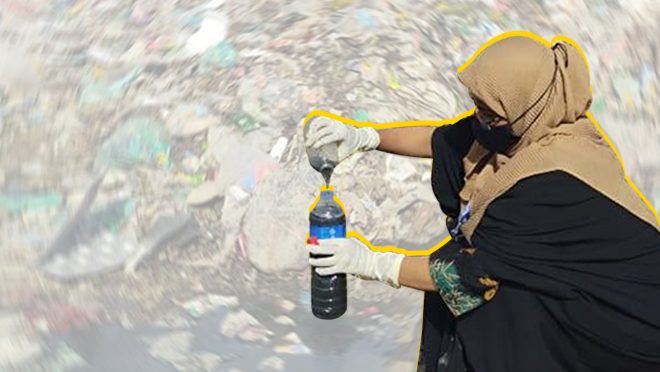
Well, out of the blue, Environmental Science and I got entangled.
This is a survival story. Maybe, a comedy or a tragedy. At times, even a horror story starring Amin Bazar landfill, one very patient money plant (Epipremnum aureum), and me… doing my best.
Great academic quest
When I was in my first year, in honours, I was a confused tourist wandering through the ocean of the Environmental Sciences department. Everything seemed complicated and unknown.
By the second year, I had evolved, but only a little. I was learning new things day by day. Group discussions became theatrical performances, and the lab work felt like a mixture of blind faith and science.
Those eras were embarrassing, mildly chaotic, but altogether beautiful. Because somewhere between all the confusion, a foundation was being built. Those imperfect beginnings, all the right and wrong assumptions, complicated concepts, were preparing me for the time when the thesis would stop feeling like a foreign language.
My project seemed perfect in theory – “Treat urban leachate (the yucky liquid found in garbage patches) using a money plant.”
That is it. A plant which cleans dirty water. Sustainable. Elegant. Almost poetic.
My brain: “Wow, the eco-friendly queen era has begun.”
Reality: Pull up a chair. We have to talk.
Before even touching the experiment, I unlocked a new level of adulthood: requesting resources professionally.
Need instruments? → Ask one supervisor.
Need access? → Ask another supervisor.
Need approval? → Circle back to the first supervisor.
At some point, I stopped being a student and became a full-time negotiator. And after several iterations of academic pleases, sir, and that which may just be one more request, things began to fall into place.
Lesson learned: Environmental science is 50% science; 50% convincing people you are doing science.
Amin Bazar – the nose’s graveyard
Let me say this clearly: nothing prepares you for landfill life. NOTHING. The moment you step into Amin Bazar, your nose resigns from its job.
The smell?
Aggressive. Personal. Long-lasting. It doesn’t just hit you—it stays with you, emotionally.
There I was at the landfill, sampling for leachate as a responsible scientist, at the same time internally thinking:
“Is this water… or a personality?”
“Why is it bubbling? Who approved this?”
At one point, I stopped reacting. I forced myself to adapt.
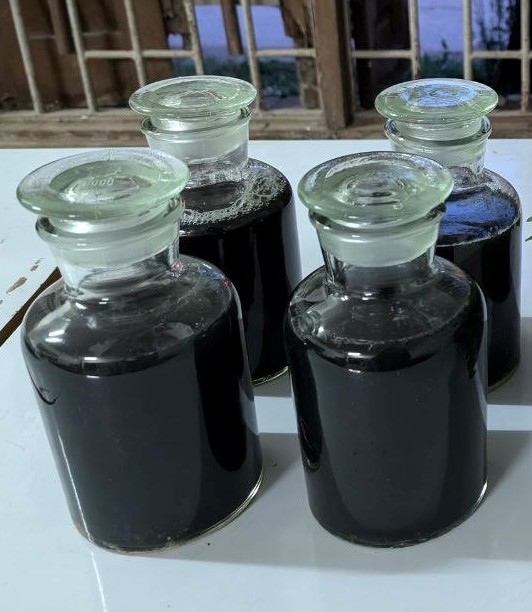
Photo: Sample of leachate (Day 1 of sample collection)
When in a landfill, you are collecting samples for your thesis; you need to choose which looks toxic; dignity doesn’t matter, data does.
45 days of lab work
If the landfill pushed my limits, the lab pushed my whole being.
Over the course of 45 days, my story was this:
Wake up → Go to lab → Monitor → Record → Panic → Repeat. Over. And over.
Some setups took the whole night. Which I did; I stayed awake all night by the plants like a sleep-deprived scientist in a low-budget documentary. At 2 a.m., staring at beakers, I had deep philosophical thoughts like:
“Am I doing science… or is science doing me?”
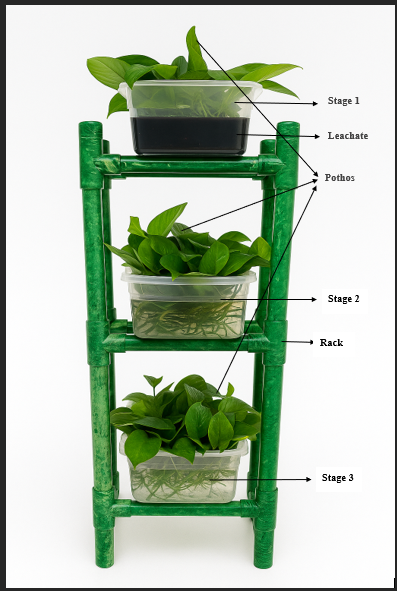
Photo: Multi stage raft
Here is a hard fact: four years of study do NOT mean you know what you’re doing.
At every hurdle, I looked it up online, or I asked around. I fixed it. I did not do that well the second time. I improved again. Better this time. Slowly and painfully, I started understanding not only the project, but the process.
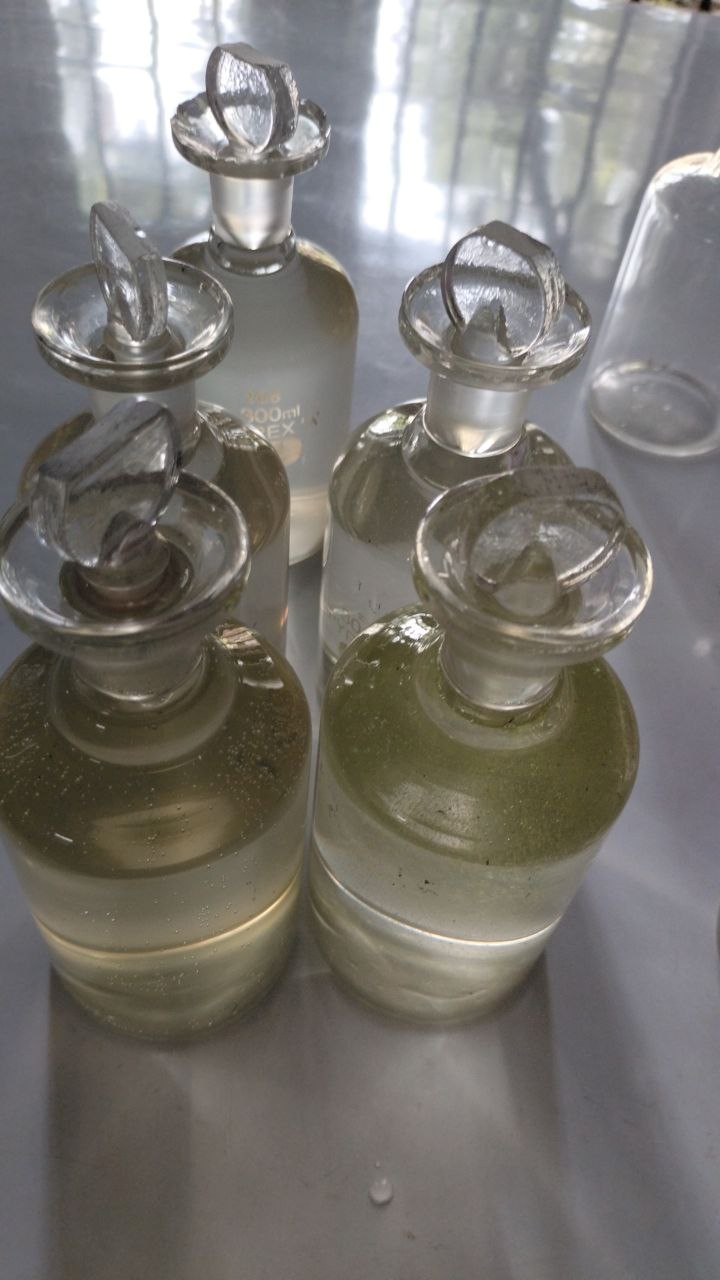
Photo: Sample of leachate (Day 33 of sample collection)
While at times I was stressed out and confused and on the verge of breaking down, the money plant was doing great. Just sitting there. Silent. Green. Unperturbed. Proven. Cleaning up leachate as a full-time task (which it in fact was). If it were based on performance, that plant would graduate at the top. I was just the assistant.
Within 45 days, we saw it was time to put structure to the chaos. Data analysis. Graphs. Tables. Interpretation. Basically translating: “I suffered for weeks” → “Statistically significant results.” I saw action for weeks. Each number told a story. Each graph held a memory. And somehow, it all came together.
Then came the final boss level: protection. I was standing before my professors, to whom I presented my research as a sure-footed academic paper.
My brain was replaying scenes from the landfill trauma, sleepless nights, emotional breakdowns, and one very hardworking plant. But this time, I wasn’t guessing. I had done my workout. I got it. I lived it.
And at times, the professors’ appreciation of the results when they noted our work on the project was a shock. Like it all came together.
Garbage, growth, and glory
Looking back, this journey was 20% environmental science, 30% survival skills, and 50% “I don’t know what I’m doing, but I refuse to give up.”
I went to a landfill and came back with a degree. I started with a plant and ended with perspective. Somewhere between toxic water, lab exhaustion, and silent determination,
I didn’t just complete a project. I evolved.
If you ever see a money plant sitting quietly in a corner, don’t underestimate it. Because behind that innocent green leaf, there might be a scientist, a landfill, 45 days of madness, and a journey that turned garbage into growth or success.
As for me? I survived in a garbage patch, the lab, the breakdowns, and earned the degree.