PM identifies 43 focus areas to boost education spending to 5% of GDP
The government will revive the school feeding programme in primary schools across all upazilas in phases to address students’ nutritional needs, he says.
PM identifies 43 focus areas to boost education spending to 5% of GDP
The government will revive the school feeding programme in primary schools across all upazilas in phases to address students’ nutritional needs, he says.
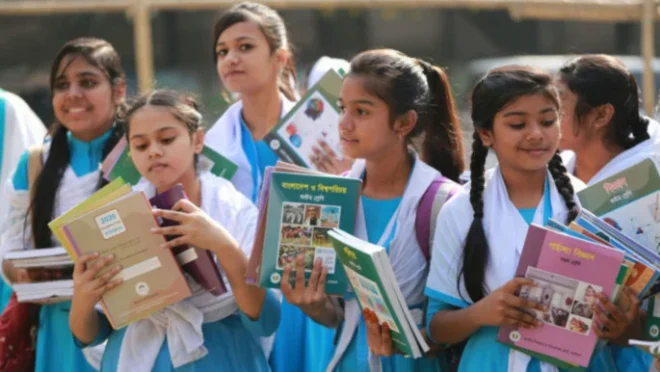
Prime Minister Tarique Rahman has said the government plans to gradually increase education spending to 5% of GDP to build a quality, life-oriented and inclusive education system in Bangladesh.

TBS Highlights
Speaking during the question-and-answer session in the Jatiya Sangsad today (8 April), he said the government has identified 43 priority areas under short-, medium-, and long-term plans for the education sector.
The prime minister highlighted key initiatives, including the school feeding programme, multimedia classrooms, free school uniforms, and expansion of technical education, which he said would help transform the country’s education system.
He said the government will revive the school feeding programme in primary schools across all upazilas in phases to address students’ nutritional needs.
“The midday meal programme boosts attendance, concentration, and nutrition, particularly among underprivileged children,” he said, adding that the initiative will be gradually implemented nationwide.
Originally launched in 2010, the programme was phased out in June 2022 after being extended three times.
As part of broader initiatives, the government will distribute free school uniforms to 2,00,000 primary school students during the current fiscal year, with plans to expand the programme gradually to all upazilas.
Tarique said the government views education as a key national investment and remains committed to developing an inclusive and modern system.
Highlighting digital transformation, he said multimedia classrooms will be established in all primary, secondary, and equivalent institutions to better prepare students for global competition.
To reduce the digital divide, free Wi-Fi will be introduced in 1,500 institutions – including secondary schools, colleges, and universities – while a unique digital identity, or “Edu-ID,” will be provided to all students and teachers.
The government also plans to make technical education compulsory at the secondary level alongside general education, in line with its manifesto commitments.
In addition, technical schools and colleges will be established in every upazila, and polytechnic institutes in every district in phases.
As part of modernisation efforts, free Wi-Fi will be rolled out within the next 180 days in 2,336 technical institutions and 8,232 madrasas. Madrasa education will also be updated through smart classrooms, teacher training programmes, and the introduction of technical courses.
The prime minister further informed parliament that the Bangladesh Computer Council (BCC), under the ICT Division, will launch training programmes within the next six months on artificial intelligence, cybersecurity, mobile app development using Flutter, Python programming, and AI-based digital marketing for students.