Bidushi Bornita: The 'Superstar' you know, the girl you don’t
After winning LUX Superstar 2025, Bidushi Bornita opens up about the struggles, societal pressures, and the grit required to survive in the Bangladeshi entertainment industry
Bidushi Bornita: The 'Superstar' you know, the girl you don’t
After winning LUX Superstar 2025, Bidushi Bornita opens up about the struggles, societal pressures, and the grit required to survive in the Bangladeshi entertainment industry
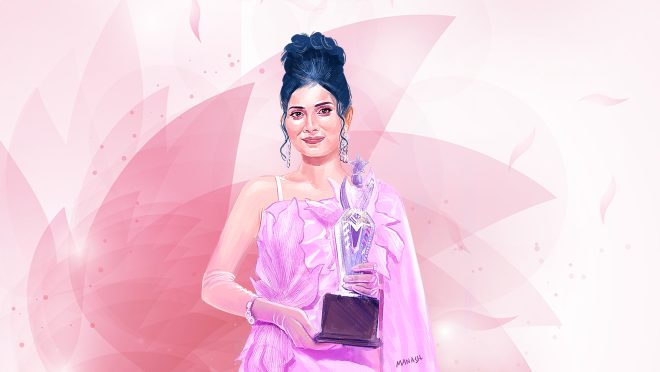
As far back as she can remember, Bornita always wanted to be a celebrity. There was something about the “idolised” aura of stardom—as she puts it—that fascinated the young girl within, sparking a secret wish that someday, she might have it all for herself.
For a girl who believes in the gimmick of the powers of manifestation, that wish has duly turned into reality. Just a week and a half ago, Bidushi Bornita secured her breakthrough as the winner of LUX Superstar 2025.
While she wasn’t handed a physical crown like predecessors Bidya Sinha Mim or Mehzabien Chowdhury, the Swarovski Trophy and the red Chery she received (among other beckoning career opportunities) are more than enough to compensate. Still, a tiny, gleeful part of her may have preferred the car in black.
This was my second time interviewing her in six months and if you are looking for a run-of-the-mill conversation with a beauty pageant/talent show winner, a rising actor, or a fashion model who’s repeating how happy she feels after winning, you can find that anywhere else on the internet. Bornita is currently being featured by nearly every media outlet in the country, likely repeating the same tired talking points about LUX Superstar—which is probably why she said she hasn’t had a decent night’s sleep in two weeks. (It might also explain why she never once removed her aviator sunglasses during our hour-long poolside conversation.)
I wanted to unearth the woman underneath. I wanted to see if there is genuine substance behind the platform she now holds—to discover if she is someone the Bangladeshi entertainment industry can truly respect and admire going forward. For the girls watching the competition, perhaps those from outside Dhaka who never experienced the high life but look up to her just as she once looked up to the stars of Hollywood and Bollywood, I wanted to find if Bornita could grow up to be an example of not just beauty, but of leadership, of setting a new standard in a rather sub-standard industry.
Victory with a cost
Victory is always a cause for celebration, but Bornita’s journey through LUX Superstar was paved with societal and familial friction—the brunt of which was felt by her immediate family as well.
“Even when you win, it isn’t all highs. The journey was difficult and incredibly straining for my family, too,” Bornita says. She was referring to the numerous times her mother had to shield her from the judgment of extended relatives, constantly convincing them that she wasn’t treading a “wrong path” by entering the entertainment industry.
Beyond the social pressure, there was the heavy reality of the cost. Coming from a family of modest means, funding the requirements of a year-long competition was no small feat. Now, Bornita looks toward the future with a deep sense of responsibility. With the movies and telefilms on her horizon, she can certainly become the “man” of the house— capable of settling family debts and providing a certain level of stability.
Yet, amidst the jubilation of victory, Bornita acknowledges a stark duality. On the flip side of fame, she finds an inevitable strain on her personal relationships—be it with family, friends, or peers within the industry.
“Obviously, it’s a significant achievement and a huge platform, and there are so many people cheering you on,” Bornita says. “But there are also quite a few who don’t take it the best way. I guess that’s just how the industry works, and the perceptions and prejudices that surround it.”
But throughout all this, Bornita constantly acknowledges the support and the faith her mother provided her with. So far as that she says from here onwards, she would want her mother to accompany her in all her future shoots and professional commitments.
Craft over charisma
As part of her winnings, Bornita has already signed on for a web film and a feature movie with the likes of Shihab Shaheen and Raihan Rafi—two of the better directors in the country.
However, I wanted to know if Bornita could break the mold of actors who are ushered into the industry based on looks alone, without any formal training in the craftsmanship of acting. While Bangladesh may lack a steady ecosystem of acting schools, acting is an art form that shouldn’t be granted on a whim to those with “pretty faces” and charisma; it is a skill that demands mastery, and Bornita is determined to do exactly that.
“This is why I started all this—I truly want to be an actress. It has a deep sentimental value to me,” Bornita says. “That’s why I want to start doing theatre.”
In fact, she had enrolled in classes at Dhaka Theatre but was forced to withdraw after her first session as the LUX Superstar journey began. Now, she is in talks with industry professionals for regular acting lessons to fine-tune her skills—which, one might say, are currently quite raw.
“I genuinely don’t want to be the kind of actor who only acts because they were handed an opportunity and a platform,” she explains. “I want to treasure my craft and leave a mark that people can truly acknowledge.”
Saying ‘no’ in a ‘yes’-driven industry
Celebrities and actresses have been idolised by young women with an air of untouchable inaccessibility since forever. These figures often possess the power to shape the values, style, and thoughts of the younger generation. But while that influence may lead to positive examples from stars overseas, the precedents set by many of our own “stars” are often far more troubling.
While many male actors are mired in reports of misconduct and controversy, many young actresses—often arriving from the rural corners of Bangladesh—find themselves groomed by powerful predatory men who exploit their gullibility. In exchange for the hope of stardom, these women are often pushed to sacrifice their integrity to become the icons they once dreamed of being.
I wanted to ask Bornita how she views this reality and how she intends to navigate these treacherous waters. More importantly, as a young woman who has just encountered national fame, I wondered how she might educate others on what not to do—and how to find the strength to say “no” to opportunities and offers that might cost far more than just time and sanity.
“See, the way I navigate these situations might be very different from what others are subjected to,” Bornita explained. “Perhaps because I have a specific platform, a certain social status, or even a certain calibre, I can say no to someone and not be approached again. A girl from a rural area may not have that luxury. I don’t think there is a definitive formula to protect yourself from everything in this country—regardless of how high you keep your guard up or how strictly you set your boundaries. Even if you do and say all the right things, you can still be slandered by the very next morning.”
She continued, “I think the best thing young women can do is find a support system that can protect them. Try to educate yourself; understand that you don’t have to say yes to everything, and you don’t have to let yourself be swept away by every approach.”
Regardless of her words, what she left unsaid—yet remained evident in her gaze—was a deeper truth: the burden shouldn’t just be on women to protect themselves; the real work lies in educating the men.
“We live in a patriarchal society,” Bornita noted. “The only thing women can probably do right now is try to break that system.”
She trailed off, going on to acknowledge the mentors she encountered on her LUX journey—icons like Jaya Ahsan and Bidya Sinha Mim—who shared candid warnings about the industry and how to navigate its power players. They spoke of how a simple coffee invitation to discuss a film script can easily morph into something else entirely, and how burgeoning talents must remain vigilant to keep themselves from being pulled into those shadows.
“For me, I am very thankful that I have my mom behind me. Having a guardian figure around you does keep some of them at bay.”
If you ask me, across the two occasions I spoke with her, Bornita seemed remarkably grounded; even acknowledging that she doesn’t necessarily fit the conventional beauty standards of Bangali women. She consistently implied that even if she reaches the heights of stardom, she never wants to feel inaccessible to her admirers. She carries herself with extreme confidence—though she admits she may have simply mastered the art of “faking it until she makes it.” She strikes me as someone wise beyond her years—a pick-up line she says she’s no stranger to—and seemingly ethical in an otherwise unethical industry.
She repeatedly emphasised the value she places on her academics, having graduated from Viqarunnisa Noon School and College, and she harbours a desire to study astrophysics in the future. I’ll admit, I have a bias toward anyone who appreciates Russian literature; she has already tackled the heavy hitters of Fyodor Dostoyevsky and even judged me for not having read George Orwell’s Animal Farm until 2026.
If all of this holds true, it isn’t an overstatement to say that Bangladesh is on the verge of welcoming a cultured, nuanced, and talented star onto its horizon. Either that, or I’ve just been gaslit by yet another Dhaka girl for ninety minutes straight—in which case, I probably shouldn’t be doing celebrity interviews anymore anyways.