Govt to launch district-level employment exchanges to bridge skills gap
The government also plans to form anti-harassment committees in all ready-made garments factories by 30 June
Govt to launch district-level employment exchanges to bridge skills gap
The government also plans to form anti-harassment committees in all ready-made garments factories by 30 June
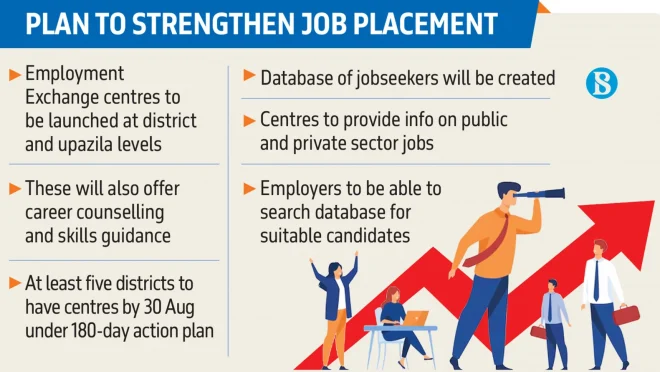
The government has initiated a plan to establish Employment Exchange centres at the district and upazila levels to provide job seekers with comprehensive information regarding public and private sector vacancies.
Under a 180-day action plan designed to implement the BNP government’s election manifesto, the labour and employment ministry aims to launch these centres in at least five districts by 30 August.
These centres will serve as career counselling hubs, offering guidance on required skill sets for specific industries and identifying institutions where such training can be acquired.
AKM Fazlur Rahman, joint secretary and focal point for implementation of the action plan, told The Business Standard that the centres are being set up to facilitate the exchange of employment-related information between jobseekers and employers. “The exchange will provide information to both jobseekers and employers.”
He said many educated and less-educated young people lack a clear understanding of which sectors they are best suited to or which sectors offer the greatest opportunities.
“Most jobseekers do not know what types of workers are in demand in different sectors of the economy. The employment exchange will provide that guidance and work as a form of career counselling,” he said.
According to Fazlur Rahman, the centres will also create a database of jobseekers, allowing employers to identify suitable candidates more easily.
However, a former labour secretary, speaking on condition of anonymity, said that improving skills development was more important than creating a new information database.
He said such guidance should instead be integrated into existing skills development centres.
The former secretary noted that the ready-made garments sector had generated significant employment in Bangladesh but continued to face structural problems.
“Even when workers have the required skills, many are unable to remain in the sector for a long period because some factory owners dismiss employees after a certain stage,” he said.
The employment exchanges are expected to be established under the Department of Labour and Employment. Officials have also taken steps to develop software to build and manage the database and operational activities of the centres.
Alongside the employment exchange programme, the ministry’s 180-day plan includes reforms to labour legislation and a range of measures aimed at strengthening worker protection and social security.
The government plans to amend and modernise labour laws to prohibit child labour and forced labour.
The ministry has also received proposals to fix minimum wages in 65 informal sectors. By 30 April, the government intends to identify the sectors most suitable for minimum wage regulation.
The ministry also plans to announce new minimum wages for tea workers, hotel and restaurant workers and employees in the iron foundry sector by 30 June.
In addition, the government plans to introduce a digital system for trade union registration by 15 July and to establish an alternative dispute resolution mechanism to speed up the settlement of labour-related cases.
To improve protection for female workers, the ministry plans to open hostels in Kalurghat in Chattogram and in Narayanganj.
The 180-day programme also includes a number of social protection measures for workers.
The government also plans to form anti-harassment committees in all ready-made garments factories by 30 June.
It also aims to bring at least 300 additional companies under the Worker Profit Participation Fund by the same date. Companies included in the scheme are required to contribute 5% of their profits to the Workers’ Welfare Foundation fund.
The central fund will continue to provide financial assistance to workers under the social protection scheme. Workers can receive up to Tk1 lakh for medical treatment, while the families of deceased workers are entitled to Tk2 lakh. Educational scholarships are also available for workers’ children.
The government has also decided to extend support to unemployed workers. Under the revised plan, 4,500 workers who have lost their jobs will receive Tk5,000 per month for up to three months during the remainder of the current fiscal year.
Tahmina Begum, joint secretary and focal person at the ministry, said unemployed workers were defined as those who had previously worked continuously for at least six months but were currently without work.
She said the original target for the 2025-26 fiscal year had been to support 3,500 unemployed workers through the central fund. During the first eight months of the fiscal year, 3,200 workers had already received assistance.
“The government’s 180-day programme has added another 1,500 workers to the scheme, although support is provided only after an application is made,” she said.
The ministry also plans to increase financial assistance under the Employment Injury Scheme for the families of workers killed in workplace accidents and to enhance benefits for injured workers.