From Nawabs to now: How Bangladeshi men are reclaiming ornaments
From Mughal courts to K-pop screens, the Bangladeshi man is rediscovering a thousand-year-old language of ornaments — one understated piece at a time.
From Nawabs to now: How Bangladeshi men are reclaiming ornaments
From Mughal courts to K-pop screens, the Bangladeshi man is rediscovering a thousand-year-old language of ornaments — one understated piece at a time.
The nawabs of Dhaka were not subtle men, at least not in their jewellery. Their turbans caught light from gem-encrusted pins; their swords gleamed with inlaid stones; their portraits record, in oils and quiet authority, that male adornment was once a language of power in this city.
A surviving portrait of Nawab Khawja Abdul Gani, one of the most powerful men in 19th-century Dhaka, shows a figure draped not in restraint but in ornament. The Mughals had understood this long before him.
Their noblemen favoured pearls; their rulers exchanged jewelled gifts as diplomacy; their aesthetic filtered down through Bengal’s courts and into its culture, leaving behind a tradition of male adornment that was as natural as it was elaborate.
Further back still, the evidence is older than any portrait. Semi-precious stone beads unearthed at Wari-Bateswar, northeast of Dhaka, date to around 1000 BC. Ancient Bengal adorned itself without the distinction of gender that would come much later. Men wore finger rings and earrings, turban ornaments, and whatever else they wished.

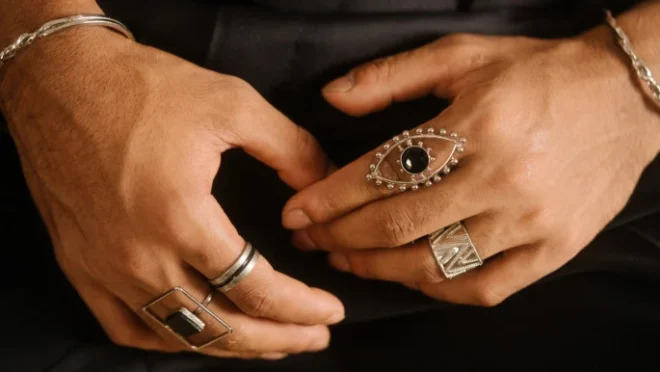
Rings, chains, and bracelets aren’t just accessories anymore; jewellery is moving from ‘occasion wear’ to everyday identity. Model: Sohan Khan, Photo: 6 Yards Story
The question of whether jewellery belonged to men or to women had not yet been invented. It would take centuries, a colonial administration, and the slow hardening of social convention to quietly shelve that tradition.
By the mid-20th century, the Bangladeshi man’s relationship with ornament had been reduced to its barest elements: a watch, perhaps a wedding ring, and not much else.
Across the world, men’s jewellery is experiencing what market analysts are calling a renaissance, and the numbers bear that out with unusual clarity. The global men’s jewellery market was valued at $48.56 billion in 2024, growing at nearly 10% annually, making it one of fashion’s fastest-expanding segments. Bracelets and chains lead the surge, with necklaces projected to grow at the highest rate through 2033.
In the Indian subcontinent, that shift has arrived with cultural weight, because the region has its own complicated relationship with male adornment. Across South Asia, men have historically kept their distance from jewellery beyond the functional watch, a ring worn for significance rather than style.
The reticence was not always there; it was learned, inherited from colonial-era ideas about masculine propriety that took root and outlasted the empire that planted them. But the mindset is loosening, and in the most visible ways possible.
When Indian stars Rashmika Mandanna and Vijay married, the cultural conversation around men’s jewellery stirred with fresh energy, their union a reminder of how deeply ornamentation is threaded into the subcontinent’s emotional life, and how readily it resurfaces when the moment is right. Bollywood has long been the region’s most powerful vehicle for style transmission.
When it comes to what Bangladeshi men are reaching for, the picture is consistent and clear: less is more. What the Bangladeshi man tends to want is a piece that speaks without shouting — a slender chain, a single ring, a bracelet that adds texture without demanding attention.
The silver bracelet that Salman Khan has worn as a near-permanent fixture turned a generation of men’s attention to the wrist as a site of self-expression. What these celebrities offered was not merely a look but a logic: that jewellery, for a man, is not a departure from identity but an extension of it.
In Bangladesh, that logic is taking hold quietly, steadily, and with a local flavour all its own. Walk through Banani or Gulshan on any given evening, and the evidence is there: a chain catching light above a collar, a ring worn with the ease of someone who has never considered it remarkable, a leather and stone bracelet stacked alongside a watch.
It is a shift that designers like Zarin Tasnim Khan, founder and owner of 6 Yards Story, have both observed and helped to create. For Zarin, the conversation about men’s jewellery begins not with trend reports but with something more fundamental. “Jewellery is a way of expressing oneself,” she said, “whether it’s for men or women — it’s their own choice how they will style it.”
In a culture where male adornment has long been viewed with ambivalence, that conviction carries quiet weight. She has watched the subcontinent’s traditional hesitance around men’s jewellery begin to soften, the old reticence giving way to something more open and self-assured. “In the Indian subcontinent, men normally avoid heavy jewellery,” she acknowledged, “but that mindset is shifting towards a more liberal one.”
Yet perhaps the single most powerful catalyst for that shift among Bangladesh’s youth has not come from Bollywood or from the West, but from Seoul. The Korean wave — Hallyu — arrived in Bangladesh not as a distant cultural phenomenon but as an intimate one, its music watched and rewatched on phone screens, its stars studied with an attention that extends well beyond the songs themselves.
For young men in Dhaka watching those videos late into the night, the image lodged itself deeply and personally. K-pop’s power in this context lies in its jewellery aesthetic: it is not aggressive or maximalist; it is refined, often minimalist, and beautifully intentional.

Minimalist jewellery and accessories for that subtle and elegant style. Photo: Get The Juice
The results of that influence are now visible across Dhaka in ways that feel both new and, somehow, entirely natural. On university campuses and at concerts, in coffee shops, young Bangladeshi men are wearing jewellery with an ease that would have turned heads just a few years ago. The shift is generational, and it is gathering pace.
Imran, 19, credits K-pop directly and without hesitation. “When you see Jungkook wearing a ring or a chain in a regular photo — not on stage, just out somewhere — it makes it feel normal. Like something anyone can do.” What young men share is not a single aesthetic but a single feeling: that jewellery is no longer something they need to justify. The conversation, for them, is already over.
When it comes to what Bangladeshi men are reaching for, the picture is consistent and clear: less is more. The maximalism of the global hip-hop tradition has not taken root here in the way that K-pop’s quiet precision has.
What the Bangladeshi man tends to want is a piece that speaks without shouting — a slender chain, a single ring, a bracelet that adds texture without demanding attention.

Silver, stainless steel, minimalist pendants, even layered chains. It’s less about tradition and more about individual aesthetics. Photo: Get The Juice
It is precisely this instinct that Zarin has built her men’s collection around. “I personally think people are now more drawn to minimalist design,” she said, “so I tried to design some minimalist jewellery for men.” Into that minimalism, she has woven pearls, a choice that is both on-trend and deeply considered. “I added pearls to create more elegance,” she explained.
“Pearl is more of an unisex element” — a material that carries no gender, that sits as naturally on a man’s collarbone as on a woman’s, and that connects, perhaps unknowingly, to the very Mughal tradition of male pearl-wearing that once defined refinement in Bengal. The layering, she added, is entirely the wearer’s own prerogative.
One of the most meaningful aspects of this emerging culture is that it is not confined to the wealthy or the fashion-forward. Zarin has been deliberate about accessibility from the beginning, pricing her pieces between Tk500 and Tk5,000, a range wide enough to include a student buying his first ring and a professional investing in something considered.
In the end, it is a small thing — a chain, a ring, a pearl catching the afternoon light. But small things, worn with intention, have a way of saying what words cannot. The Bangladeshi man is learning, or perhaps relearning, that he too has a vocabulary of ornament, one that stretches back a thousand years, through Mughal courts and ancient riverbanks and portraits hung in dimly lit rooms. The ornament has returned. It never really left.