While others post, he plants: A different kind of environmental activist
While others post, he plants: A different kind of environmental activist
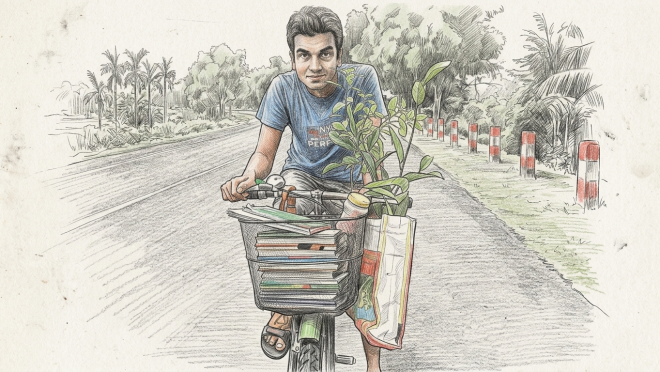
In an age where environmental concern is often reduced to hashtags, symbolic campaigns and seasonal gestures, the true essence of environmental stewardship risks being overshadowed by performative activism.
Yet, beyond the digital noise and staged awareness programmes, at its heart, there exists genuine environmentalism. It is not merely about planting trees once a year or participating in occasional clean-up drives; it is about nurturing a lifelong relationship with the environment. Mahmudul Islam is one such example.
We were fortunate enough to speak with Mahmudul to learn more about the man who won the National Environment Award, 2024.
Inspiration
Mahmudul has been planting trees and gifting seeds since his childhood. For the past two decades, he has been cycling and travelling from village to village for the purpose of voluntary work.
Being an advocate for nature, he hopes to create an impact that goes beyond performative environmentalism.
“By riding a bicycle myself, I try to inspire others not to depend on motorbikes or cars. These fuel-powered vehicles harm the environment and emit gases that contribute to global warming. I practise moderation myself and teach others through my actions.”
His activism has also led him to distribute environmental awareness books free of cost.
“I have even built a nature-based library in my yard using a straw roof.”
However, Mahmudul only shares glimpses, a few pictures here and there, of some of his work. He believes, “Work itself should be the content. If this idea spreads, the world of content creation can become more meaningful and people may become more responsible.”
To align the progress of education with humanity, he urges people to understand the rhythm of nature and work. For this, one needs an educated mindset.
Continuity projects
Mahmudul never believes that he will fail. What gives him inner satisfaction is doing his own work; he is someone who is not afraid to swim against the flow.
“I have never tried to run the rat race like many others. But I firmly believe that nature has no substitute. If soil, trees, animals and birds survive, only then can we survive.”
With faith in the Almighty, he works assiduously to grow saplings with his own hands and gift them to others, alongside preserving and distributing seeds. He uses this pathway to support his environmental and social work.
“Following this path, I feel I am serving nature, and I encourage others to practise the same.”
When asked about his ethical values, he affirmed that many people are aware of his efforts and have seen them with their own eyes. This makes him feel that his values are flowing alongside his work.
In Bangladesh, economic priorities often outweigh environmental concerns. This issue remains uncompromising in the nation. In a state of concern, Mahmudul said, “Under the name of development, harmful practices take place, and nature repeatedly responds in return. We are facing various natural disasters and crises as a result. I highlight these issues and continue my efforts.”
Challenges
The journey of a true environmental advocate is not without challenges. It often demands resilience in the face of scepticism, indifference and even criticism. Those who choose this path may find themselves going against societal norms, sacrificing personal comfort and making choices that others may not fully understand.
“I have heard people say, ‘Stop this now, you have done enough.’ Some have even called me mad. But I have noticed that those who call me mad are also beneficiaries of my work.”
Despite everything, he continues his uncompromising journey. Breaking the shackles of traditional thinking, he said he did not even commit to marriage. When asked the reason, he said it might hinder his educational pursuits and environmental work.
“Nowadays, people are highly ambitious. This sacrifice in my life is also a way of overcoming obstacles and continuing my work. I have not stopped; instead, I have connected my passion with additional supportive work.”
At times, he feels guided by a divine signal, which is quite a rare way of aligning work with life.
Throughout his journey, he never thought about having an audience or fan base. He believes that people with good hearts and sound thinking naturally respect and appreciate his work.
“Many people have shown respect and even suggested that I should receive the Ekushey Padak. I never imagined such recognition and felt too shy to respond.”
Evaluation
Through responsible behaviour, every individual should become an environmentalist. Since climate change and disasters are largely caused by humans, this awareness must be developed.
Mahmudul believes it should begin in educational institutions and extend to religious practices. Every person has a moral responsibility to act as an environmentalist in their own place.
“It is essential for survival.”
Observing for days, weeks, months and even years, Mahmudul came to the conclusion that government institutions in this country treat tree plantation as something limited to June–July, often accompanied by photo sessions. This only sends the wrong message.
Keeping pace with reality, he emphasises that every day should be a day for planting and nurturing trees.
“Trees sustain us every moment. Let them become our greatest teacher of selflessness.”
Beyond institutions, social media can also spread inspiration effectively. Many people start their own initiatives after being inspired by individual efforts. With this aim, Mahmudul tries to share content on his social media platforms.
Receiving the National Award
When asked if he were given the opportunity to scale his work nationally, what systems and strategies he would prioritise to maintain effectiveness and authenticity, he said that he works in his own way and feels accountable to himself. This self-created responsibility is something he enjoys.
“People from faraway places come to see me and consider this lifestyle as a form of learning.”
Looking at his journey from 2006 to today, 2026, he is confident that he is on the right path.
“Not everyone would be willing to make such sacrifices, but when I look at the growing crisis, my sacrifices feel meaningful and instructive.”
Philanthropy, he believes, is desired by others when it materialises in the form of results and sustainability.
With joy and satisfaction, he said, “I have received a national award for my grassroots efforts, granted by Almighty Allah for my work and simple lifestyle. These things cannot be bought with money.”
Ultimately, caring for the environment is not just an external responsibility. It is an internal commitment. It is about aligning one’s values with one’s actions and recognising that every effort, no matter how small, contributes to a larger purpose.
In a world increasingly threatened by climate change and ecological degradation, such authenticity is not only rare but essential. It is through this lens of love, care and responsibility that environmentalism can move beyond performance and become a powerful force for lasting change.
Mahmudul dreams of an education system designed in such a way that, from childhood, every person understands that science, arts and commerce are interconnected and rooted in the environment. Through broader knowledge and responsible practices, people can grow into more conscious human beings, leading to more sophisticated and harmonious days ahead.