Chasing two Cuckoos that read my mind
In the forests of Satchari, two of Bangladesh’s most dazzling and elusive cuckoos test a photographer’s patience, and reward it
Chasing two Cuckoos that read my mind
In the forests of Satchari, two of Bangladesh’s most dazzling and elusive cuckoos test a photographer’s patience, and reward it
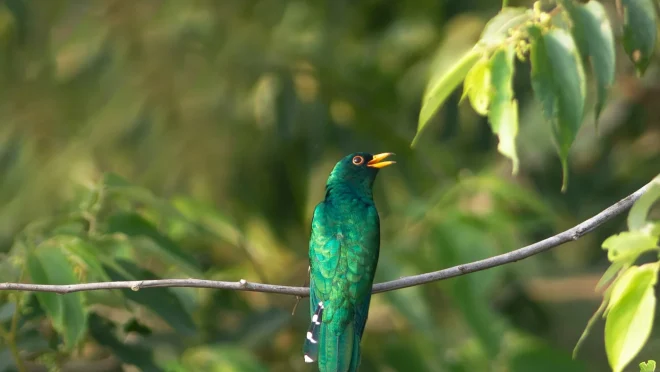
There is a particular kind of madness that grips a wildlife photographer when they are within reach of something extraordinary. Rational thought dissolves. Flight tickets become negotiable. Sleep becomes optional.
I discovered the full depth of this madness on a sweltering April afternoon in Satchari National Park, crouched on the first floor of a watchtower, waiting for a bird that — I was almost certain — was never going to come.
I am not a twitcher, the kind of birdwatcher who loves to sight, maybe photograph, rarities. More so, my fieldwork and other commitments do not allow me to be one. Yet I have my own wish lists. Two shining cuckoos glow on that roster.
So, I had come to Satchari following two of Bangladesh’s most spectacular birds: the Violet Cuckoo and the Emerald Cuckoo. In a country whose avifauna is too often overshadowed by its more famous neighbours, these two species stand apart — jewel-toned, restless, and notoriously difficult to photograph well.

The Violet Cuckoo, another summer breeder in Bangladesh, grows amethyst-violet feathers in males. Coral orange bill and eye ring add up a striking contrast.
The Violet Cuckoo (Chrysococcyx xanthorhynchus) is a compact, iridescent wonder, the male cloaked in a deep amethyst sheen with a fiery orange bill. The Emerald Cuckoo (Chrysococcyx maculatus) is, if anything, even more stunning — its upperparts a blaze of metallic green that shifts from a teal to gold base depending on how the light catches it, the underparts barred boldly in black and white. Both species are quite small by cuckoo standards, roughly the size of a starling. Seeing one makes for a good day. Photographing both well, on the same visit, feels close to myth.
My first attempt had ended in nothing. I managed to spend an entire day in early April, kiting responsibilities. That day also came right after another stint of fieldwork. I scanned the canopy from the Satchari watchtower, listening to the forest until my back ached, legs gave in, and came away with little to show for it. Cuckoos have that quality — present in sound, absent in sight. Their calls carry across the forest with disarming clarity, and then the bird itself simply refuses to appear.
The second attempt in mid-April was born of impulse and good information. I was at a forest in Chattogram, five hard days into a field survey — the kind of fieldwork that leaves your back sore, your legs heavy, and your focus blunted by exhaustion. I was packed and ready to return to Dhaka when word arrived: the Emerald Cuckoo had been seen calling regularly at Satchari. I changed my ticket. No real forethought involved.
I arrived tired, and it showed. The heat by mid-morning was oppressive, the kind that presses down on you like a weight. The Emerald Cuckoo was nowhere to be found. The Violet Cuckoo was present — I could hear it, occasionally glimpse it — but it kept its distance, offering nothing that would satisfy a camera. By late morning I had set myself a deadline: if nothing happened by 12pm, I would accept the day as a loss and leave.
At 11:44am, the Violet Cuckoo changed its mind. It dropped onto a branch of the famous mandar tree — Erythrina — near the watchtower, close enough and still enough for a proper frame. The light fell cleanly on that deep purple plumage, the red eye bright as a coal, the orange bill catching a trace of warmth. I got my shot.
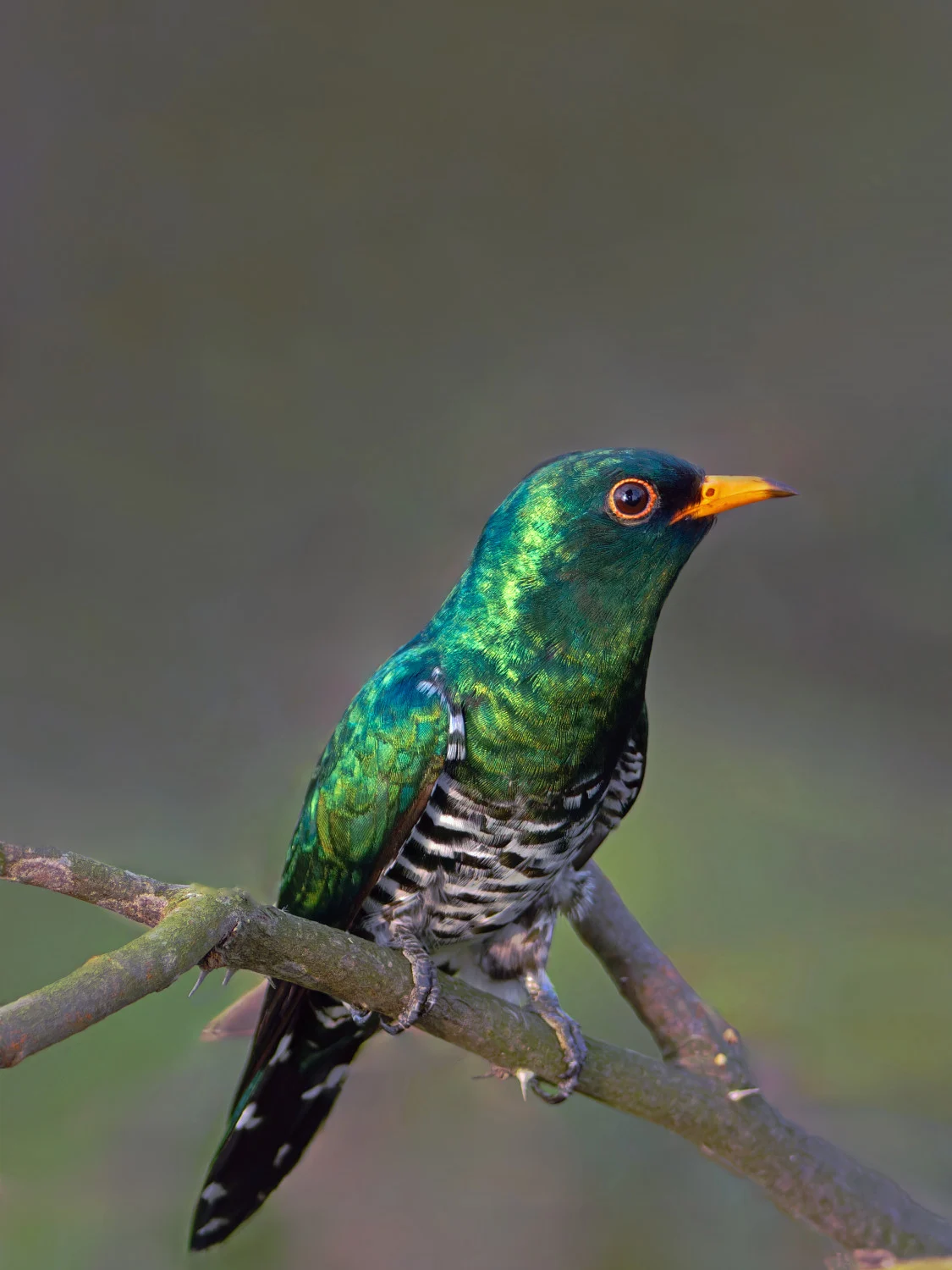
These Chrysococcyx, ‘golden cuckoo’ in Ancient Greek, are common in hill forests in Bangladesh
What followed was a small internal crisis. The Emerald Cuckoo had not appeared. Should I stay through the afternoon — through the dead heat, after an already exhausting week — on the possibility that it might? My friend Harish Debbarma, who had been out in that same forest, insisted I stay. He has a good hunch with the birds.
I took a two-hour rest in the dormitory, a brief armistice with my body, and returned to the watchtower in the afternoon.
The forest was quieter in the heat of the day, but by four o’clock something shifted. The Emerald Cuckoo began to move — first high up, then on mid-canopy branches, then, improbably, lower. I was watching it from the top floor of the watchtower when I noticed it drifting toward a tree to the right of the structure, its movements suggesting it might descend further and come closer. Near the base of the watchtower was a low thorny shrub, right at eye level from the first floor of the tower.
It was a gamble. I climbed down, set up on the first floor. I clicked some shots, then checked whether I got something decent. I noticed a sharp movement on my right.
The bird came exactly where I wished.
In those moments — and any wildlife photographer will know this feeling — time stops being continuous. There is only the frame, the light, the stillness of the subject. The Emerald Cuckoo perched with the unhurried confidence of a creature that has never needed to justify its beauty to anyone. Its metallic plumage caught the late afternoon sun and broke it into something extraordinary: green that was also gold, teal that deepened into cobalt in the shadows. It called once, beak parted, throat pulsing, and then was still again.

But, getting them in eye-level is a really daunting matter of patience, positioning, and luck.
A forest like Satchari is offered freely if you are patient enough to receive them. I came away with images of several species among blazing Erythrina blossoms, all beautiful in their own right. But this round would be one of my most special days.
There is something in how cuckoos gave themselves up — reluctantly, on their own terms, exactly at the moment you had almost surrendered — that feels less like luck and more like a conversation. That’s the story not only with birdwatching but with every other wildlife encounter I had in my life.
You show up, day after day. You show up when there are no cameras pointed at you. You trudge through roads less-traveled, muddy, boulder-strewn, out of the spotlight. You change your ticket. You stay through the heat. You climb down one floor on a hunch.
And then, the forest meets you halfway.