IUB hosts workshop on modern mushroom cultivation to tackle industry challenges
IUB hosts workshop on modern mushroom cultivation to tackle industry challenges
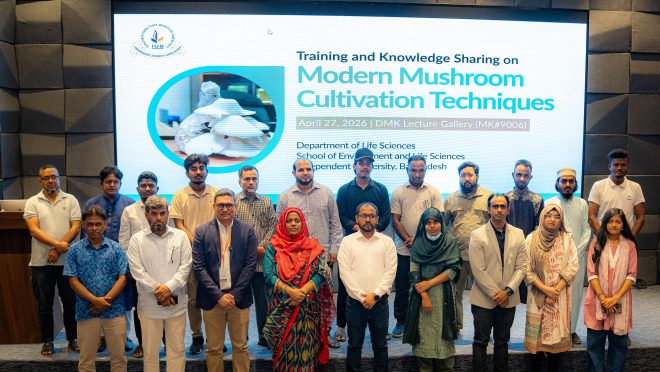
The Department of Life Sciences at Independent University, Bangladesh (IUB) organised a workshop on modern mushroom cultivation techniques on 27 April 2026, bringing together 20 cultivators and entrepreneurs from across the country for a knowledge-sharing session.
Mushrooms, increasingly recognised for their role in improving household nutrition and generating income for marginal families, continue to face significant production challenges. Among these, fungal contamination remains one of the most persistent issues, often originating in a single spawn bag and rapidly spreading to affect entire farms.
Addressing this concern, Dr Jebunnahar Khandakar, Associate Professor of Life Sciences at IUB, introduced an innovative technique developed over nearly three years of research. The method is designed to prevent the spread of harmful fungi without reducing yield, while remaining safe for both the environment and human health.
The workshop focused on two key objectives: responding to farmers’ questions regarding the new technique and gathering feedback for further refinement, as well as helping entrepreneurs better understand the ongoing challenge of sustainable market access in order to improve profitability.
Speaking at the inaugural session, special guest Rezaul Karim Siddique, a prominent media personality and host of the agricultural programme Mati O Manush, highlighted that mushroom cultivation has struggled to reach grassroots communities in Bangladesh over the past four decades. He attributed this to lingering doubts about mushrooms as a food source, limited access to quality spawn, and ongoing marketing challenges that have confined demand largely to middle- and upper-income groups.
Jamal Uddin Ahmed, founder of the Priyozon Mushroom Foundation in Bogura, shared his experience of over 20 years in the sector, noting that the dropout rate among mushroom entrepreneurs is alarmingly high, at approximately 99.9%. He emphasised that despite its benefits, including potential health advantages from regular consumption, the sector continues to suffer from a lack of coordinated support. He further explained that mushroom cultivation requires careful management across the entire value chain, from tissue culture to marketing, particularly due to its perishable nature.
The inaugural session also featured remarks from IUB Pro Vice Chancellor Professor Dr Daniel W. Lund, Dean of the School of Environment and Life Sciences Dr K Ayaz Rabbani, and Head of the Department of Life Sciences Dr Md Mahmodul Hasan Sohel.
During the technical session, Dr Khandakar presented the scientific foundations of her newly developed method. She stressed that mushroom cultivation is a knowledge-based practice that requires continuous learning and incremental improvements. By explaining both the technique and its underlying principles, she aimed to equip participants with a more comprehensive understanding of the process.
Dr Ikramul Hasan, Head of the Department of Human Resource Management at IUB, highlighted the importance of social media and digital platforms in expanding market reach. He encouraged entrepreneurs to develop independent branding strategies while also fostering collaboration within the sector, noting that collective efforts could play a key role in strengthening Bangladesh’s still-developing mushroom market.
The workshop concluded with active engagement from participants, reflecting a shared commitment to overcoming sectoral challenges and advancing sustainable mushroom cultivation practices in Bangladesh.