Clay pots make a quiet comeback in Bangladesh
In recent years there has been a growing trend of returning to basics as people are switching to clay pots as a natural way to cook
Clay pots make a quiet comeback in Bangladesh
In recent years there has been a growing trend of returning to basics as people are switching to clay pots as a natural way to cook
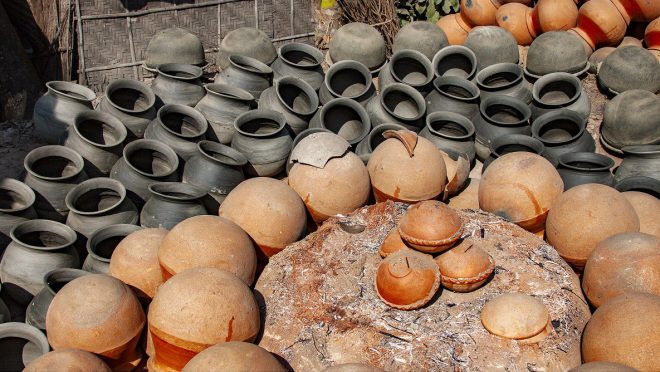
About a year ago, Shampa, a successful organic farmer from Manikganj, was thrilled to hear that I wanted to write about her use of clay pots and earthenware in her daily cooking. An innovative rural woman, Shampa started to think that instead of using alternative pots and pans, it is better to stick with traditional earthenware. She has been mostly using clay pots for cooking ever since she and her husband left Dhaka to start an organic farm.
On the farm, Shampa and her family practise a holistic lifestyle, avoiding chemicals, pesticides, and other harmful substances that threaten their health and that of their two children. It is a way of life for her.
Another reason for using clay pots is to ensure the food she cooks upholds old traditions that are slowly fading. Though the use decreased significantly over the past three decades, cooking in earthen pots is becoming popular again in rural areas. The comeback is encouraging news as it connects families to their culture.
Keep updated, follow The Business Standard’s Google news channel
By using mritshilpo (clay art) products, a woman like Shampa also exemplifies the health benefits of earthenware. In humid environments, clay pot cooking used to be a preferred option in rural areas.
However, with the availability of affordable cookware made of durable aluminium and stainless steel, the use of clay pots sharply declined over the last 30 years. The dying art of traditional potters and changing consumer preferences are largely responsible for this decline. Using clay pots had almost become a rarity, along with a loss of tradition. Regardless, in recent years there has been a growing trend of returning to basics. Increasingly, people are switching to clay pots as a natural way to cook.
What about city dwellers? In urban households, tables during festivities dazzle with traditional food served in decorative earthenware. This has now become a trend.
However, getting back to roots is challenging for several reasons. Clay pots are mainly designed for earthen stoves used in rural areas. Urban people have largely moved away from using clay pots because of the availability of longer-lasting alternatives. Besides, modern modular kitchen stoves are not well suited for clay pots. There is also a risk of cracking due to thermal shock, as clay pots are fragile.
Clay pots are also impractical in city kitchens, despite their health benefits. In a fast-paced urban environment, everything has to be done quickly, including cooking. City dwellers are not accustomed to the taste and smell of food with an earthy flavour.
In cramped cities, most people live in apartments or flats, where every square foot is used efficiently, leaving no space for an open, rural-style kitchen. Clay pots and pans require delicate handling, and cleaning them by soaking for long periods is cumbersome.
Moreover, due to their porous nature, clay pots can absorb dishwashing detergent, making them difficult to clean in a modern kitchen. They also heat gradually and require slow cooking, which is often unrealistic for urban lifestyles.
Since the decline of clay pot use, rural people have increasingly relied on alternatives due to their availability and affordability. They have experimented with aluminium, stainless steel, and non-stick pots and pans, which are available everywhere. These are lighter, more durable, and easier to cook with. Many villagers now use gas stoves that are not well suited for clay pots.
Earthenware is eco-friendly and non-toxic. Its porous nature helps retain moisture, allowing nutrients to remain intact — key features that make it appealing to health-conscious people. The earthy aroma it imparts to food is also preferred by many, as it evokes memories of traditional home cooking.
Due to the decline of traditional potters, clay pots are now rarely used. They are no longer produced on a large scale due to high production costs (clay and fuel), intense competition from cheaper alternatives, and declining consumer demand. Pottery is usually a family-run business passed down through generations. However, these small-scale traditional producers lack modern, efficient firing furnaces, making mass production difficult.
Potters cannot hire additional workers due to high labour costs, and younger generations are abandoning the profession. As a result, only a handful of families in each village continue the craft, and their profits are insufficient to expand production.
Industrialisation has further contributed to the shift away from traditional handmade clay items. Environmental changes have reduced the availability of high-quality clay. Urbanisation has also restricted traditional workspaces, replacing them with residential and commercial developments.
Despite these challenges, cooking in clay pots has many advantages. The benefits of using clay pots and their role in ensuring chemical-free cooking are significant. Earthenware is eco-friendly and non-toxic. Its porous nature helps retain moisture, allowing nutrients to remain intact — key features that make it appealing to health-conscious people. The earthy aroma it imparts to food is also preferred by many, as it evokes memories of traditional home cooking.
Unglazed clay pots develop a natural non-stick surface after repeated use. This occurs without the need for toxic polytetrafluoroethylene (PTFE) coatings used in commercially manufactured cookware. While such coatings offer corrosion resistance, heat can cause chemicals to leach into food. In contrast, clay pots act as natural pressure cookers, ensuring non-reactive and healthier cooking. They are valued for heat retention and lower fuel consumption, as food is cooked on low to medium heat.
A gradual shift is taking place as people rediscover that cooking in clay pots is easier to digest. The alkalinity of clay helps neutralise acidity in foods such as fish and dal. The food also tastes better. With growing awareness of chemical leaching from metal and plastic cookware, and a renewed appreciation for traditional flavours, both rural and urban households are increasingly adopting sustainable cooking practices.
Despite their imperfections, the revival of clay pot cooking reflects a renewed appreciation for this traditional craft. Some probashi households regularly use glazed clay serving dishes. Others go further by building matir chula (clay stoves) in their backyards to cook with clay pots. During gatherings and special occasions, they prepare meals outdoors using these traditional methods.
This past Pahela Baishakh, some of my friends cooked ilish along with many other dishes in clay pots. The food was later served in decorative earthenware. The presentation looked elegant and offered a rustic charm in an artisan setting. It was a beautiful way to preserve cultural traditions and celebrate the Bengali New Year 1433.
Using clay pots is both an eco-conscious and traditional choice. There is much to learn from Shampa’s commitment to tradition. Modern cookware, including copper pots and pans, does not necessarily guarantee better health or flavour. She highlights the risks associated with cooking in metal and non-stick cookware. In Shampa’s kitchen, we see that while traditions may have faded, they have also evolved. For her, clay pots are more than cooking vessels — they symbolise continuity, culture, and a connection to heritage passed down through generations.
Zeenat Khan writes opinion pieces, short stories, and nonfiction essays for South Asian journals. She also translates works of Jasimuddin, Tagore, and Nazrul into English.
Disclaimer: The views and opinions expressed in this article are those of the author and do not necessarily reflect the opinions and views of The Business Standard.