Rebuilding Dhanmondi in pixels: The teenage trio reimagining game development
In Dhaka’s Dhanmondi, three students are attempting something quietly ambitious: rebuilding a familiar neighbourhood as a playable digital world. With no formal funding and limited resources, they are developing a simulation-based game that blends real-world mapping with AI-assisted systems, aiming for an experience that can eventually run even on low-end devices.
Rebuilding Dhanmondi in pixels: The teenage trio reimagining game development
In Dhaka’s Dhanmondi, three students are attempting something quietly ambitious: rebuilding a familiar neighbourhood as a playable digital world. With no formal funding and limited resources, they are developing a simulation-based game that blends real-world mapping with AI-assisted systems, aiming for an experience that can eventually run even on low-end devices.
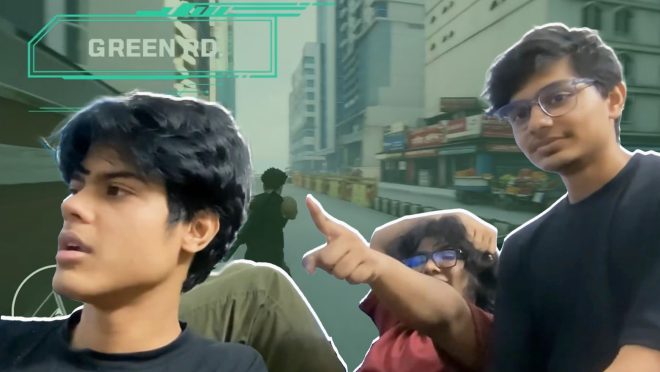
At the centre of the project is Rafid Ahmed, a final-year A-level student whose journey into technology began unusually early. “Back in sixth grade, I got into programming,” he says. “For a long time I was doing graphics programming with OpenGL.”
That early interest in rendering systems gradually expanded into artificial intelligence. By 2021, Rafid had shifted focus towards machine learning and research-oriented projects. In 2024, he represented his country at the first International AI Olympiad as part of the national team, earning a medal after competing internationally multiple times.
Before starting this project, Rafid was working at BornoAI, an education-focused AI startup that trained models on Bangladesh’s national curriculum (NCTB). The team gained international exposure through Founders Inc., eventually attending the Startup World Cup grand finale in San Francisco and Silicon Valley.
Despite that trajectory, he felt constrained by the scope of his work. “I wanted to do something more ambitious than just a textbook RAG startup,” he explains.
That ambition led him back to two long-time friends: Tanzim Abrar and Md. Nabil Islam. The three have known each other since kindergarten, remaining close even as their academic paths diverged.
Abrar brought hands-on industry experience that would prove critical. While still in school, he worked with Unreal Engine at BinaryCGI, contributed to projects connected to Technicolor India, and participated in online game jams. Nabil developed his skills independently as a 3D artist, building a portfolio through freelance work, peer collaborations, and personal projects.
Despite their combined backgrounds, confidence was not what defined the beginning of the project. “We didn’t believe we could make it happen,” Rafid admits. “We’ve tried ambitious projects before and most of them failed. But we were very passionate about this one, so we kept going.”
What emerged is a developing simulation of Dhanmondi, designed as an explorable game world where players can move through streets, interact with basic systems, and eventually contribute their own spaces. At its current stage, the project includes reconstructed buildings, roads, and early NPCs, alongside initial traffic and environment systems under development.
When asked what kind of experience they are aiming for, Rafid gives a surprisingly simple answer. “I want the game to run smoothly.”
That simplicity contrasts with the complexity behind the system they are building.
One of the team’s biggest challenges was designing a working production pipeline without prior large-scale studio experience or external funding. “We had to figure out what actually works in practice,” Rafid says. “There was no clear roadmap.”
The result was a long process of experimentation. The team tested more than 20 different workflows for generating and reconstructing 3D environments from visual data. Some approaches, such as Gaussian splatting, proved difficult to integrate into real-time game engines. Photogrammetry produced highly detailed models that were too heavy to optimise for gameplay. Neural radiance field-based methods required computational resources beyond what the team could access.
Eventually, they settled on a hybrid pipeline using open-source image-to-3D reconstruction tools, combined with manual optimisation and mesh post-processing. While less automated than ideal, it provided a workable balance between fidelity and performance.
Rafid credits Abrar’s experience in game development for helping them navigate these challenges. “Even while building the game, we ran into problems that didn’t have obvious solutions. We had to figure them out as we went. But Abrar’s experience meant he had seen many of these patterns before, which helped a lot.”
Looking at the broader industry, Rafid believes AI is rapidly lowering the barrier to entry for independent developers. “It’s now much easier for indie developers to build games at scale,” he says. “But games are not just about graphics or mechanics. The concept matters more than anything.”
He also sees potential in Bangladesh’s position within the global development ecosystem, particularly in outsourcing and cost advantages. The global game industry, he notes, is now valued at over 500 billion dollars.
“I really hope we can have a AAA-level studio in Bangladesh within the next five to six years,” he says.
For now, however, the focus remains firmly on their own world.
“We want to spend the rest of our lives working on this,” Rafid says. “All of our energy will go into making it better, bigger, and more enjoyable.”
It is an ambitious statement from three young developers still in school, working without formal backing or infrastructure. But their project also reflects a broader shift in how games are beginning to be built, where small teams, AI-assisted workflows, and iterative experimentation are starting to replace traditional studio pipelines.
Whether their digital version of Dhanmondi becomes a fully realised game remains uncertain. What is already clear is that they are part of a new generation redefining what it means to build interactive worlds from the ground up.