SSC examinees dropping out: System gaps, readiness and enforcement
The absence of more than 25,000 SSC candidates in 2026 is not a one-off anomaly but a warning sign of deeper weaknesses in Bangladesh’s education system, from poor preparation and inequality to growing student disengagement
SSC examinees dropping out: System gaps, readiness and enforcement
The absence of more than 25,000 SSC candidates in 2026 is not a one-off anomaly but a warning sign of deeper weaknesses in Bangladesh’s education system, from poor preparation and inequality to growing student disengagement
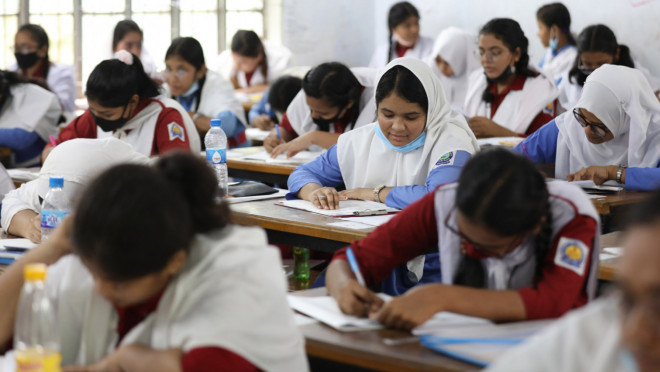
It is not merely an isolated statistic that more than 25,000 SSC candidates were absent in 2026. It reflects a deeper systemic disconnect between preparation and expectations, where stricter enforcement, uneven school accountability and weak learning foundations converge at the very point of graduation.
The 2026 case: A signal, not an exception
The fact that 25,408 students did not attend the first day of the Secondary School Certificate (SSC) examination, out of more than 1.5 million registered candidates, is not simply a statistical variation but a structural warning sign. These were not early school dropouts, but students who had progressed through the academic system and then chose not to appear at its final stage.
More worryingly, the trend continued. On the second day of the examination, more than 2,000 additional candidates were absent, while the number of expelled candidates nearly tripled. This development turned what might have seemed a one-day anomaly into an emerging pattern.
Supporting evidence over recent years
The 2026 case becomes more meaningful when viewed in context. In 2024, absenteeism stood at 19,359 candidates. In 2025, the numbers fluctuated sharply, ranging from 14,738 on the first day to nearly 29,000 on later examination days.
The fact that absenteeism has increased by almost a third in two years, alongside such volatility, suggests that it can no longer be treated as a one-off occurrence. It is gradually becoming behavioural.
A South Asian point of reference
Bangladesh occupies an uneasy middle ground within the region. India’s central boards usually record absenteeism rates between 0.5% and 1%, supported by continuous assessment systems and stronger institutional discipline.
Sri Lanka has similarly maintained participation rates above 99%. Nepal, despite structural constraints, generally records absenteeism rates between 2% and 4%.
What the 2026 case reveals about students
The absentee group signals a behavioural shift. Many students with weak academic foundations are still reaching the SSC level. Faced with the risk of failure, absence may appear to be a rational choice.
Increasingly, some students seem risk-averse: they would rather not sit the examination than face a poor result. This marks a subtle but significant shift from resilience to avoidance.
Enforcement: A revealing pressure point
Anti-copying measures and stricter invigilation have changed the examination environment, and developments on the second day underline this reality. The sharp rise in expulsions suggests active filtering of behaviour inside examination halls, just as absenteeism reflects filtering of participation outside them.
Together, these trends expose a deeper systemic issue: a segment of students has advanced through the system without acquiring the competencies needed to function in a rules-based assessment environment.
Institutional gaps exposed
The problem does not lie solely with students. Many institutions still place greater emphasis on registration than readiness, allowing students to progress to higher levels without mastering the required foundational skills. This creates a structural disconnect: students are technically eligible to sit examinations but remain academically unprepared. When the examination arrives, absence or failure becomes the natural consequence of long-term neglect.
The margins the system leaves behind
Absenteeism is unlikely to be evenly distributed. Large numbers of absent candidates are likely to come from rural and economically disadvantaged families, where parents already struggle to make ends meet. For such households, education is a long-term investment that can easily be sacrificed under pressure.
When a student withdraws at this stage, the consequences are not merely academic. It may delay entry into further education or the labour market by at least a year, and it increases the risk of permanent dropout. What appears as a national statistic often translates into household-level economic stagnation.
The 2026 case, therefore, points not only to weak preparation but also to a growing willingness to withdraw. This suggests that the system is failing to build trust as well as capability.
Action to take: Preventing the trend
If the present trajectory is to be reversed, policy responses must be focused and systemic. This includes introducing early-warning tracking from Class IX and making examination participation a key school performance indicator. Remedial programmes in core subjects should be compulsory, alongside stronger academic support systems to complement strict enforcement.
Student readiness monitoring needs to be strengthened at the school level, particularly by headteachers, while targeted academic support must reach rural and poorer districts. Stipends and incentives should be linked to both participation and performance, and pre-SSC readiness assessments should be introduced.
At the same time, the system must expand vocational and alternative education pathways, provide structured pre-examination counselling to reduce fear and anxiety, engage parents as active accountability partners, and publish school-by-school absenteeism and expulsion figures to improve transparency
A warning at the finish line
The emerging trend of 2026 reveals a twofold reality: students are missing from outside the examination hall, while others are being removed from inside it. Neither outcome is simply a matter of individual choice; both reflect systemic strain at the end of the educational pipeline.
Bangladesh has undoubtedly made major progress in expanding access to education. The next challenge is to ensure that students not only reach the final stage but are prepared, confident and willing to cross it.
Md Nazrul Islam is a former executive chairman of BEPZA, a retired major general of the Bangladesh Army, and a PhD researcher on technology, workforce transformation and industrial competitiveness.
Disclaimer: The views and opinions expressed in this article are those of the author and do not necessarily reflect the opinions and views of The Business Standard.