Inside JU’s female halls: Beyond the rumours and noise
“Rumours are carried by haters, spread by fools, and accepted by idiots.” Whoever said this had probably never spent five minutes on Bangladeshi social media during a slow news week, because if they had, they would have added a fourth category: people who have never actually set foot inside Jahangirnagar University but have very strong opinions about its female halls anyway.
Inside JU’s female halls: Beyond the rumours and noise
“Rumours are carried by haters, spread by fools, and accepted by idiots.” Whoever said this had probably never spent five minutes on Bangladeshi social media during a slow news week, because if they had, they would have added a fourth category: people who have never actually set foot inside Jahangirnagar University but have very strong opinions about its female halls anyway.
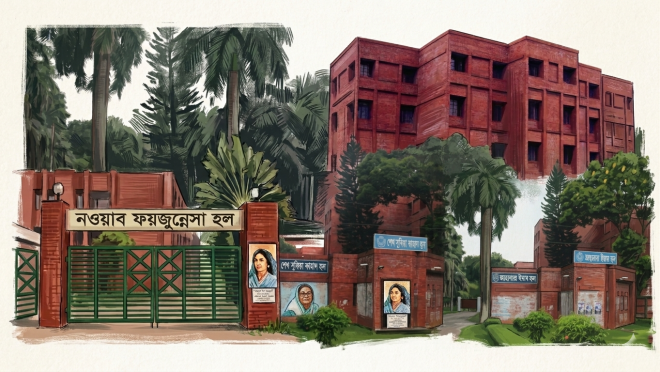
JU’s female residential halls are, by a significant margin, some of the most talked-about, least-understood spaces in the country’s university landscape.
They get dragged into political conversations, feature heavily in rumours that spread faster than the semester results, and somehow manage to carry the weight of being both scandalous and sacred, depending on who you ask and which day of the week it is.
So what are they actually like?
Jahangirnagar University has eleven female residential halls, and if those halls could talk, really talk, the way an old grandmother who has watched ten thousand students graduate might, they would each have something very different to say.
Nawab Faizunnesa Hall, named after the educationist and social reformer Nawab Faizunnesa Choudhurani, has the quiet dignity of someone who has been around long enough to find everything slightly amusing. She has watched girls arrive with suitcases bigger than their ambitions, seen them cry over first-semester results, and watched those same girls walk out years later like they owned the place. She does not get involved in drama. She has simply seen too much of it to be impressed.
Jahanara Imam Hall carries the name of the woman Bangladesh called the Mother of Martyrs, and she takes that weight seriously. There is something about this hall that seems to attract the ones who care too much, stay up too late, and write things in notebooks that they will never show anyone. She has absorbed more exam anxiety and 3 am breakdowns than any building reasonably should.
Begum Sufia Kamal Hall, named after the poet and feminist, has a personality that can only be described as having read every book in the library and formed an opinion about all of them. The girls who live here tend to surprise people. Quiet in the corridors, loud where it matters.
Pritilata Hall, named after Pritilata Waddedar, the revolutionary nationalist who fought British rule and did not flinch, has simply never had patience for people who complain about minor inconveniences. She has seen real struggle. She knows the difference.
The newer halls, Begum Rokeya, Fazilatunnesa, and Bir Protik Taramon Bibi, arrived with modern facilities and new energies. Better infrastructure, brighter rooms, and the particular privilege of not having decades of stories just yet.
What all eleven share, regardless of name or era, is this: every hall has an administrative body, a provost, security guards available around the clock, house tutors, dining services, a canteen, a reading room, a small library, a store for daily necessities, and a common room. The services exist. The support exists.
What the outside world tends to overlook, in its eagerness to build a narrative, is that these halls function genuinely and consistently as homes.
The rooms tell the stories that never make it to social media. The girl who left a small district town for the first time and spent her first week convincing herself she belonged here. The one who failed a course and rebuilt herself quietly before anyone noticed. The one who got a scholarship and did not tell her roommates until the letter arrived.
The ones who survived on hall canteen food and sheer stubbornness and came out the other side with degrees and something harder to name, a particular kind of resilience that you only develop when you have learned to call a place home even when it is difficult.
For parents and guardians, especially those sending daughters from outside Dhaka, the halls offer something that no amount of reassurance can fully replace: proximity, structure, and safety in a town that sits between the rush of the city and the quiet of somewhere smaller. The campus itself, green, sprawling, genuinely beautiful in the way that only universities built before land became impossible can be, adds a layer of serenity that students tend to underestimate until they have left it.
Higher education is already hard. For female students travelling from across the country to study at Jahangirnagar, the halls are not just accommodation. They are the reason the journey is possible at all.
The world outside is welcome to keep forming its opinions. The halls, for their part, have seen it all before, and they are not particularly worried about any of it.