The death of printed dictionaries
Today, dictionaries sit more as relics than necessities, reminders of a time when learning a new word meant flipping through pages rather than tapping a screen
The death of printed dictionaries
Today, dictionaries sit more as relics than necessities, reminders of a time when learning a new word meant flipping through pages rather than tapping a screen
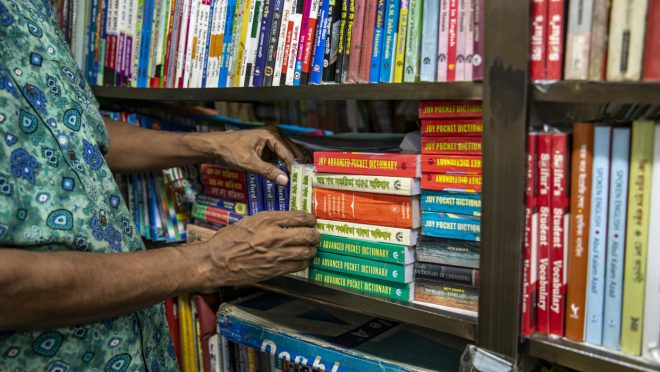
I was walking through Old Paltan when a small red book suddenly caught my eye, almost out of place among glossy paperbacks and exam guides. It was a dictionary — once a constant companion for students across Bangladesh.
A simple question crossed my mind: “When was the last time I opened a printed dictionary?”
I do not actually remember. In this age dominated by smartphones, search engines, apps, and now AI chatbots, printed dictionaries are losing relevance — both globally and in Bangladesh. Today, they sit more as relics than necessities, reminders of a time when learning a new word meant flipping through pages rather than tapping a screen.
A global shift
The decline of printed dictionaries is not limited to Bangladesh. Across the world, major publishers have been shifting their focus to digital platforms. In 2010, the Oxford English Dictionary announced that its next edition would likely never be printed, signalling a major turning point.
The reasons are clear: convenience, accessibility, and the ability to update content continuously. Online dictionaries can be revised several times a year, whereas printed editions take decades. With just a right-click or a quick search, users can now access meanings, pronunciations, etymologies, and usage examples instantly.
Yet, this transition has not been without criticism. Some lament the loss of the tactile experience and the joy of browsing — of discovering unexpected words while searching for another.
At the same time, the digital boom has created a paradox. Dictionaries are now more widely used than ever, but the traditional dictionary business is struggling. According to reports, the number of full-time lexicographers in the US has dropped drastically — from around 200 two decades ago to less than a quarter of that number today.
Bangladeshi nostalgia
In Bangladesh, the shift has been equally pronounced, though more deeply intertwined with changing habits, educational practices and technological accessibility.
There was a time when dictionaries were part and parcel of every student’s life. “The dictionary, which was once popular among students of all classes, is now on the verge of extinction,” said cultural activist Md Shamshul Arifin.
Bangla Academy produces several major printed dictionaries, including Byaboharik Bangla Abhidhan, Shomokalin Bangla Bhashar Abhidhan, Shongkhipto Bangla Abhidhan, and the Bangla Academy Bangla–English Abhidhan. Other well-known dictionaries include Samsad Bangla Abhidhan, Chalantika, and Bangiya Shabdakosh.
There are also specialised works such as Bangladesher Ancholik Bhashar Abhidhan, Bangla Uchcharan Abhidhan, Bangla Banan Abhidhan, Madhyajuger Bangla Bhashar Abhidhan, Lekhok Abhidhan, Bangla Academy Charitabhidhan, and the Joykoly English to Bangla Dictionary.
These dictionaries have long been among the most widely recognised and used in Bangladesh. However, their usage has declined in recent years due to the growing reliance on digital tools, mobile applications, and online translation platforms. Rather than becoming obsolete, they are gradually transitioning from everyday reference tools into more specialised academic and literary resources.
According to Bangla Academy, the Bangla Academy English–Bengali Dictionary, edited by Zillur Rahman Siddiqui, is widely regarded as the only academic book in Bangladesh to have sold over one million copies since its first publication in 1993.
For years, dictionary sales remained robust. In a typical successful year, such as 2023 or 2024, the Academy sold between 20,000 and 40,000 copies of its top three dictionaries combined during February alone, driven largely by demand at the Amar Ekushey Book Fair.
However, this trend has begun to shift. Recent figures suggest a noticeable decline, with total annual sales in 2024–25 falling to around 20,000 to 25,000 copies. The drop indicates a changing pattern of readership, as digital tools increasingly replace printed dictionaries in everyday use, even as their academic and institutional relevance persists.
“Carrying a small or medium-sized dictionary to search for the right meaning of words is outdated nowadays and rather time-consuming,” said Saad Khan, an English medium student.
“I use online and offline mobile dictionary apps. These are very handy, comfortable, and less time-consuming,” he added.
The rise of digital tools has fundamentally changed the way people interact with words. Online dictionaries offer far more than definitions; they include synonyms, antonyms, pronunciation guides, etymology, example sentences, and even videos. Many are free and regularly updated.
As Arifin points out, “online and offline dictionary apps are very fast, user-friendly, weightless, lucrative, and customisable. Besides, it also offers pronunciation options, which are very important to correctly pronounce the words.”
Even teachers have embraced this shift.
Naif Mahmud, a teacher of Milestone school, admits, “If I need to look for the meaning of an unknown English word, I use the mobile dictionary app installed on my phone. It is indeed quite impossible for me to remember the last time I used the printed dictionary. It has been on my bookshelf for years.”
A market in decline
The decline is perhaps most visible in the book markets of Nilkhet, once bustling with dictionary sales.
“More than 10 years ago, dictionaries were in great demand, but now I can sell only a handful throughout the year,” said Ramzan Ali, a bookstore owner.
The remaining customers are niche: English department students looking for pronunciation symbols, job seekers buying customised dictionaries, and medical students purchasing specialised ones.
“Other than English department students, job seekers also come here to buy dictionaries. But they are very few in number,” he added.
The story of the pocket dictionary encapsulates this decline. At its peak between 1990 and 2000, sales reached 10,000 copies per month. Today, that figure has dropped to around 500 copies per year.
Almas Hossain, a bookseller in Nilkhet, said, “The demand for dictionaries has decreased. Five to seven years ago, we used to sell two to five dictionaries a day, especially to college students and those preparing for IELTS. Now, that number has dropped to just one or two sales a week.”
“We still have a few customers, mainly students from Bangla departments, who buy Bangla-to-Bangla dictionaries for academic purposes. Earlier, people used to keep a dictionary at home as a sign of being educated. That culture is no longer there,” he added.
“In the past, people would buy dictionaries with enthusiasm. That enthusiasm has faded,” said Shahid Hasan Tarafder, owner of Gyankosh Prokashoni.
“The reasons are both technological and economic. The rise of mobile apps caused sales to take a nosedive around 2015–16. At the same time, production costs have increased significantly. The price of paper has nearly doubled, from Tk800–900 per rim in 2018 to Tk1,700–1,800 today, while labour costs have also risen. Profits are not even half of what they used to be,” Shahid noted.
Impact on language
Beyond economics, the decline of printed dictionaries raises concerns about language learning itself.
“A dictionary is a tool to learn a language,” writes Nazma Yeasmeen Haque, emphasising its importance, particularly in mastering a second language.
Yet, despite the abundance of dictionaries in the market, usage has declined. “Varieties of dictionaries do not necessarily mean that our students or we ourselves have been using them more and more,” she observes. “Had it been so, there would not have been a constant decline in learning a language.”
While English dictionaries have successfully transitioned to digital platforms, the situation is more complex for Bangla.
Sangeeta Imam highlights that although digital tools have made English learning easier, with features like auto-correction and grammar software, Bangla dictionaries have not kept pace.
“Still, in the case of Bangla dictionaries, no institutional responsibility has been established online,” she writes.
This gap has led to the proliferation of unreliable apps and websites, often spreading incorrect meanings and spellings. “Wrong spelling and wrong meanings are being presented as correct,” she warns.
The solution, she argues, lies in institutional intervention. The Bangla Academy, as the primary authority, must take the lead in digitising and standardising Bangla dictionaries. Digital integration could make comprehensive resources more accessible, while also correcting widespread inaccuracies.
Importantly, digitisation does not mean abandoning print altogether. “The necessity of printed dictionaries will remain,” Imam notes, though perhaps in more specialised contexts.
The story of dictionaries in Bangladesh is not just one of decline; it is one of transformation too.
Printed books, despite digital competition, continue to thrive globally. Billions of copies are sold each year. But dictionaries are different. They are tools, and tools evolve with technology.
Today, the dictionary has not disappeared; it has migrated. It lives in search bars, apps, and algorithms. It is in people’s pockets, in the palm of their hands, a right-click away.
As Bangladesh navigates this transition, the challenge is not to resist change but to manage it, ensuring that accessibility does not come at the cost of accuracy, and convenience does not replace understanding.