SAU hosts seminar on solar radiation modification in climate-vulnerable Bangladesh
SAU hosts seminar on solar radiation modification in climate-vulnerable Bangladesh
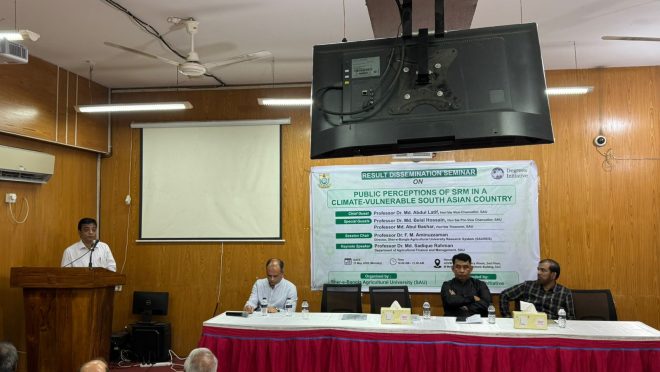
Sher-e-Bangla Agricultural University (SAU) organized a seminar on 11 May 2026 to raise awareness and share findings from a research project titled “Acceptance of Solar Radiation Modification (SRM) in the Context of a Climate-Vulnerable South Asian Country: Public Perception and Their Associated Factors”.
The seminar focused on public perceptions of solar radiation modification in Bangladesh and brought together academicians, researchers, NGOs, development partners, and policymakers to discuss the scientific, social, and policy dimensions of SRM in a climate-vulnerable country.
Prof Dr Md Sadique Rahman delivered the keynote speech, presenting an overview of SRM techniques, their potential risks and benefits, and stakeholder perspectives in Bangladesh. He highlighted the existence of significant knowledge and information gaps among different stakeholders regarding SRM and stressed the importance of clear, evidence-based communication to improve understanding in the Global South.
In his remarks, Prof Rahman argued that ethical implementation of SRM would require moving away from a “top-down” Global North-driven approach towards a transparent and multilateral framework in which climate-vulnerable nations are given meaningful decision-making authority.
Professor Md Abul Bashar, Treasurer of SAU, attended the seminar as special guest. He emphasized the need for balanced and scientifically grounded climate action strategies and highlighted the importance of exploring complementary climate solutions such as SRM alongside conventional mitigation measures.
The session was chaired by Prof F M Aminuzzaman, Director of the Sher-e-Bangla Agricultural University Research System. In his address, he underscored the role of academic institutions in advancing climate resilience research and policy dialogue and stressed the need for multidisciplinary collaboration to evaluate both the opportunities and risks associated with SRM.
The seminar concluded with an interactive discussion session where participants emphasized the importance of informed policymaking, increased research investment, and stronger regional and international cooperation in addressing climate challenges.
The research project is funded by The Degrees Initiative, an NGO that works to place the Global South at the centre of global discussions on solar radiation modification research.