Why Professor Anwar’s lectures feel different from every other classroom
Complexity invites readers into a refreshing approach to learning where clarity replaces confusion.
Why Professor Anwar’s lectures feel different from every other classroom
Complexity invites readers into a refreshing approach to learning where clarity replaces confusion.
Normally, STEM students rely on Indian accents in order to pass their term exams.
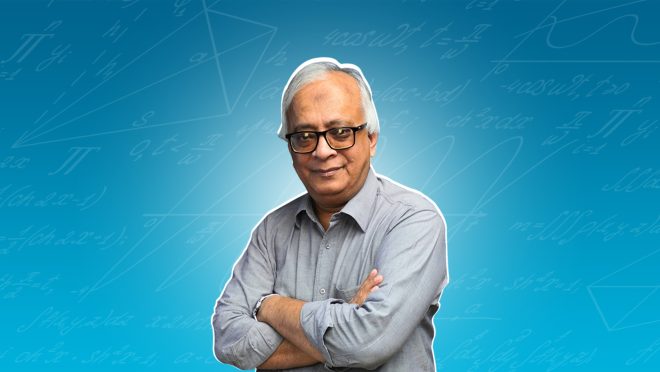
However, when I stumbled upon a video of a professor who was explaining differential equations with immaculate precision and in a language I could only hear in my classroom, I knew I had to meet the man behind that screen.
Professor Anwar is the man I wanted to meet, and as I wrote my email, his humble replies and the subsequent invitation to his campus at IUB made the trip more worthwhile.
Inspiration
Professor Anwar explained that his motivation started decades back from the influence of courses being made available by MIT, followed by Stanford.
At the end of the 90s, MIT had created an open-course platform where all the lectures were made available for students outside MIT, making them accessible to students around the world. Witnessing this bold move, the media asked the President of MIT, “People will find out what MIT teaches. Was this decision a wise one?”
The President of MIT had replied that was exactly what he wanted: the world to acknowledge what MIT teaches as the best institution in the world. He wanted people to understand how good MIT is. Later on, Stanford University followed the same pathway.
“Talking about South Asia, India created a mass revolution in this regard. They opened up massive technical courses accessible for all on the web. Pakistan also did the same thing but, unfortunately, Bangladesh did not make any sort of move like this.”
Professor Anwar decided to establish that precise open-course culture in Bangladesh.
At first, he tried to start this at IUB, where he serves as a faculty member, but due to technical issues he could not.
Later, a student of Professor Anwar helped him by providing support to create open courses and, getting his first inspiration from there, he started laying the stepping stones by first conducting a lecture series on Probability and Statistics.
Professor Anwar was utterly surprised after seeing the response from students. Gradually, he started a more technical course in differentiation. After that, he moved to engineering courses for four years.
A social media post requesting whoever wanted to join the course was flooded with positive responses. The professor’s calculations took hundreds into account, but instead thousands showed up.
Moreover, more Indian students attended the classes than Bangladeshi ones.
“Whenever I give a lecture, my mindset is to use local examples so that students can connect easily,” the professor shared.
Early on, as a student of Mechanical Engineering at Bangladesh University of Engineering and Technology, he had an interest in Mathematics, but later he faced many problems with the way classrooms taught it.
“From the start at IUB, my goal was not to teach maths as maths, but rather as a tool of engineering, which I lacked at BUET, so that those who study engineering never imagine, ‘Why have we started this?’ but instead think, ‘That is why we needed it.’”
The demand
Upon asking about the lectures he enjoys teaching the most, the professor replied, “I enjoy the basics.”
He further explained that he does so because students’ minds remain fresh and, as such, he can mould the concepts into whatever shape suits them best.
“I try to create the basics,” the professor shared.
As the professor explained, it is unfortunate that even today, whenever he looks at the syllabus of certain universities, it is designed around concepts from five decades ago.
Even at IUB, he is bound to follow the traditional pathway of teaching. Online platforms made it easier for him by allowing him to deliver lectures without following any constrained syllabus.
“There are some lectures I gave online which are rare in Bangladesh. It’s both fascinating and enjoyable.”
When I asked him how he chooses topics before a lecture, he said, “I generally follow three to four universities while choosing lectures, among which the most followed are MIT and Stanford. I cover those topics but definitely not in exactly the same way.”
Stating his vision with this platform, he said, “If I take learning economics as an example, Dhaka University, BRAC University, and North South University are the best, no doubt. But what about other places? X, Y, and Z universities are teaching economics, but there’s a huge gap in teachers when it comes to delivering lectures. These subpar courses and the lectures they demand are simply destroying the lives of students.”
According to him, there should be nationwide platforms that teach the basic courses of economics, which are common everywhere.
Similarly, Professor Anwar holds a vision to deliver lectures that are designed nationally and accessible to everyone, just as India has done.
When I asked where students suffer the most, he said it is in connecting theory with real life.
The challenges
Often, we see university students, especially engineering students, fall victim to depression and anxiety because of CGPA pressure and a lack of deeper understanding of lectures.
When I asked Sir what the core reason behind this was, he gave a surprising answer.
“Students underestimate themselves a lot.”
Secondly, there are expectations. “Whenever students come into university, they observe their counterparts, often those superior to them. As a result, they fall into depression and become trapped in a spiral of bad habits.”
According to him, the biggest problem is that more than 67% of students come to Dhaka from outside areas to enrol in universities here, and there is no one to monitor them or guide them through an unfamiliar path.
In his concluding remarks, he emphasised the importance of creating a productive peer group, the perfect example of which is the comment sections under his videos.