Mymensingh villagers revive mud architecture to build climate-resilient school
Organisers say classrooms remain 3 degrees Celsius cooler than conventional buildings, with humidity levels 5% lower
Mymensingh villagers revive mud architecture to build climate-resilient school
Organisers say classrooms remain 3 degrees Celsius cooler than conventional buildings, with humidity levels 5% lower
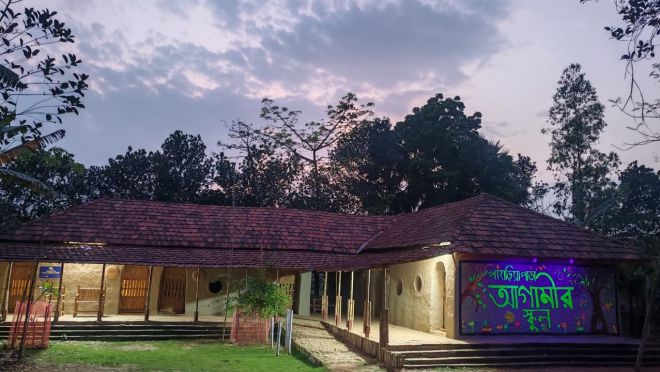
Residents of a remote riverside village in Fulbaria, Mymensingh, have built a school using mud, bamboo and traditional construction techniques in an effort to improve access to education and strengthen climate resilience through a community-led initiative.
The initiative, known as Pahariapara Agamir School, was developed through a collaboration among villagers, the Grow Your Reader Foundation (GYRF), and architectural research organisation Perceive.
Located beside the Akhalia River, Pahariapara village is home to 141 households. Poor roads, seasonal flooding and the long distance to nearby schools had left many children without regular access to education for years.
According to organisers, literacy rates in the area remained around 20%, while younger children and girls were among the most affected by school dropout and delayed enrolment.
The school now serves 95 students with three teachers, operating classes in shifts to accommodate children from different age groups in the riverside community.
Around two years ago, villagers approached GYRF seeking support to improve access to education in the community. Rather than introducing an external solution, the organisation began a series of community discussions focused on local experiences, strengths and cultural practices.
Community member Salim Ahmed said the village had long struggled with limited educational opportunities despite residents’ aspirations for development.
“This is an education-deprived village. People wanted many changes, but those could not be implemented for various reasons,” he said.
“Through discussions with GYRF, villagers gradually rediscovered their own strengths and heritage. The decision to build with mud was not planned at the beginning – it came from reflecting on our own traditions.”
Those discussions eventually led villagers to revisit the traditional practice of mud-house construction, a technique that had gradually declined as many families shifted towards brick and tin structures, often viewing mud homes as symbols of poverty.
The school was later constructed using locally sourced soil, bamboo and community-contributed land and labour. The building process was led by Gafur Chacha, an 80-year-old traditional craftsman who trained local youth in mud construction techniques during the project.
According to organisers, the mud-built structure reduced construction costs by nearly 70% and avoided approximately 2,000 tonnes of carbon emissions compared to conventional construction methods. They said the classrooms remain around 3 degrees Celsius cooler, with humidity levels about 5% lower than conventional structures.
Beyond the infrastructure project, villagers and GYRF jointly developed a curriculum inspired by Unesco’s “Greening Curriculum Guidance”, integrating farming practices, environmental awareness, seasonal knowledge and local cultural traditions into classroom learning.
GYRF Chief Executive Officer Sadia Jahan said the initiative’s long-term sustainability depends on community ownership and the revival of local knowledge systems.
“Villagers themselves contributed land, labour and materials, creating a strong sense of responsibility towards maintaining and protecting the school,” she said. “Traditional mud-building knowledge is also being transferred to younger generations, ensuring these climate-responsive skills are not lost.”
She added that linking education with local realities and lived experiences could help reduce dropout rates and improve participation among children, particularly girls.
According to GYRF, the initiative followed its SALT approach – Support, Stimulate, Appreciate, Listen, Learn, Link, Team and Transfer – focused on community-led development and local participation.
The organisation is also arranging immersion visits to Pahariapara for educators, youth groups and development practitioners interested in community-driven education and climate resilience models.
Organisers say the project demonstrates how vulnerable rural communities can combine cultural heritage, climate adaptation and collective action to address educational and environmental challenges.