From Jahangirnagar to Oxford: The making of a fully funded economics scholar
Samia Islam Anika did not plan to apply to one of the world’s most competitive economics doctoral programmes. She simply did the work, for years, quietly, deliberately, and the programme found her.
From Jahangirnagar to Oxford: The making of a fully funded economics scholar
Samia Islam Anika did not plan to apply to one of the world’s most competitive economics doctoral programmes. She simply did the work, for years, quietly, deliberately, and the programme found her.
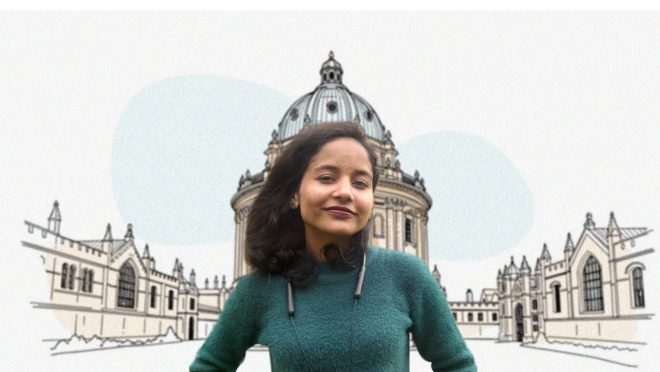
The first thing Samia Islam Anika tells me is that she almost did not apply to Oxford at all. She had a plan — a sensible, stepwise plan of the kind that students from public universities in Bangladesh typically build when they dream cautiously — and the plan did not include a top-ten global institution at the first attempt. A mid-tier foreign university for a master’s degree, she thought. Then perhaps a pre-doctoral fellowship. Then, if everything went well, maybe a shot at a doctoral programme at somewhere genuinely world-class. That was the five-year version of the dream.
The accelerated version arrived unexpectedly. After receiving her GRE scores, a faculty mentor suggested she apply for the MSc in Economic Development at Oxford. She browsed the website, decided she wanted to stay in theoretical economics rather than development, and clicked on MPhil in Economics instead. She noticed, almost in passing, that Oxford’s MPhil+DPhil integrated programme considers all applicants automatically for the standalone MPhil as well — meaning she could apply once and be assessed for both levels. She applied for the doctoral track.
The rest, as they say, is history — though that phrase does a disservice to the six years of deliberate choices, late nights, and faculty relationships that made the outcome possible. Samia received a fully-funded place under the Clarendon Scholarship for the Integrated MPhil+DPhil in Economics at the University of Oxford.
FAST FACTS
Undergraduate & Masters: B.Sc. and M.Sc. in Economics, Jahangirnagar University
Destination: Integrated MPhil + DPhil in Economics, University of Oxford
Scholarship: Clarendon Scholarship (Oxford University Press endowment, merit-based, fullyfunded)
Scholarship value: Full tuition and college fees + annual living grant at UKRI doctoral stipend rate (current rate of course fees and living stipend combined for my programme is approx 50k GBP per year, however I think it is best not to mention it), for the full five-year programme
Oxford programme: Launched 2021: two years MPhil (theory, econometrics, applied economics) + three to four years DPhil (original research). Structured like the integrated five-year PhD at leading US economics graduate schools
Admission level: Highly selective; the Department of Economics aims for around 90 (only 6 of them are taken for MPhil+DPhil, if that is of any interest) students across MPhil and MPhil+DPhil combined annually. MPhil+DPhil entrants are expected to take advanced-level courses from year one
Other Applications and Offers:
Postgraduate Associate at Y-RISE, Yale University, sponsored by the Kabir Banerjee Predoctoral Fellowship
MSc in Economics, University of Warwick (did not explore funding opportunities)
Graduate Program in Economic Development, Vanderbilt University (70 percent funding)
Publications (at the time of application):
1 journal article in The Jahangirnagar Review, 1 conference paper presented at the 7th SANEM
Annual Economists’ Conference (SAEC) 2024, 3 papers in progress
IELTS – 8.5
GRE – 331
THE SCIENCE STUDENT WHO CHOSE ECONOMICS
You came from a science stream. Most families — and the entire structure of how we think about merit in Bangladesh — push science students toward medicine or engineering. What made you go the other way?
I think I have always had a few rebellious ideas. Not many — I am not someone who rejects things just for the sake of rejecting them. But one thing I was very clear about from early on: I would not study something I did not enjoy. I do not like biology. I was never going to study it.
When I had the freedom to choose what I wanted, I chose what I was genuinely drawn to. Economics, it turned out, was that thing. And the support of my family made it possible to actually act on that choice instead of just thinking about it.
This might sound like a small thing. In the landscape of Bangladeshi higher education, where the pecking order of disciplines is often treated as a law of nature rather than a social construct, it is anything but. Students who leave science for social science at the undergraduate level face a peculiar mix of curiosity and quiet concern from the people around them. Samia navigated that transition and then built, inside it, one of the most competitive graduate profiles this department has produced.
A lot of students at Jahangirnagar — and across Bangladesh generally — have no framework for about international graduate applications. Walk me through what you wish someone had explained to you earlier.
A graduate application is a profile, and a profile has multiple components that all carry weight. Your academic record, your research work, how your CV is constructed, your Statement of Purpose, your letters of recommendation, how you come across in an interview if there is one. No single element can make or break you. The strength is in the combination. But — and this is the part people miss — you also have to be the right match for the specific programme you are applying to.
Can you say more about that? What does ‘match’ actually mean in practice?
It means that a strong general profile is not enough if you are applying to the wrong programme for who you are. The Oxford MPhil+DPhil in Economics is an integrated research programme, modelled on the five-year PhD structure at leading American economics graduate schools. It was launched in 2021 and is specifically designed for applicants who want to go into academia — research, theory, that world. From the very first year, MPhil+DPhil students are expected to take advanced-level courses and are oriented toward doctoral research from the start. That is not what every programme wants. If I had applied to a Masters in Public Policy, or to a development studies programme, they would have been looking for a very different kind of applicant. Not better or worse, just different. My profile was built for theoretical research in economics. It matched Oxford’s programme. That is why it worked.
She pauses, then gives me an example that illustrates the point with characteristic precision.
I applied to Vanderbilt, just because a friend told me the application fee was waived and I could send my materials at no cost. They offered me admission. They also offered me only seventy (was offered to me finally, 50 was the initial offer) percent scholarship. Oxford offered me a full scholarship. A much higher-ranked, far more rigorous programme, and a better financial offer. Why? Because at Vanderbilt, I was overqualified for what they were looking for (I think this requires rephrasing and more substance as well. My being overqualified is one of the reasons, but not the only one. This program, being terminal in nature, does not provide fullfunding to anyone. So they were offering me the best that they could, but incidentally their best was not good enough, and that is why it was not a good match. It is more of a professional degree, so it would be a good offer for someone who can pay for the rest of the tuition fee and living stipend themselves, and then take up a high-paying job quickly after graduation without having to invest time in getting a PhD). Their programme focuses more on applied and real-
world engagement — the kind of economist who goes out and works at the grassroots level. That is a perfectly legitimate and important path. But it is not mine. Fit works in both directions.
“Oxford gave me a full scholarship and Vanderbilt is a lower-ranked programme. A strong profile in the wrong place is still the wrong profile.”
BUILDING RESEARCH — WITHOUT A PLAN FOR OXFORD
Your application included five publications. For most students at our level in Bangladesh, that number alone is remarkable. How did that happen?
Honestly, none of it was planned as a strategy for Oxford. I was not sitting in my second year thinking: I need five publications for a top global application. I was interested in research. I had faculty mentors who gave me the opportunity to work with them. And when you keep saying yes to those opportunities — when you take each piece of work seriously as a piece of work, not as a line on a CV — things accumulate. Not everything was a peer-reviewed journal publication in the traditional sense. But they showed a consistent track record of doing research and engaging with academic communities.
The research proposal for Oxford — how long did it take, and was it written from scratch?
The proposal built on my SANEM conference paper. The intellectual work was already done — the question, the literature, the methodology. What Oxford required was a version adapted to their word limit, which meant compressing without losing the argument. That part was manageable. The Statement of Purpose was a different matter entirely. am a night owl by nature, and I told you, it was written in only one attempt and in just two nights, which you also mention here later – so wrong info + inconsistency. But yes, it was written from scratch, and it was absolutely tailored for the MPhil+DPhil of Oxford)
Was any of what you wrote in the SOP exaggerated?
Some of it was — presented in the most favourable light, let us say. I think that is part of what makes a good SOP. You are not lying. You are making the strongest possible argument for yourself. You are telling a story in which the connective tissue is real, the choices are real, the publications are real — but you frame them to show a coherent narrative of intention and direction. If you write your SOP the way you would describe your last few years to a friend, it will be flat. You have to write it the way you would argue a case.
THE GOAL THAT CLARIFIED EVERYTHING
There is a coherence to your application that reads as though it was planned from the beginning. Was it?
Not as a specific plan — but yes, in terms of direction. I always knew I wanted to stay in academia. That was my fixed point. And once you have a fixed point, making decisions becomes much simpler. Every opportunity I encountered, I asked one question: does this move me toward the thing I actually want? If the answer was yes, I took it. If not, I did not, even if the opportunity sounded impressive. Over six years, those decisions accumulated into a profile that pointed in a consistent direction. From the outside, it looks like a plan. From the inside, it was just a series of honest answers to the same question.
WHEN A DEPARTMENT SHOWED UP
You’ve spoken publicly about what your department did after you received the Oxford offer. Can you walk me through what happened?
When Oxford sent the formal offer letter, it contained a condition I had not anticipated: before my visa application could proceed, I would need to submit my master’s transcript. At that point, my department had not yet begun its final examinations, let alone published results. The standard institutional timeline made the condition almost impossible to meet. I told my teachers and my classmates what was happening. And what followed was — I do not have another word for it — a collective mobilisation.
My classmates made sure the final examinations proceeded without disruption or delay. My teachers took on extra workload to ensure results were published as early as possible. The transcript reached Oxford in time. My visa moved forward. Without that, I would not have been able to take up the offer at all. And that collective effort — that willingness, from everyone around me, to do more than their job required — was a significant factor in my decision to choose Oxford over Yale. It meant I was leaving a place that had genuinely invested in me. That matters when you are about to be somewhere else for five years.
You have mentioned that you never acknowledged your faculty publicly while you were a student. Why?
I did not want it to be misread. Expressions of gratitude toward teachers, when you are still a student, can look like positioning — like building goodwill for future favours. I was careful about that. Now I am an alumna, and I can say clearly: the teachers I learned from at
Jahangirnagar did not just give me an education. They nurtured my ambition in the years when it was not yet clear whether I had any right to be ambitious. They wrote letters of recommendation under impossible deadlines and during vacations. They pushed back on my work. They told me when I was wrong. That kind of mentorship is not something you can repay. You can only try to pass it forward.
“They nurtured my ambition in the years when it was not yet clear whether I had any right to be ambitious. That is not something you can repay. You can only pass it forward.”
ON COST, ACCESS, AND WHAT NOBODY TALKS ABOUT
You have been unusually candid about the financial side of applying. Talk me through what the process actually cost.
I applied to four places in total. Oxford, Vanderbilt, Warwick, and the Kabir Banerjee
Fellowship. The reason those four is partly about strategy — but partly, honestly, about cost. Oxford allowed me waiver But I only applied to Vanderbilt because a friend told me there was no application fee and it would cost nothing to try. Application fees can be a considerable burden in the process, but it can be at times minimised if one keeps a look out for the offers. Often applicants do not think this step through, and therefore end up spending more than is necessary. I probably would have applied to Oxford even if they required me to pay some fee, but wouldn’t apply to Vanderbilt without a fee waiver because I knew that it wasn’t really a programme that I was interested in pursuing. Lucky for me, that I got accepted to a graduate programme before having to spend any money on application fees. Most people may not find such luck. However, in paying for graduate applications, strategising can significantly help in reducing costs. Before paying the application fee, one can and should always weigh the costs and benefits of applying to that particular programme. Am I likely to get accepted? Does this programme match with my profile? Am I interested in pursuing the programme in case I get acceptance? Do these programmes offer application fee waivers? These are questions worth considering.). GRE and IELTS fees are not trivial. Application fees for individual American programmes can be sixty to a hundred dollars each. For a student whose family is managing carefully, paying five or six application fees simply is not possible. This is a real structural barrier, and it is almost never discussed in conversations about who gets access to these opportunities.
The Clarendon Scholarship, for its part, requires no separate application. Any student who applies to a full-time Oxford master’s or DPhil programme by the relevant January funding deadline is automatically considered. The scholarship covers full tuition and college fees, plus an annual living grant at the UKRI minimum doctoral stipend rate — — for the full duration of the programme (the amount is inaccurate, and Clarendon scholarship value can vary depending on programmes). For a student from Bangladesh, it is a complete removal of financial anxiety about studying at one of the world’s leading universities for five years.
“I did not apply to Vanderbilt because it was the right fit. I applied because a friend told me the fee was waived. Cost is a real barrier. Nobody in these conversations talks about it honestly.”
WHAT SAMIA WOULD TELL YOU TO DO DIFFERENTLY
If you could speak directly to a first- or second-year student at Jahangirnagar reading this piece, what would you tell them?
My answer would be assessing the student’s status quo early on. This can include anything that influences their resources at hand – their personal strengths and weaknesses, or that of their current programme, department, university or surroundings for that matter. Knowing early what can be some potential weak spots of their graduate application, given current circumstances, allows them time to strategise and circumvent those shortcomings. (You can link the “fixing goal first” at this point, it is also a part of that initial assessment). And thirdly, something that is very important for first- or second-year students is to focus on maintaining a decent (does not have to be the highest CGPA) academic profile, because that saves them a lot of work later (also, if you want to include that suggestion about starting research early on, I think this is the better window to add that).)
When the goal is specific, every decision you make over the next four years becomes easier. You stop saying yes to things just because they are opportunities and start saying yes to things because they serve the direction you have chosen. That selective accumulation, over time, is what creates a coherent profile. You cannot manufacture it retroactively in the last six months before you apply.
What about students who feel their institutional affiliation is a disadvantage? That coming from Jahangirnagar, or from any non-Dhaka-University institution, puts them behind?
I want to be honest about this, because the honest answer is complicated. Institutional affiliation does give you some advantages or disadvantages at the margins — access to certain networks, the name recognition your supervisors carry when they write your letters of recommendation. That is real. But what travels most is the work itself. Your research, your publications, your intellectual clarity in the SOP and interview — that is what the admissions committee is actually evaluating. I was a student at Jahangirnagar. I got Oxford. The affiliation was not what got me in. What got me in was the quality of the work and the relationships I built with faculty who cared enough to invest in me. Build those. The institution matters less than what you do inside it.
OXFORD — AND WHAT COMES NEXT
I am already halfway through my first year). The programme she is entering is one of the most demanding in the world — its structure, launched in 2021, is explicitly modelled on the five-year integrated PhD at leading American economics graduate schools, with the difference that Oxford’s system provides more structured coursework and research training in the MPhil years before the full DPhil research phase begins. The department at Oxford typically aims for around ninety students across the combined MPhil and MPhil+DPhil cohort annually; those admitted to the integrated track are expected to take advanced-level courses and demonstrate doctoral-level research engagement from their first term. She plans to stay in theoretical economics. The longer-term goal is academia — research, teaching, perhaps eventually the kind of work that sits at the intersection of economic theory and public policy. She is, as she says herself, still in the process of deciding exactly which questions she wants to spend the next decade asking.
She mentions, almost in passing, that she has never actually been to Oxford.
An extremely self aware individual who understands her support system, her family, the backbone of her journey. Also she unapologetically acknowledges her privileges. She is aware that she has huge expectations to meet up. The scholar ended the conversation on an optimistic note that she intends to pay back to her country and her people !!
The dream, the passion, the hard work, and the prayer — and, as it turns out, one very good match between a researcher and a programme that needed exactly what she had spent six years becoming.