From Jahangirnagar to Oxford: The making of a fully funded economics scholar
Most people who get into Oxford have been planning it for years. Samia Islam Anika was not one of them. She sat for her GRE in December, got a perfect quant score, and her teachers encouraged her to aim higher. She looked at Oxford’s benchmark, saw her score cleared it, and applied
From Jahangirnagar to Oxford: The making of a fully funded economics scholar
Most people who get into Oxford have been planning it for years. Samia Islam Anika was not one of them. She sat for her GRE in December, got a perfect quant score, and her teachers encouraged her to aim higher. She looked at Oxford’s benchmark, saw her score cleared it, and applied
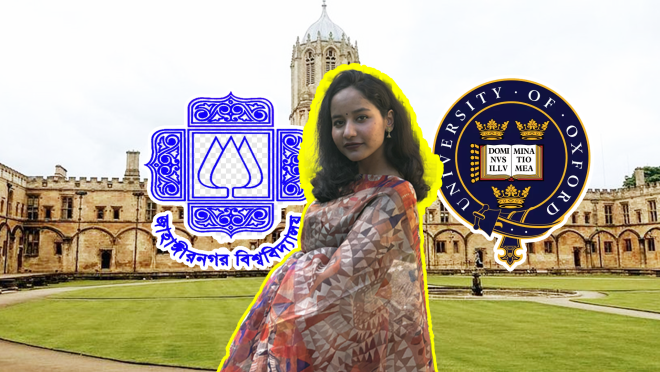
Two days total for the SOP. Four universities, all unplanned. She got into all of them. Oxford gave her a full ride.
Seems like a magical journey, doesn’t it? But behind the almost magical journey was the hard work she has done for years.
To get to know that magical journey a little more closely, I sat down with her. In the interview, she talks about her preparation, what made Oxford say “Yes” to her, the contribution of her family, and much more.
Economics from a science background
Samia came from a science background, but she wasn’t the person to follow the conventional route. “I never liked the idea of accepting and doing things that society asked us to do,” she said. She confessed to having the tendency of not doing what everyone was doing.
She liked mathematics, but engineering did not feel right. Her parents, like every other parent, had hoped she would go into medicine. But, she had different dreams. What she did love was reading newspapers and books. Social issues pulled at her. And since she loved mathematics, economics, “the subject that heavily incorporates mathematics in social science”, made complete sense.
She credits her family with giving her the space to make that choice. “My parents always expressed what they wanted, but they were never very strict parents in a traditional way. So I had the freedom to choose what I wanted to do. I feel like your family’s support matters a lot.”
Building the profile
Samia did not have any fixed foolproof plan. What she had was one fixed idea: she was going to academia, and if she was going, she was going somewhere worth going. “I always thought I would go for higher studies. But not only because I needed to go. I would go to study at a good institution in a good programme.”
That single decision sorted everything else. When opportunities came up during her undergraduate years, she ran them through a single filter: “Does this teach me research, or does it add something real to my profile?” “When you make decisions like this consecutively, ultimately everything aligns.”
Her research output grew steadily through her time at Jahangirnagar. One paper was published in the university’s economics journal, co-authored with her teachers. Another was a conference paper she presented at a SANEM conference, where she was both the first author and the presenter. Other works were in progress.
When the time came to apply, she submitted that conference paper as her writing sample. Her reasoning was: “It says more about who I am, my interests, and since it’s my own work I was feeling more confident with that.”
The application
After getting the GRE result and getting an awesome score, her teachers encouraged her to go for a PhD, which wasn’t her plan initially. She had plans in her mind for a master’s. She started looking for programmes whose deadlines were still open.
Oxford’s website listed their competitive GRE benchmarks: 165 for quant and 160 for verbal. She had cleared both. “When I got my score, it easily clicked to me that I scored more than what Oxford requires on average, so I can definitely aim for that.”
She wrote her SOP in two days. She spent one night researching, one night writing. But the thing that made it work, she said, was that she wrote it entirely from scratch, tailored to Oxford’s MPhil-DPhil specifically. She read what the programme teaches, identified the prerequisites they listed on their website, and made sure her SOP addressed those directly. “I researched and figured out what they are going to teach in this particular programme. Then I tried to show how those align with my goals and why I need to learn those.”
Outside Oxford, she applied to three other places, Vanderbilt because a friend suggested it and there was no application fee, Warwick, and a pre-doctoral fellowship she heard about. All four were, by her own description, not-planned. “As you can see, they are very random. These do not have any similarities that graduate applications usually have.” She got into all of them.
Why Oxford chose her
The MPhil-DPhil at Oxford is a small programme. Each year, only six students are selected from MPhil to focus on research from the very first year, students who are advanced enough to skip foundational training and go straight into producing work.
We asked Samia why she thinks Oxford picked her. “My research output was most probably the reason. Because my programme is research-focused. They must have thought I am well equipped for research.”
But she is also careful not to isolate one thing. Every part of her application was treated with equal weight, the scores, the recommendation letters, the writing sample, the SOP, the research background. “I think that for all my components of the application I put emphasis and importance on each of them equally. And that was my strength.”
She submitted four letters of recommendation in total, including one added after her informal interview, when she asked whether it was too late and was told it could only help.
On the scholarship
Samia did not have to apply separately for funding. The MPhil-DPhil programme was fully funded, and all applicants are automatically considered for Oxford’s different types of scholarships. Six of those scholarships require separate applications. None of those six matched her profile. So, she did not have to apply for any of them. She was awarded the Clarendon scholarship, associated with her college. Every year, one student from Economics receives it. This year, that was her.
In terms of what the whole process actually cost, Samia was unusually light. IELTS and GRE had their fees. The other three applications had no fees. Oxford waived its application fee when she indicated she could not pay it otherwise. The real costs came after admission: visa, health surcharge, airfare. Around a thousand pounds or more. To be safe, she would suggest that a student keep five lakh taka as preparation, as applying to universities can be costly sometimes.
However, she also mentions that there are ways to manage these costs. Many scholarships actually cover visa and other fees upon request. For instance, Clarendon pays her a lump-sum that can be issued early to cover these costs, if needed. Therefore, while financial commitment requires preparation, prospective students shouldn’t be discouraged by it.
On being a woman who went further
A woman from a public university in Bangladesh, without any exposure to standardised testing culture or international admissions growing up, ending up at Oxford on a full ride. We wanted to know what she thinks her X factor was.
Her answer was not about talent. “Society tries to teach girls to be dependent. You have to depend on your father, you have to depend on your husband. Ultimately you will see that when you depend on people, at one point people will let you down.”
She mentions her family was different. Her father, while posted in Sylhet for work, chose to travel back weekly rather than move the family and disrupt her education and comfort at Jahangirnagar. “The level of sacrifice my family made for my education and for my career, girls in Bangladesh do not get that.”
But alongside the family support, there was a decision she made for herself early on. “I have to be self-reliant, I have to be self-sufficient, I will not depend on anyone in the future. This thought helps a lot.” She also mentions her father brought her up in this way. This was how she was raised. Her admiration for her family was present throughout the interview and she agrees her family was the X factor.
On obstacles
We asked what stood in her way. “I did not have any obstacles of that kind, I would say,” she said. “I did not let any obstacles define me. I just changed what needed to be changed.” Even in Bangladesh, she mentions how she and her peers fought challenges together. “In our times we did not have that many opportunities for research. We increased our interactions with teachers and took help from them.”
The one gap she acknowledged was that she did not have seniors who had walked this exact path before her, nobody who had studied at a place like this, and could tell her what to expect. But she had teachers who mentored her throughout.
For students currently standing at the beginning of this process, Samia’s story is not really about Oxford. It is about what happens when you know what you want and let that one thing make every smaller decision for you. Because if you follow the path the decisions pave for you, at the end of the road, you might find yourself achieving your goal, just like Samia.