What Eid al-Adha reveals about womanhood in Bangladesh
Every family has three kinds of daughters. Eid al-Adha reveals which is which — and then marriage comes along and makes the question irrelevant.
What Eid al-Adha reveals about womanhood in Bangladesh
Every family has three kinds of daughters. Eid al-Adha reveals which is which — and then marriage comes along and makes the question irrelevant.
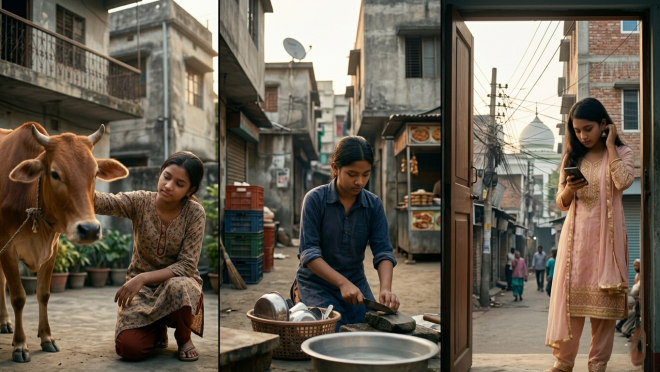
A few weeks before Eid al-Adha, something shifts in the households of Bangladesh. The men get restless. Fathers check their savings accounts. Teenage boys begin making daily visits to the local haat with empty pockets but immense confidence, bargaining fiercely over animals they cannot yet afford, then they return home to announce that they have found the one. The perfect cow. The right goat. The deal that cannot wait.
And then, somehow, the animal arrives. It is tied in the garage and streetside. For boys and men, the haat is the beginning of a weeks-long preparation of Eid al-Adha.
The girls in these same households receive the news of the arriving animal quite differently. In every Eid al-Adha you will find three kinds of daughters, and the distance between them is wider than it first appears.
The first falls for the animal immediately. She gives the cow a name, Lali. She brings it grass with her own hands, checks on it before school, photographs it every now and then. By the time Eid morning arrives, she is inconsolable, weeping quietly in her room, refusing to eat meat on Eid. She loved Lali, and she is now required to make peace with what it was always meant to be. The grief is genuine. She feels it every year.
The second daughter is the one in the bloodstained kameez. She is less emotionally attached to Lali. Her preparation happened elsewhere, in the sharpening of blades and the arranging of cutting boards. On Eid morning, she does not reach for eyeliner. She reaches for her oldest clothes. She starts planning meat cutting with the calm authority of someone who has been mentally running through this for days. This, for her, is the best part of Eid al-Adha.
And then there is the third daughter. She is not grieving. She is not sharpening anything. She slept well the night before, woke up at a reasonable hour, and is now standing in front of her mirror with foundation and a new dress, completely unbothered. To her, Eid al-Adha is Eid, full stop. The occasion calls for photographs, for good food and good family gathering. The qurbani does not concern her. She is not heartless — she has simply made a clean partition in her mind between the ritual and herself. She will post her Eid selfies, she will eat the meat at dinner, and she will have a genuinely lovely day. The cow’s arrival and departure are, to her, logistical facts she sees no reason to be emotional about in either direction.
All three of these daughters are, in every sense, Papa ki pari. Precious. Raised in the same house, eating at the same table. One chose softness, one chose participation, one chose distance, but all of them were choosing freely. The festival, the kitchen, the workload, all of it was still, for each of them, a matter of preference.
Marriage changes this entirely.
Nobody announces it. There is no specific moment where someone sits a new bride down and explains what Eid al-Adha will now require of her. It simply becomes clear when, in the first year, things are handed to her without being asked. The basin of meat that appears at her feet. The older women of the house are already in motion around her, their eyes occasionally sliding towards her to see whether she is keeping up. The unspoken understanding that standing to the side is no longer an available option.
For the daughter who used to weep over Lali, this part is almost easier. She has always felt the weight of the day. She already knew that Eid al-Adha carried something serious inside it. What changes is only that the weight is now hers to carry in a more practical sense: the washing, the separating, the long hours of sorting meat that will feed people who are, for now, still strangers to her. She does it with the same tenderness she once gave Lali. It is grief redirected into labour, and she is not unfamiliar with either.
For the daughter who loved the knife, the shift is subtler and, in some ways, harder. She was good at this. She chose it, she enjoyed it, she was proud of the precision she brought to the work. But there is a particular kind of exhaustion that comes from doing something you once loved freely and now do because it is expected of you. The knife is the same knife. The work is the same. And yet something in it has changed: not the task, but the terms under which she performs it. What was once a hobby is now a duty, and the distance between those two words is longer than it looks.
And then there is the third daughter, the one who never thought any of this concerned her. She is the one for whom marriage is the most disorienting. She has, her entire life, been the daughter who wore the new dress and took the photographs and left qurbani to the people who wanted to be in it. She has never touched raw meat. The smell of it, the texture of it, the sheer intimacy of separating it by hand — none of this was ever part of her world, and she had no reason to believe it would become part of her world. And then it did. Not because she changed her mind. Not because she developed a new interest. But because she moved into a different house, and in that house, on Eid al-Adha, this is simply what the women do.
And for all three of them, over years and Eids, it stops feeling foreign. They develop their own rhythm, their own way of working.
What marriage does, in the end, is collapse the distance between the three daughters. The one who felt everything, the one who did everything, and the one who stood apart from everything — they all arrive at the same kitchen, the same basin, the same long Eid afternoon.
Somewhere between those three, every girl misses her father’s home a little harder on this very day. And quietly, somewhere in all of this, a girl is calmly transformed into the world of women and responsibilities.