Research, resilience and a fully funded scholarship: Zubayer's journey to Universiti Malaya
When it comes to postgraduate fully funded scholarships, the Malaysia International Scholarship (MIS) is one of the most prestigious.
Research, resilience and a fully funded scholarship: Zubayer's journey to Universiti Malaya
When it comes to postgraduate fully funded scholarships, the Malaysia International Scholarship (MIS) is one of the most prestigious.
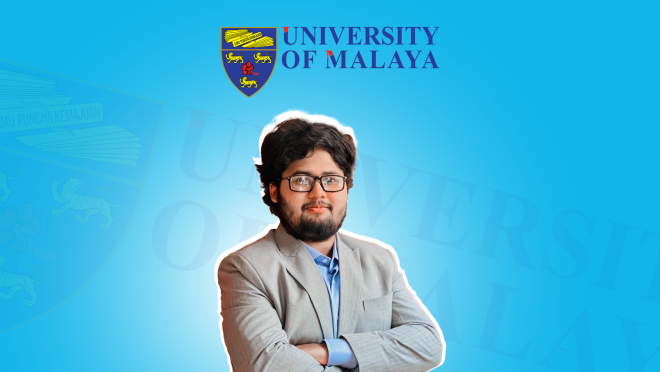
Chowdhury Zubayer Bin Zahid is an MIS recipient and a master’s student at Universiti Malaya, doing research in concrete science. His story is all about starting early, staying focused, and actually building things instead of just preparing to build them later.
Zubayer chose IUT because it was the best option he had compared to other universities. He saw that IUT has a good standing in Bangladesh in terms of academic reputation, campus life, and alumni network.
But the university name only helps if you make proper use of it.
“The university name will not give an advantage unless one is motivated by oneself,” he said. “It solely depends on how you see your future and approach it.”
Studying at a prestigious university is a blessing only if you do the hard work yourself. IUT did give him a good environment, but he had to do all the work that helped him get the scholarship.
On extracurricular activities
When it comes to extracurriculars, Zubayer tried building activities that actually mattered to him. In his third year, he founded and became President of the ACI IUT Student Chapter. He did it because it was directly connected to the research he wanted to do later.
“The ECA was directly related to my higher studies application because we used to work in the same field where I’m interested in doing future research,” he mentions.
He followed the same strategy with his international competitions. He did not do checkbox activities. His activities were more like extensions of what he was already thinking about.
However, that did have a cost.
“To balance all these alongside my engineering studies did make me struggle,” he admits. “Sometimes, I also used to burn out.”
But things worked out for him because he got back up.
“However, the motivation and determination to strive for excellence made me follow the same path after waking up the next morning.”
The COVID period
In his fourth year, he had to choose an undergraduate research topic, and Zubayer wanted to do lab-based research in this field. But because of COVID, universities were closed, and so he could not access the lab facilities. Therefore, he had to go for a computer-based topic instead.
But he made the decision to publish anyway.
“I realised the importance of publication since I wanted to apply for higher studies,” he mentions.
So, he published his thesis and another work from an international competition in an international conference immediately after graduation.
If you take some time to analyse, while most of his classmates were probably still figuring out what their next step would be, Zubayer was already building the profile he would need for a scholarship application.
Post-graduation period
Zubayer started receiving job offers from construction companies after graduation. He rejected those and went back to IUT and started working in the lab, even without payment at first.
“I was determined to pursue research and higher studies. Therefore, I decided not to join any industry job; I continued working in the lab with my undergraduate supervisor without any payment. Later on, I joined as a paid Research Assistant when the position was available under a seed grant from my supervisor.”
He spent his days working in the lab from morning to afternoon, and at night, he was teaching himself how to write academic papers. He did not learn from any textbook or course; he learnt it by reading published papers in his field.
Basically, he was building a research profile piece by piece. Three distinct research streams in concrete science, each helping him move closer to something that looked exactly like a scholarship application.
Publication and experience
A major part of publishing work is dealing with rejections. Zubayer could not avoid them. He faced rejections and tough feedback. But he handled them by preparing himself beforehand.
“Actually, I used to learn a lot from online resources and YouTube videos. So many of these things came naturally to me. Since I was aware of them beforehand, I could handle and learn very easily.”
The Malaysia International Scholarship was Zubayer’s goal for a while. But the timing was quite uncertain. When it was time to apply, he had everything he needed ready.
“It was the plan all along. However, I was not certain when the opportunity would come. Surely, my research, international conference presentations, and awards helped in getting the Malaysia International Scholarship.”
Zubayer joined the World University of Bangladesh as a lecturer in 2025. This was even before getting his master’s degree.
“I had already finished most of the formalities of my master’s at that time. So I could show that I could submit my certificates when it was finished.”
Now, what actually got him the job?
“I think my research publications had the biggest impact on getting the job. In short, I can advise students to focus on these three aspects: their CGPA, research publications, and awards related to academia.”
The research proposal
The scholarship is a fully funded one.
“The MIS generally covers the whole tuition fee and a living stipend of RM 1,500 for two years of study for a master’s and three years for a PhD. Mostly, a single candidate can cover all expenses under the scholarship, except for the flight tickets.”
Zubayer found his supervisor by looking at the UM website. He searched for professors whose research interests matched his own and then sent an email asking to meet and discuss their research interests.
Zubayer did not simply come up with his own research proposal without preparation. He discussed it with his potential supervisor first and refined it based on their feedback.
“The research proposal generally includes an introduction, a literature review, a detailed methodology, objectives, potential outcomes, and references.”
Interview process
The MIS screening happens in two stages. In the first stage, they evaluate the applications. Then they shortlist the top candidates for an interview with panels of professors in their field. Zubayer heard back two to three months after submitting his application.
“In MIS, the screening is normally in two stages. After submission of the application online, they would select the top candidates for an online interview with the panel members, which consist of professors in the field you will be applying to. Based on the interview performance, the MIS is awarded to the finally selected candidates. Those who are selected for the interview are generally asked to present their research proposal during the interview through a PowerPoint presentation.”
In the application, accuracy and proof are important. Do not claim something without documentation to support it.
“The whole application information should be accurate and backed by documentation. Applications that contain overly general information are considered weak applications.”
Life at Universiti Malaya
After being accepted, there comes the visa process. It goes through EMGS.
“The visa process for Malaysia is very straightforward,” he says.
When asked what it is actually like at Universiti Malaya, Zubayer replies:
“For me, I found it very engaging in terms of research. I was surrounded by people who were also serious about research, which helped me learn a lot and boosted my confidence. The campus culture is very festive, and the research community was diverse, as I had people from several countries in my research group.”
Zubayer mentions that his supervisor is busy, so they do not meet all the time. However, they stay connected through WhatsApp and email regarding research updates. So, it is not like someone is holding your hand the whole time.
He also mentions international collaborations and conferences. They are available. You have to look for them and discuss them with your supervisor. But the opportunities are there.
The advice
If you are an engineering undergraduate right now and thinking about doing something like Zubayer, he has some advice for you:
“I would say to start early and stay focused on what you want to do. Try to make your decisions early, whether you want to go into industry, a government job, or academia. Then plan and prepare according to your goal.”
And if we are talking about a year-by-year breakdown of things students should do, undergraduate students should reach out to professors whose research interests match theirs. This does not have to happen in the final year. It can happen at any time.
“They can reach out to the professors in their respective departments whose research or area of work aligns with their interests. This can happen at any time; one does not have to wait until the final year of study. They can reach out to professors, seniors, or even alumni who can guide them to start their journey.”
Now, we have been talking only about the academic pathway. For people interested in pursuing the industry path, the journey is going to be a bit different. Academic performance and CGPA are important for scholarships, but that is not all.
“For the job route, they should consider gaining the skills needed for the type of job they are targeting. Suppose someone is aiming for corporate jobs; they might focus on case study competitions, leadership programmes offered by various companies, networking, etc.,” Zubayer mentions.
The main thing is to choose what you want and plan your path accordingly.
Apart from the educational advice, if a Bangladeshi engineering student is reading this now, Zubayer has three things to say:
“Three pieces of advice: Believe in Allah, have patience, and work hard.”
His low CGPA and how he handled it
Zubayer’s undergraduate CGPA was not high, and that did cause him pain.
“The single hardest moment in my academic journey so far was having a low CGPA in my undergraduate studies, yet securing a fully funded scholarship,” he said.
But how did he get past it?
By proving himself through other things.
“I pushed through it with research experience, publications, and international awards.”
When one of your metrics is weak, other metrics need to be strong. If you have a low CGPA, your publications need to be strong, your awards need to compensate for it, and your research needs to prove your worth. So, even if you have a low CGPA, it is not over. Working on other metrics can certainly help.
Future plans
Zubayer is planning for a PhD but does not have a location fixed in mind.
“However, the location depends on the options available when I start applying and getting offers. Priority will be given based on research interest alignment with the supervisor and university ranking.”
We asked him if he plans to return to Bangladesh, and he was honest about the uncertainty.
“At this moment, I cannot say what the future holds. However, I see my research career unfolding internationally. It does not matter much whether it happens by staying in Bangladesh or abroad.”
What he wishes he had known earlier
When asked what he wishes someone had told him in his second or third year of undergraduate study, he does not really talk about study strategies or scholarship hacks.
He says:
“Do not follow people and their trends; follow your heart, enjoy life.”
Zubayer’s journey from an undergraduate student to a lecturer and then to a fully funded master’s student in Malaysia is proof that no matter which university you study at, what CGPA you got, or what your odds are, there is always a way to strengthen other aspects of your profile and achieve your dreams. You just have to be patient, work hard, and believe in God.
This article is written in partnership with Abroadmates, the all-in-one mentorship platform for study abroad.
To know more about the MIS Scholarship, book a session at https://www.abroadmates.com/chowdhury-zubayer-bin-zahid