Real fans vs seasonal fans: A debate that returns every four years
There is no official definition to determine who qualifies as a ‘real fan’. However, real fans claim that they are the ones who follow football throughout the year—not just during the World Cup—and know the history, geography, and culture of the game inside out
Real fans vs seasonal fans: A debate that returns every four years
There is no official definition to determine who qualifies as a ‘real fan’. However, real fans claim that they are the ones who follow football throughout the year—not just during the World Cup—and know the history, geography, and culture of the game inside out
Whenever the FIFA World Cup arrives, excitement spreads everywhere. Some support Brazil, some Argentina, while others cheer for Germany, Spain, or France. They wear their favourite teams’ jerseys and put up flags on walls, balconies, and rooftops.
Tea stalls host football debates, and Facebook feeds are flooded with opinions and discussions about the game. This passion and excitement make the greatest show on earth feel so special.
However, it is not always peaceful. The tournament often leads to arguments and even fights. News headlines regularly report quarrels in one area and clashes in another, all because of football rivalries.
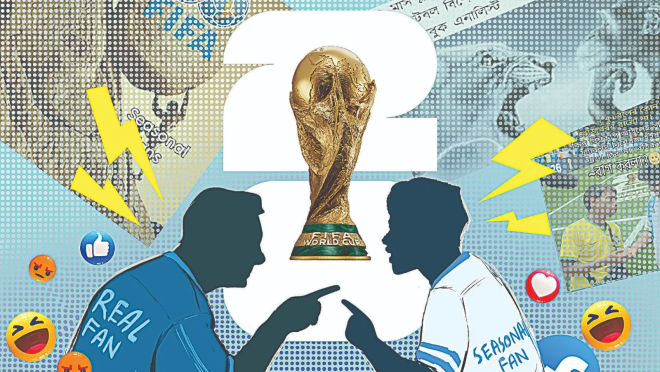
Arguments over football teams are nothing new. But another debate also takes centre stage during the World Cup. On social media, a battle begins between “seasonal fans” and “real fans.”
There is no official definition to determine who qualifies as a ‘real fan’. Yet the argument returns every four years, along with the World Cup itself.
So who are these “real football fans”? They claim that they are the ones who follow football throughout the year, not just during the World Cup. They know the history, geography, and culture of the game inside out. They can discuss a manager’s tactics, analyse a player’s style of play, and tell you which footballer is likely to move to which club during the next transfer window.
After staying awake all night to watch the Champions League, they turn up to class or work the next morning and still manage to deliver a detailed match analysis. In short, these are the fans who treat watching football almost like an art form and who proudly consider themselves the game’s true supporters.
As soon as the World Cup begins, these “real fans” start to feel a little insecure. They know that the “seasonal fans” are about to arrive.
People who have not posted a single thing about football for the past four years suddenly change their profile pictures and appear in Argentina or Brazil shirts. Some even dare to make match predictions like professional analysts.
This is where the teasing begins. Real fans flood social media with posts, jokes, and memes aimed at seasonal supporters. Arguments often start with questions such as, “Do you even know what offside is?”
Some proud real fans even jokingly offer courses to help seasonal fans memorise the names of players on their favourite teams. Others share guides on Facebook explaining how to identify a seasonal fan.
According to one popular stereotype, a seasonal fan is someone who refuses to admit that their team is playing badly, no matter how poor the performance. They believe their favourite player is the best in the world, with no equal. In short, once the World Cup arrives, the battle is not just between teams on the pitch but also between real fans and seasonal fans online.
Some people become so irritated by the presence of seasonal fans that they can hardly contain their frustration. One self-proclaimed real fan wrote on Facebook: “Do you know who seasonal football fans are? You never see them when club football is on. They do not watch the Champions League, domestic leagues, or the Copa Libertadores. But as soon as the FIFA World Cup, Copa América, or the Euros come around, they suddenly turn into football experts.”
“The funniest part is that they spend more time arguing than actually understanding the game,” the post continued. “After watching a single match, they talk as if they have mastered the entire history of football. If a player has one poor match, they call him overrated; if he has one good match, they start calling him the greatest of all time.”
However, the so-called seasonal fans are not without a response. They too take to social media to mock those who see themselves as football experts. “Do these people who claim to be real fans get paid by their teams?” they ask. Others respond with a different question: “Do you need a PhD to watch football?” For them, football is meant to be enjoyed, not treated as an academic qualification.
The jokes do not stop there. On social media, people often tease that real fans receive a monthly ration from FIFA. Some have even gone so far as to create a mock list of supplies supposedly allocated to Bangladesh’s most dedicated football supporters. The fictional package includes coffee, sugar, puffed rice, spicy snack mix, biscuits, earplugs, a body pillow, and a few other tongue-in-cheek items.
Others have taken the humour a step further by sharing guides on how seasonal fans can deliberately annoy self-proclaimed football purists. One Facebook user, Zakaria Tasrik, posted a list of suggestions ahead of the World Cup. Among them were calling a striker a “centre-forward,” insisting that a 4-4-2 formation should actually be written as 1-4-4-2 because a team has 11 players, and inventing one’s own explanation of the offside rule whenever the topic comes up.
The list continued in a similarly playful tone. Readers were advised to use football terms such as “through ball,” “long pass,” and “ground pass” as often as possible; declare that Roberto Carlos is the greatest footballer of all time whenever the Messi-versus-Ronaldo debate appears; praise transfer journalist Fabrizio Romano as the best coach in football; question why centre-backs do not play further forward; and ask why a goalkeeper did not rush out during a one-on-one situation. The humour reflects how the World Cup has become about more than football itself; it is also a season for memes, banter, and endless online arguments.
Many football supporters may not spend the entire year talking about the sport or filling Facebook with match predictions. But when the World Cup arrives, everything changes. They throw themselves into the excitement, backing their favourite teams and joining the celebrations. In the eyes of many, these fans are the very lifeblood of the World Cup.
As one Facebook user, Omar Sharif Raihan, put it, “I do not think being a seasonal fan is a bad thing. Not everyone has the same lifestyle, schedule, or interests. Some people follow football all year round, while others only support their favourite team during major tournaments. In the end, football is about enjoyment and emotion.”
Perhaps that is why the debate never really has a winner. While self-proclaimed real fans and seasonal fans continue their annual online battles, the World Cup itself thrives on both. One group brings year-round dedication, while the other brings fresh enthusiasm. Together, they help create the unique atmosphere that makes the tournament a global celebration.
Yet despite all the arguments over who qualifies as a real fan, there is often little difference when it comes to celebrating a victory. One supporter may watch the English Premier League all year round, while another may only tune in once every four years for the World Cup. But when their favourite team goes to a penalty shootout, both feel their hearts racing. When a clear chance is missed, both put their heads in their hands. And when the winning goal goes in, both celebrate with the same joy.
Perhaps that is the true beauty of football. It has a unique ability to bring people together through a shared emotion. The playful rivalry between seasonal fans and self-proclaimed football experts has itself become part of the World Cup experience. One loves football as a year-round passion; the other embraces it as a festival. But love for the game is all the same.
After all, when a goal is scored on a World Cup night and a roar erupts from the house next door, there is no way of knowing whether it came from a die-hard football purist analysing tactics every weekend, or from a seasonal supporter who has fallen in love with the game all over again after four years.