BRAC launches 3 experiential learning boats with robotics, digital learning facilities
BRAC has added three new thematic boats to its Experiential Learning Boat fleet, expanding opportunities for children in remote river erosion-prone and haor areas to learn about the environment, digital technology and history through hands-on activities.
BRAC launches 3 experiential learning boats with robotics, digital learning facilities
BRAC has added three new thematic boats to its Experiential Learning Boat fleet, expanding opportunities for children in remote river erosion-prone and haor areas to learn about the environment, digital technology and history through hands-on activities.
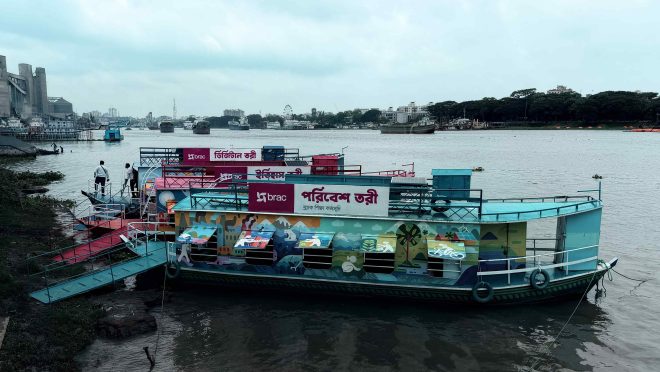
With the latest additions, the total number of Experiential Learning Boats now stands at six. The floating learning spaces aim to bring play-based and practical learning experiences to children in riverine communities, many of whom have limited exposure to such technologies and educational tools.
The new boats were inaugurated on Monday, 15 June, 2026, at the Kadam Rasul Dargah grounds in Narayanganj by BRAC Executive Director Asif Saleh.
The activities and learning materials on the boats have been designed mainly for primary school children, although learners of all ages and visitors can also take part in the activities.
Speaking at the event, Asif Saleh said memorisation-based learning may help students pass examinations, but it does not equip them to solve real-life problems.
He said one of the major shortcomings of the education system is the lack of a clear connection between classroom learning and its practical application in everyday life.
Bangladesh faces many challenges but has too few problem-solvers, he said.
“I want students to grow into capable individuals who can address the challenges of the future. Preparing for tomorrow requires more than memorising information; it demands the ability to apply science and technology and to solve real-world problems,” Asif said.
He said the primary objective of the Experiential Learning Boats is to give children first-hand experiences that bring to life the concepts they read about in books or encounter through news and online platforms.
The boats will travel across the country, creating opportunities for students to learn, explore and understand through active participation, he added.
Safi Rahman Khan, Director of BRAC’s Education, Skills Development and Migration Programme, said the boats are more than educational tools for BRAC. They are spaces that expand children’s imagination and introduce them to worlds and experiences they might otherwise never encounter.
Niveen Reza, Head of Social Enterprises at the BRAC Education Programme, said the boats often serve as a first introduction to archaeology, robotics, environmental simulations, augmented reality, virtual reality, interactive storytelling and hands-on scientific exploration for children living in haor and riverine areas.
Shibani Sarkar, Upazila Nirbahi Officer of Bandar Upazila in Narayanganj; Md Abdul Kium Khan, Upazila Secondary Education Officer; and Md Azmal Hossen, Upazila Primary Education Officer, were also present at the inauguration. They toured the boats and observed the learning activities.
In 2011, BRAC introduced boat schools in the flood-prone north-eastern region of the country to ensure uninterrupted learning. After the initiative concluded, several boats remained in operation.
As part of BRAC’s 50th anniversary celebrations, the BRAC Education Programme began transforming these boats into spaces for play-based and experiential learning, leading to the launch of the Experiential Learning Boats initiative.
The first three boats focused on science, mathematics and values-based education.
Among the newly launched boats, the Environment Boat addresses one of the most pressing realities facing children in Bangladesh: climate change. Designed as a floating environmental learning centre, it helps children learn about environmental awareness, sustainable lifestyles, biodiversity, pollution, waste management, ecosystem balance and environmental responsibility.
The Digital Boat introduces children in riverine areas to technologies they may not have experienced before. On board, children can take part in activities involving augmented reality, virtual reality, robotics and interactive digital learning.
The History Boat offers six learning activities, including archaeology-inspired exploration, simulated excavation experiences, story-based installations, visual narratives and map-based discovery exercises. These are designed to help children connect with Bangladesh’s history and heritage in engaging ways.
Travelling along waterways from Bhola to Sunamganj, the initiative has so far brought experiential learning opportunities to 77 locations across 16 districts.
To date, 79,185 students have participated in learning activities through the boats, while 462 female volunteers have received training.
For many children, learning through science, mathematics, values, history, environmental studies and digital technology has been an entirely new experience.
Each boat usually remains in a community for seven to ten days and is open daily from 10am to 4pm.
In addition to children, teachers, parents and local residents can also participate. Special ramps have been installed to ensure access for children and people with disabilities.
BRAC said the Experiential Learning Boats are not merely an entertainment initiative, but an effort to address several challenges in Bangladesh’s education system, including the climate crisis, educational inequality, limited exposure to diverse learning experiences, rote-based teaching methods and unequal access to opportunities.
For BRAC, the boats represent a future in which rivers are no longer barriers, but pathways to learning and possibility.