Where the land disappears, one girl rewrites what’s possible
From a remote char in Gaibandha, Nurunnahar made it to France through Friendship’s ISCP programme, and exchanged ideas with European students on weather patterns, food systems, culture, and environmental challenges
Where the land disappears, one girl rewrites what’s possible
From a remote char in Gaibandha, Nurunnahar made it to France through Friendship’s ISCP programme, and exchanged ideas with European students on weather patterns, food systems, culture, and environmental challenges
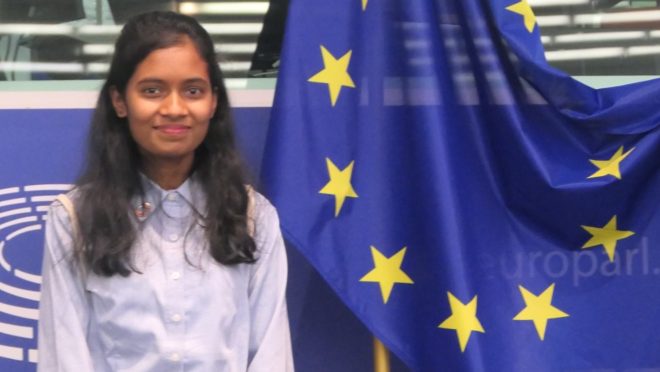
Nurunnahar Khatun was born in Erendabari, a low-lying, river-carved island in Gaibandha where the Jamuna does not merely flow past but governs everything, taking land, defining lives, and testing the resilience of anyone who dares to stay rooted.
Nurunnahar was raised there and shaped by that river. Currently she is studying at the Asian University for Women (AUW) in Chattogram, on a full scholarship.
“Growing up in the char was both beautiful and challenging,” Nurunnahar says.
Rivers on every side, open skies, green fields, and a community held together by unity and care. Quality education, transportation, and healthcare were either distant or absent. Seasonal floods were not weather events, they were life events.
The Jamuna swallowed portions of the community whole over the years, taking homes and livelihoods with it. “It was painful to see people lose their homes,” she says, “but it also showed us how strong and resilient our people are.”
Nurunnahar’s family of four shaped her just as durably. It is her father she returns to most often when speaking about motivation. “My father has always been my greatest source of inspiration and my hero,” she says. “When I look into his eyes, I can see the dreams and expectations he has for me.” In a community where daughters were routinely married off before sixteen, her father’s eyes hold dreams for his girl.
Beacon of hope
Before Friendship School arrived in the area, the educational landscape for children in the char was bleak. “There were only two government primary schools,” Nurunnahar recalls.
“There was no secondary school nearby, and the nearest high school was very far away.” The pattern that followed was predictable. The girls finished Class 5 and got married. Boys fared only marginally better.
Nurunnahar herself attended the Friendship school from Class 1 through Class 8. When she completed Class 8 and dreamed of studying science, aspiring to become a doctor, the absence of a science stream in her area threatened to shatter those ambitions. The nearest school offering the required curriculum was far away and provided a weak academic foundation.
It was at this moment that Friendship intervened as a beacon of hope.
Friendship worked for decades in Bangladesh’s most geographically isolated communities, particularly the chars and haors. In Erendabari and surrounding areas, its schools did not simply fill an educational gap, they recalibrated what was possible for an entire generation.
Nurunnahar’s teachers at Friendship Secondary School, where she enrolled for Class 9, guided her away from the impulse to chase a distant science curriculum and said that her future depended on her commitment, not on a particular academic track.
“They helped me understand that success depends on dedication and hard work, not only on a specific academic background,” she recalls. Her father trusted their counsel. She stayed.
That decision changed everything.
In 2021, Nurunnahar was selected for Friendship’s Inter-School Connectivity Project, known as ISCP, a programme that connected students from Bangladesh with peers in France and Luxembourg for collaborative work on climate issues.
For a girl from a char who had rarely been beyond her district, the experience was disorienting in the best possible way. She exchanged videos, presentations and ideas with European students, discussing weather patterns, food systems, culture and environmental challenges. Abstract concepts from textbooks began to acquire texture and urgency.
“Before joining these programmes, I knew about climate change mainly from textbooks and news reports,” she says. What the ISCP gave her was something textbooks cannot: the lived perspectives of young people from countries where climate policy is a daily public conversation, filtered through the experience of someone who had already watched a river consume her community.
Standing in France
In 2023, the arc of that journey reached a point she had never imagined. Nurunnahar was selected, through Friendship, to participate in the European Youth Event organised by the European Parliament in Strasbourg.
“The day I received the news, I was overwhelmed with joy,” she says. She could not believe it was real.
She describes the moment she told her father. He was so overwhelmed that he could hardly express it in words. That image, a man standing in a char in Gaibandha, barely able to speak because his daughter was going to Europe to speak at a parliament, carries more weight than any statistic about rural education outcomes.
In France, she sat in rooms with young people from across the continent and spoke about climate change, youth empowerment and the realities of living in a riverine, flood-prone community. “I felt that my voice mattered,” she says, “and that I could contribute meaningfully in global conversations.” She returned home with a broadened worldview, new friendships and a confidence she had not possessed when she left.
Friendship’s Career Guidance Cell, which supports students in navigating higher education decisions, was a constant through all of this. “Whenever I faced an academic decision or felt unsure about my next step, I reached out to them, and they always provided thoughtful advice and practical solutions,” Nurunnahar acknowledges.
Getting into a global university
Eventually, Nurunnahar sat for the independent admission test at the Asian University for Women (AUW) and secured a full scholarship. AUW is a residential university with students from different countries, and adjusting to life there was not easy.
Living away from her family, adapting to a new academic environment, and learning to make decisions on her own came with challenges. But the experience also helped her grow. She became more confident, developed stronger critical thinking skills, and learned to understand different perspectives.
Her goals have sharpened accordingly. She wants to complete her undergraduate degree, pursue a master’s abroad, and build a career in international organisations working on climate issues. She is clear-eyed about the distance between where she started and where she intends to go, and that distance no longer frightens her.
To girls still growing up in chars and remote communities, she has a message that she has earned the right to deliver. “Your background does not define your future,” she says. “With education, determination, and the right support, you can achieve even the dreams that once felt impossible.”