The student who built his own finance app because nothing else worked
Akhlak Hossain Jim is a Computer Science student and independent app developer from Bangladesh. Alongside his studies, he has spent years building web and mobile applications with one consistent goal: solving problems that actually exist in people’s daily lives. His focus areas are financial technology, productivity, and user-centred design. He works alone, learns mostly on his own, and builds things because he needs them.
The student who built his own finance app because nothing else worked
Akhlak Hossain Jim is a Computer Science student and independent app developer from Bangladesh. Alongside his studies, he has spent years building web and mobile applications with one consistent goal: solving problems that actually exist in people’s daily lives. His focus areas are financial technology, productivity, and user-centred design. He works alone, learns mostly on his own, and builds things because he needs them.
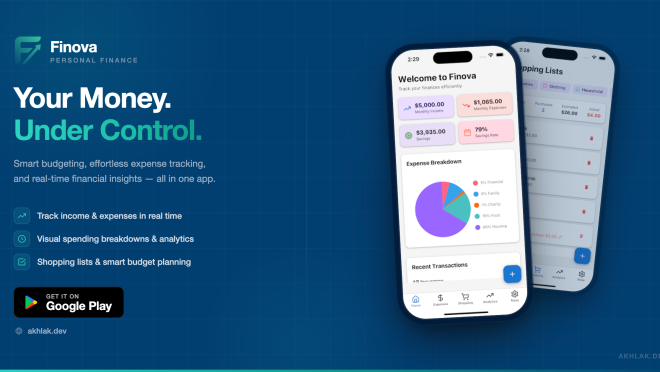
Finova, his personal finance app currently available on the Google Play Store, is the clearest example of that approach. It has over 1000 downloads, reaching users in countries outside Bangladesh as well. Jim did not build it to launch a startup or impress anyone. He built it because nothing else was doing the job.
The problem with existing apps
Open the Play Store and search for finance apps. You will find hundreds. Jim did the same thing and came away unsatisfied. Most of what he found was built for a different kind of user in a different kind of economy. The financial habits of students, freelancers, and families in Bangladesh, he felt, were simply not reflected in what was available.
“Most finance apps on the Play Store were designed for a very different lifestyle and financial structure than what we experience in Bangladesh,” he says.
The evidence was right in front of him. Most people he knew were still tracking expenses in Excel sheets or writing things down on paper. That, in his view, was not a personal failure on their part. It was a signal that the apps available were not practical enough to replace those habits. They were either too complex or built around assumptions that did not match local reality.
The way money moves between people here is different. Friendly loans between friends are common. Many people earn from freelance work, which means income is irregular. Families often manage finances together rather than as separate individuals. Most apps flatten all of this into a simple list of transactions. That is not how it actually works.
Building for himself first
Jim did not set out to build a product for the market. He set out to solve his own problem as a student and young professional trying to keep track of expenses, savings, and dues in one place.
But during development, he started noticing something. The struggles he was solving for himself kept showing up in the lives of the people around him too: students managing tight budgets, freelancers with uneven cash flow, families trying to coordinate spending. The problems were different on the surface but similar underneath.
So the app grew. It moved from something built for one person to something designed for a wider group, while staying simple enough for anyone to pick up and use.
He describes the goal of Finova not just as expense tracking, but as giving users genuine financial peace of mind. His view is that most financial stress does not come from having too little money. It comes from uncertainty: not knowing where money went, forgetting due payments, or having no clear picture of what comes next. Clarity alone, he believes, can change how people feel about their finances.
A student building on his own
Jim does not treat development and studying as two separate things pulling in opposite directions. For him, coding is both a profession and a personal interest. Building Finova alongside his Computer Science degree did not create burnout because the work felt meaningful and connected to real life. Fixing a bug in the app felt more relevant than solving a textbook problem.
Most of the technical knowledge behind Finova came not from lectures but from self-teaching: documentation, tutorials, experimentation, and years of personal practice. His academic background gave him a foundation in structured thinking and problem-solving, but the practical work was largely self-directed.
That independence extended into the harder moments too. There were stretches where bugs piled up, performance issues slowed him down, and maintaining momentum over a long period felt difficult. What kept him going was simple: he was building something he personally needed. Most of the updates came about because he needed that feature himself. When you are your own user, stopping does not make much sense.
What makes Finova different
Jim is deliberate about the design choices in Finova. Rather than building a list of features and calling it a finance app, he tried to reflect how financial life actually works.
One example he gives is grocery shopping. Most people doing their weekly shopping switch back and forth between a shopping list and a finance tracker. Finova tries to bring those together into one experience. Similarly, the app treats a friendly loan between two friends differently from a bank loan, because in practice they are handled differently. Freelance income behaves differently from a salary. The app tries to reflect those real differences.
He also pushed back against the common approach of generating feature ideas from trends or templates. The ideas in Finova came from his own lived experience, which he believes made the product more grounded and practical.
On security, he was careful even as a solo developer. Financial data is sensitive, and he built around secure authentication and limited data collection, giving users as much control over their own information as possible.
Going global, staying local
One of the more surprising outcomes of releasing Finova has been its international reach. The app includes multi-currency support, which made it accessible across different regions. Jim did not expect users from so many countries to find it useful, or that some of them would engage with the app more actively than he does himself.
Building that multi-currency system was one of the more complex parts of development. Currency formatting, calculation logic, and how financial data is presented all vary between regions. Making the app feel local and accurate to a user regardless of where they are requires careful planning and a lot of testing.
The iOS version is technically ready but not yet released. Publishing on the Apple App Store requires an annual developer fee of around 100 USD, which is a real barrier for an independent student developer.
There are also limitations specific to Bangladesh around payment and verification systems that make the App Store harder to access. Jim hopes to release it in the future but acknowledges these are genuine obstacles.
What comes next
Future updates for Finova will focus on two areas. The first is accessibility, making the app easier for senior citizens and people who are not comfortable with technology. Jim is exploring AI-powered features that would reduce the amount of manual input needed, which would benefit older users especially.
The second is family collaboration. He wants to build tools that let parents and family members manage finances together and help younger family members develop better financial habits early.
When asked what advice he would give to other students sitting on a good idea but feeling unprepared, Jim keeps it short.
“Start small, start imperfectly, and keep improving,” he says. “Your app may crash, your design may fail, or your Play Store submission may get rejected multiple times. That is completely normal. The important part is continuing to build and solve real problems. Over time, those small efforts turn into something meaningful that you can proudly present to the world.”
Finova, half a year in and still growing, is proof that he means it.