Larry the Cat: The furry survivor who outlasted 6 British PMs
At around 19 years old, Larry the Cat has become something of a British institution. Officially known as the “Chief Mouser to the Cabinet Office”, he has spent more than a decade and a half at the heart of government, witnessing events that have reshaped modern Britain.
Larry the Cat: The furry survivor who outlasted 6 British PMs
At around 19 years old, Larry the Cat has become something of a British institution. Officially known as the “Chief Mouser to the Cabinet Office”, he has spent more than a decade and a half at the heart of government, witnessing events that have reshaped modern Britain.
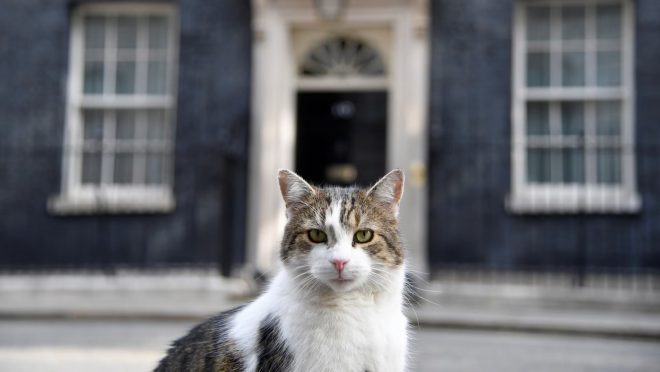
Prime ministers have fallen, governments have changed and crises have come and gone. Through it all, one resident has remained a constant presence at 10 Downing Street – Larry the Cat, Britain’s most famous feline and one of its most enduring political symbols.
On any given day outside 10 Downing Street, journalists gather behind security barriers, photographers wait for politicians and diplomats, and television crews prepare for another chapter in Britain’s fast-moving political story.
Yet one of the most anticipated appearances often has nothing to do with politics.
Instead, cameras turn towards a grey-and-white tabby cat leisurely crossing the pavement, stretching in the sun, or settling down near the famous black door of Number 10.
His name is Larry.
At around 19 years old, Larry the Cat has become something of a British institution. Officially known as the “Chief Mouser to the Cabinet Office”, he has spent more than a decade and a half at the heart of government, witnessing events that have reshaped modern Britain.
While politicians come and go, Larry remains.
A resident who outlasted six prime ministers
When Larry arrived at Downing Street in February 2011 after being adopted from Battersea Dogs & Cats Home, David Cameron was prime minister, Barack Obama was in the White House and the Brexit referendum was still years away.
His original mission was straightforward: help tackle a rodent problem around the prime minister’s residence. He was also introduced as a family pet for the Camerons.
But few could have predicted that the rescue cat would become one of the most recognisable figures in British public life.
Since moving into Downing Street, Larry has outlasted David Cameron, Theresa May, Boris Johnson, Liz Truss and Rishi Sunak. He continues his duties under Prime Minister Keir Starmer.
In a country where political careers can end abruptly, Larry’s longevity has become almost legendary.
Social media users often joke that he has survived more leadership contests than most politicians have election campaigns.
The accidental celebrity
Unlike the politicians who pass through Downing Street’s famous front door, Larry never sought public attention.
Yet attention found him anyway.
Photographers covering Westminster quickly realised that Larry had an uncanny ability to appear at exactly the right moment. Whether greeting a visiting president, interrupting a television broadcast or casually strolling through a carefully choreographed political photo opportunity, he frequently managed to steal the spotlight.
Over time, his appearances became part of the rhythm of political reporting.
For many journalists, spotting Larry has become as routine as covering a cabinet reshuffle.
His popularity eventually spread far beyond Westminster. Dedicated social media accounts track his activities, newspapers report on his encounters with other animals, and international media regularly feature stories about Britain’s most famous cat.
Life during turbulent times
Larry’s years at Downing Street have coincided with one of the most dramatic periods in recent British political history.
He has lived through the Brexit referendum, general elections, leadership crises, constitutional debates, the Covid-19 pandemic and economic turmoil.
Successive prime ministers have stood at the podium outside Number 10 to announce resignations, election victories and major policy changes. Through it all, Larry has remained largely unmoved.
Perhaps that is part of his appeal.
For many Britons, Larry represents continuity in a political landscape often defined by uncertainty.
When governments change, Larry stays.
When ministers resign, Larry stays.
When elections reshape the political map, Larry stays.
More than a mascot
Critics have occasionally questioned Larry’s effectiveness as a mouser, pointing to periods when rodents were reportedly spotted around government buildings despite his presence.
British tabloids have even joked about his habits, with some calling him “Lazy Larry” after reports suggested he spent more time sleeping than hunting.
Supporters, however, argue that his value extends well beyond pest control.
In an era when politics can often appear distant or divisive, Larry offers a rare source of light-heartedness. His presence humanises one of the world’s most powerful political addresses and provides moments of humour amid serious national debates.
Unlike many household pets, Larry does not leave Downing Street when a prime minister departs. He remains part of the official residence and continues his role regardless of which party holds power.
Few public figures can unite political opponents.
Larry somehow manages it.
Britain’s most enduring political resident
As Larry approaches his 20th year, his place in British political folklore appears secure.
He is not elected, appointed through a parliamentary process or accountable to voters. Yet he may be one of the few occupants of Downing Street whose popularity consistently transcends party lines.
His story is ultimately about more than a cat.
It is about continuity in a time of change, stability amid political turbulence and the enduring appeal of a character who asks for little more than a warm spot to nap and the occasional mouse to chase.
The next prime minister will eventually arrive at Number 10. Another cabinet will be formed. New political battles will emerge.
And if history is any guide, Larry the Cat will probably still be there – watching quietly from the doorstep, as he has done for more than 15 years.