The forgotten cartoons of Bangladesh's golden childhood
The forgotten cartoons of Bangladesh's golden childhood
During the late 1990s, 2000s, and early 2010s, television cartoons were more than just entertainment for many children growing up during that period. From waking up early in the morning and sitting in front of the television, to watching cartoons whenever there was nothing else to do, from eating food while watching cartoons to enjoying uplifting moments, we lived our childhood fully.
But over time, we gradually forgot our childhood cartoons. The more we grow up, the more we forget. Nostalgia often hits when we see a poster, when a familiar tune plays during an occasion, and especially during cosplay events.
From Sisimpur to Meena, from Thakurmar Jhuli to Montu Miah, the dialogues still murmur in our hearts.
Sisimpur
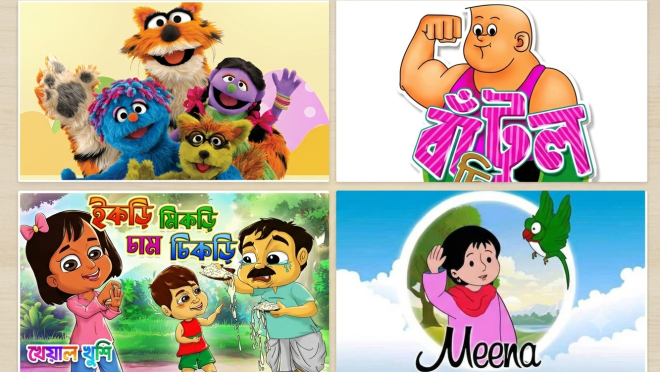
Broadcast on Bangladesh Television (BTV) from 2005, it became one of the most iconic children’s programmes. It taught us hygiene, kindness, equality, and education alongside Bangladeshi culture, villages, songs, and traditions.
Every Friday morning, even today, feels incomplete without watching Halum, Tuktuki, Shiku, Ikri Mikri, and Manik Ratan.
“চলছে গাড়ি সিসিমপুরে” was more than just a song to us; it was, and is still today, considered the anthem of children.
Meena
Broadcast on BTV from the 1990s, Meena became one of the most socially impactful cartoons in Bangladesh. Created with support from UNICEF, the show focused on girls’ education, child rights, health awareness, and equality through its main characters: Meena, Raju, and Mithu the parrot.
Some of its most memorable episodes included Too Young to Marry, Will Meena Leave School?, Say No to Dowry, and Learning Can Be Fun.
Montu Miah
Montu Miah is remembered as one of the underrated locally made Bangladeshi animated characters. Though not as widely known as Meena or Sisimpur, it created nostalgia among early Bangladeshi viewers by representing local animation efforts, reflecting Bangladeshi humour and lifestyle, and becoming a nostalgic memory for many children of the 2000s.
BTV children’s animation and puppet era
Before satellite television dominated Bangladesh, BTV aired numerous educational and cultural children’s segments featuring puppet shows, moral storytelling, folk tales, alphabet-learning cartoons, and rural cultural stories.
These programmes were often simple but emotionally memorable for children growing up in the 1990s and early 2000s.
Batul the Great
Created by the legendary cartoonist Narayan Debnath, Batul the Great became one of the most beloved Bengali comic characters to be broadcast in animated form.
This Bengali-style superhero comedy, mixed with action, strong cultural nostalgia, and unique hand-drawn aesthetics, was once an inspiration for many children.
Ikri Mikri
Though part of Sisimpur, Ikri Mikri became individually iconic among Bangladeshi children. With its funny pronunciation, curiosity-driven learning, colourful educational storytelling, and interactive questions for children, it drew widespread attention.
Many children used to copy Ikri’s voice and speaking style during their early school days.
Meena O Raju
Apart from the regular Meena series, special educational episodes and awareness campaigns were frequently broadcast on BTV. The themes included flood safety, vaccination, girls’ education, child labour awareness, hygiene, and nutrition.
These episodes became part of school awareness programmes and national campaigns.
Panchatantrer Montro, Nattu Bura, and Bangla-dubbed versions of Cinderella, Snow White, Aladdin, Arabian Nights, Ali Baba and the Forty Thieves, as well as Doraemon, also drew attention alongside our own productions.
Unlike today’s social media generation, television cartoons once created a shared national childhood experience, serving as a medium of joy and mood upliftment.
Before smartphones and streaming platforms took over our childhood, Bangla cartoons created a simpler world, one filled with innocence, imagination, and the joy of waiting for a favourite show on television, from Sisimpur’s educational songs to Meena’s social messages, and from folk tales to puppet shows.