Bangladesh wins three golds at Asia-Pacific AI Olympiad
Bangladesh wins three golds at Asia-Pacific AI Olympiad
Bangladesh has won three gold medals at the first Asia-Pacific Artificial Intelligence Olympiad, making a strong debut in one of the region’s leading competitions for young artificial intelligence talents.
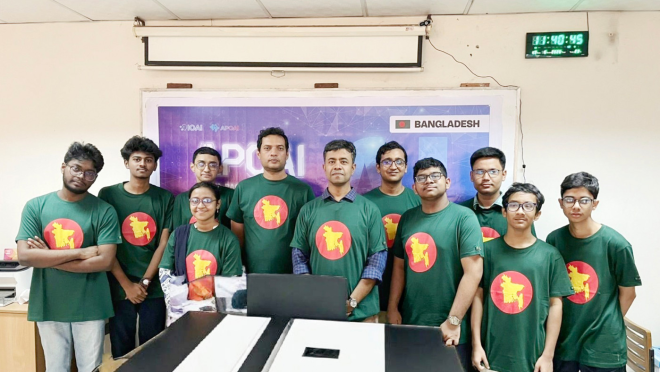
Competing against 129 contestants from 18 countries, including China, Russia, Singapore, Japan and Iran, three Bangladeshi students secured gold medals. Of the 10 gold medals awarded at the Olympiad, Bangladesh won three – the highest number by any participating country.
The gold medallists are Labib Shahriar, a Class 10 student of Homna Adarsha High School; Md Saiduzzaman Araf, a Class 11 student of Moulvibazar Government College; and Tridib Roy Arjo, a Class 11 student of Notre Dame College, Dhaka.
They ranked fourth, fifth and ninth respectively in the final standings.
Four other members of the Bangladesh team received honourable mentions. They are Nawfeel Rahman, a Class 8 student of Darus Salam Government Secondary School; Nairrah Nawar Ahmed, a Class 11 student of Ideal School and College, Motijheel; Anonyo Zarif Akand, a Class 11 student of Munnu International School and College; and Mobtasim Chowdhury Priom, a Class 11 student of Notre Dame College, Dhaka.
Another Bangladesh team member, Murtaza Abdullah, a Class 10 student of National Ideal School, also performed well throughout the competition.
The eight-member Bangladesh team joined the international contest online from the Institute of Information Technology at the University of Dhaka on 13 June, like participants from other countries, under live video proctoring and screen recording.
The six-hour competition began at noon Bangladesh time and continued until 6pm. Contestants solved four separate machine learning problems on the Bohrium platform.
The competition problems have been made open by the organising committee, and participants will be able to attempt them until 31 July.
Sharing his reaction after winning gold, Labib Shahriar said, “When I saw ‘Labib Shahriar – Gold Medal’ beside my name in the results list, for a moment I felt like the happiest person in the world.”
He said he had expected a medal because of his position during the contest, but winning gold for Bangladesh in the first edition of the Asia-Pacific Artificial Intelligence Olympiad was an extraordinary moment.
“This achievement was possible because of the combined efforts of many people. I am sincerely grateful to Bangladesh Open Source Network, the Bangladesh Artificial Intelligence Olympiad Committee and the APOAI Organising Committee for making this possible,” he said.
Gold medallist Md Saiduzzaman Araf said winning for oneself was never the biggest matter, but representing the country changed the meaning of the competition.
“When I saw ‘Gold’ beside my name and the map of Bangladesh on the official scoreboard, it felt truly special. This victory is not mine alone; it belongs to Bangladesh,” he said.
Another gold medallist, Tridib Roy Arjo, said he was delighted to win gold at the Asia-Pacific Artificial Intelligence Olympiad and proud to uphold the honour of his country.
Bangladesh Open Source Network President Munir Hasan said the achievement marked a historic moment for Bangladesh.
“No other country in the Asia-Pacific region won more than two gold medals, while our students alone secured three gold medals. This is a matter of immense pride and joy for us,” he said.
He also praised the Bangladesh Open Source Network team for successfully organising the national process despite various constraints and congratulated the winners.
Bangladesh team leader and University of Dhaka Institute of Information Technology Professor Dr BM Mainul Hossain said the result was highly encouraging.
“This is not only our achievement; it is a strong declaration of Bangladesh’s intellectual presence before the world,” he said.
He said the organisers would continue arranging artificial intelligence training and competitions for students and the next generation.
Bangladesh team coach and Daffodil International University Associate Professor Dr Mohammad Azam Khan said the result was a matter of pride for the country.
He said the achievement reflected the students’ hard work, courage, perseverance and determination to represent Bangladesh at the highest level.
“Through regional and national rounds, training camps and intensive practice, our eight talented students demonstrated extraordinary dedication and problem-solving ability. We did not merely take part in a competition; we represented the artificial intelligence and machine learning capabilities of Bangladesh’s young people on the global stage,” he said.
Bangladesh team Academic Coordinator Tasnim Mahfuz Nafis said the team’s performance was impressive across all areas of the competition.
He said the four problems in this year’s Asia-Pacific Artificial Intelligence Olympiad covered agronomy, audio processing, wildlife image analysis and chemistry.
“No matter which domain a high school or college student dreams of working in, skills in artificial intelligence and machine learning will keep them ahead, because creating new knowledge in any domain requires working with large volumes of data,” he said.
He added that students can now begin learning machine learning practically by learning basic Python and using platforms such as Kaggle – an opportunity that was not easily available even a decade ago.
The Bangladesh team was selected by the Bangladesh Open Source Network, organiser of the Bangladesh Artificial Intelligence Olympiad, after a three-month selection process and assessment at the national selection camp held from 20 to 23 May.
Bangladesh Open Source Network was the main organiser and operator of the national initiative. Bangladesh University of Business and Technology was the platinum sponsor and national round host, while Reve Chat was the powered-by partner.
Brain Station 23 was the gold sponsor, Million X Bangladesh and Creative IT were silver sponsors, Bitna was the bronze sponsor, and the Institute of Information Technology at the University of Dhaka was the knowledge partner.
Deepto TV was the television partner, while Bangladesh Science Popularisation Society, Rokomari.com and Jadu PC were among the other partners.
Organisers said the achievement has opened new possibilities for Bangladesh’s artificial intelligence and information technology sectors and will encourage school-level students to build foundational skills in artificial intelligence.