Mafia Messi: How Infantino's infant bought football (allegedly)
Mafia Messi: How Infantino's infant bought football (allegedly)
I used to believe football was a fair game. Twenty-two players, one ball, and the better team wins. Then I started watching Lionel Messi, and everything suddenly made sense. There is no way one man can keep breaking records for nearly twenty years. Talent? Hard work? Intelligence?
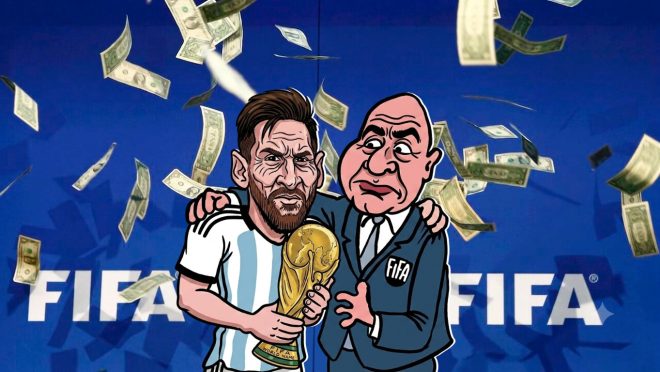
Please. The answer has been right in front of us all along. Lionel Messi didn’t become the greatest footballer ever. He simply bought FIFA.
Every morning in Zurich begins the same way. Gianni Infantino wakes up, makes a cup of coffee, and checks his phone. One message is waiting. “Good morning. I’ll come on around the 60th minute today. I’d like one free kick just outside the box. Also, remind the defenders not to tackle too cleanly.” Infantino smiles, replies with “Yes, Boss,” and another matchday script is ready.
That’s exactly what happened today. Messi came onto the pitch in the second half. Just a few minutes later, a defender committed a foul near the edge of the box. What a coincidence. The referee blew the whistle instead of ignoring it. Even more suspicious. Messi placed the ball down, took a few steps back, and curled it into the top corner, just as he has done countless times before. The goalkeeper dived. The wall jumped. The crowd exploded. Another free-kick goal. Another day of corruption.
Of course, the record books also needed updating. Messi now has the most goals from outside the box in World Cup history. He is also level with the most direct free-kick goals in World Cup history. What unbelievable timing. Imagine thinking these records happened because one player is ridiculously gifted. No, FIFA clearly bribed the laws of physics. The ball bends because gravity has been on Messi’s payroll since 2006.
Then there are the fouls. Have you noticed something strange? Whenever defenders pull Messi’s shirt, kick his ankle, or shove him from behind, referees sometimes give him a foul. Outrageous. Football used to be a contact sport. Apparently, now players aren’t even allowed to assault Messi without consequences. The corruption has become shameless.
The conspiracy doesn’t stop there. Eight Ballons d’Or. A World Cup. Two Copa Américas. Olympic gold. A Finalissima. The most assists in football history. The most Man of the Match awards. Thousands of successful dribbles. Every time Messi achieves something impossible, people don’t ask how he did it. They immediately ask how much FIFA charged him for the upgrade package.
The funniest part is that this “mafia” has survived every investigation. Different coaches. Different teammates, different referees, different tournaments, different countries, and generations of defenders who all somehow failed to stop the same little Argentine. If this really is a conspiracy, it has to be the greatest organised operation in sports history.
There is another thing I can’t forgive Messi for. He has completely ruined football debates. Remember when people argued using stats, trophies, or performances? Not anymore. Every time Messi does something ridiculous, the conversation somehow becomes about referees, FIFA, penalties, or corruption. Imagine scoring a free kick after coming on as a substitute, breaking yet another World Cup record, and instead of discussing the goal, millions of people begin searching for hidden camera angles to prove the wall jumped too early. If that’s not the work of a mafia boss, what is?
And honestly, Messi should be ashamed of himself. He has made conspiracy theories work harder than defenders. Every year, he forces people to invent a brand-new excuse. First it was Barcelona. Then Xavi and Iniesta. Then UEFA. Then FIFA. Then penalties. Then “farmers’ league.” Then “he only walks.” Now, apparently, he controls referees, gravity, and the laws of physics. At this rate, if Messi wins another trophy, people will accuse him of bribing time itself just so he can keep playing forever. And perhaps that is his greatest achievement, not the goals, not the assists, not the trophies, but making millions of people believe that an international football organisation secretly runs on the instructions of a 5’7″ Argentine with a magical left foot.
Or maybe not.
Or maybe FIFA rigged nothing at all. Maybe the referees simply called the fouls they saw. Maybe the Ballon d’Or voters voted for the player they genuinely believed was best. Maybe the World Cup was not scripted. Maybe the records are simply real. Strange theory, I know. Especially for a fanbase that has spent fifteen years treating reality like a personal insult.
That is the possibility Ronaldo fans have been avoiding since around 2011. Not because it is complicated, but because it is painfully simple. Every time Messi won something, a new excuse was born. First it was Barcelona. Then Xavi and Iniesta. Then UEFA. Then FIFA. Then penalties. Then “he only walks.” Then “farmers’ league.” Now, apparently, he controls referees, gravity, and the laws of physics. The excuse list has grown longer than Ronaldo’s trophy cabinet, which is saying something, because that cabinet is also not as full as advertised.
The uncomfortable truth is that conspiracy theories only exist when reality becomes too painful to accept. Nobody invents a global corruption network to explain an ordinary footballer. You only do that when a player keeps doing things that should not be possible, and the player you support keeps finishing second. Ronaldo fans did not create Mafia Messi because they are foolish. They created it because watching someone be naturally better than your carefully constructed, obsessively disciplined, gym-built hero is a very specific kind of pain. The machine lost to the artist. The grinder lost to the gifted. And no spreadsheet, no highlight reel, no hat-trick against Luxembourg has been able to fix that.
Somewhere in Rosario, a kid was born with a left foot that football may never see again. But he did not just rely on it. He trained through a growth hormone condition that nearly ended his career before it began. He moved to a foreign country at thirteen, alone, to chase something most people told him was unrealistic. He failed in Copa América finals and came back. He was booed by his own national team’s fans and came back.
He lost a World Cup final and came back. And then, at 35, when most players are managing their bodies and thinking about retirement, he ran more than anyone in Qatar, assisted more than anyone, and dragged Argentina to a trophy his country had been waiting forty years for. The gift was real. But so was everything behind it. He just never felt the need to tell you about it. No announcement. No brand. No campaign. He let the left foot do the talking and went home quietly, which is somehow the most infuriating thing about him.
And that, more than any Ballon d’Or, more than any World Cup, is what Ronaldo fans truly cannot forgive. Ronaldo showed his work. Every session, every sacrifice, every Instagram post at midnight in the gym. He made sure the world knew how hard he was trying. Messi never told anyone anything. He just showed up, looked slightly bored during warm-ups, and then spent ninety minutes making world-class defenders look lost. Same dedication, completely different packaging. One man needed the world to see the effort. The other made the effort invisible. And invisible effort, when it produces better results, is the most brutal thing one footballer can do to another.
Ronaldo walked away with five Ballons d’Or, zero World Cups, and the most dedicated group of cope artists the sport has ever produced. Eight to five. One World Cup to zero. No refund. No recount. No mafia. Just a man who was better. And a fanbase that will spend the rest of their lives writing essays about why that cannot be true.