Mourinho could have been a great dictator. Instead, he became a football manager
“As a civilisation, we’re lucky Mourinho didn’t go into politics”
Mourinho could have been a great dictator. Instead, he became a football manager
“As a civilisation, we’re lucky Mourinho didn’t go into politics”
Netflix docuseries Mourinho director Joe Pearlman said this about José Mourinho in a Guardian interview. I totally disagree.
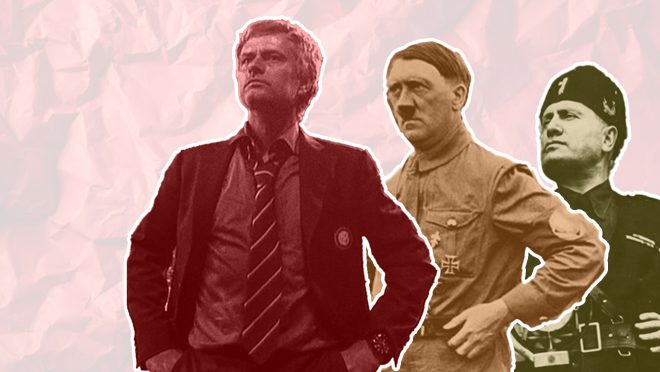
If Mourinho had chosen politics, his innate charisma, egotistical nature and the cult of personality could have made him bigger than many of the dictator-esque figures of modern politics.
Hence, if any football character deserved a documentary, it is José Mourinho.
The latest three-part Netflix limited series is structured around his first stint at Chelsea after winning the Champions League with Porto, his treble-winning time at Inter Milan, the absurd theatrics at Real Madrid and, ultimately, the man behind it all.
The series focuses on the period when the Portuguese manager was at the peak of his power. It is well edited and the historical footage used is superb. The matches capture Mourinho’s intense, physical football, so the series never gets boring.
Throughout the three episodes, his ego and larger-than-life personality are gripping.
Mourinho recounts his early stint at Barcelona, where he worked as an assistant to Bobby Robson and spent his days analysing opponents, only to be labelled by the media as a “translator”. There is clear resentment in the way he remembers it.
The Portuguese manager also cannot resist taking another subtle jibe at his old foe Pep Guardiola. “Some guys, they need a sabbatical, which is something that I hate. I hate that word,” Mourinho says. “For me, sabbatical means weakness. Don’t speak with me about sabbaticals. I never need a rest. I will have a rest when he,” he says, pointing towards the sky, “decides to say: ‘Come up.’” Classic Mourinho.
The spectrum of his personality becomes clearer as the series progresses. “There are no documentaries made about losers,” he says. It sounds absurdly arrogant. But beneath all the cockiness, he can actually back it up. The Champions League titles, league titles and trophies from across Europe are not imaginary evidence. His demeanour shows that he is a man completely consumed by football and winning.
“Not a nice guy” is how Mourinho describes himself, and he says it with utmost pride.
The series shows why. The self anointed “Special One” fights with owners and referees. His media battles. His constant wars with rival managers and even members of his own team.
His provocative press conferences and psychological warfare show how intoxicating his presence could be. That’s why I think he could have been a terrific modern politician. Look at Trump, a self-indulgent man, and how he dominates and puts himself at the centre of attention. Mourinho had many of the same traits.
The series calls him sociopathically free of doubt and one of sport’s greatest man-managers. Add his tactical brilliance to it and you have a formidable political character.
And, unironically, his players loved him. Zlatan Ibrahimović, who himself is a proper egomaniac, tells how he was humbled in front of Mourinho. At one point, John Terry says he would have left the pitch “in a coffin” for him.
Didier Drogba, Frank Lampard, Zlatan Ibrahimović and others recall what it was like to play under him. The series is packed with interviews from the people who lived through the Mourinho era, including Sir Alex Ferguson, Iker Casillas, Javier Zanetti, Samuel Eto’o, Petr Čech and many others.
It also revisits his time at Real Madrid, one of the most turbulent periods of Mourinho’s career. Mourinho accused Iker Casillas of leaking dressing-room information to the media and eventually dropped him. Mourinho, though, has no regrets about his treatment of the Real Madrid captain of that time.
When questioned about Casillas’ friendship with Barcelona players, Mourinho says, “When you go to the national team, then you can kiss the guy, but not now. This is war.”
Maybe the only time Mourinho seems genuinely vulnerable is when he talks about his father. His response to questions about his father’s death exposes a different side of the manager. Mourinho becomes visibly emotional. “He’s the opposite of me in that everybody loves him,” Mourinho says.
The series touches less on his personal life, or I should say Mourinho didn’t give them much of a chance. He says his family generally have a enjoy much more without him.
The makers paced out after his 2nd stint at Chelsea in the last episode. And when the interviewer asked about the third season syndrome, he gives him death stare and avoids it. Which I found really funny.
Mourinho is not the most conventionally successful manager anymore. He is odd, arrogant, theatrical and occasionally unbearable. But he is back at Real Madrid, which is surprising given that he won his last league title in 2015. It seems only someone who can manage the big egos and indulged stars of Madrid can induce a new era of discipline.