SSC toppers to get laptops, schools to get e-buses, solar panels
SSC toppers to get laptops, schools to get e-buses, solar panels
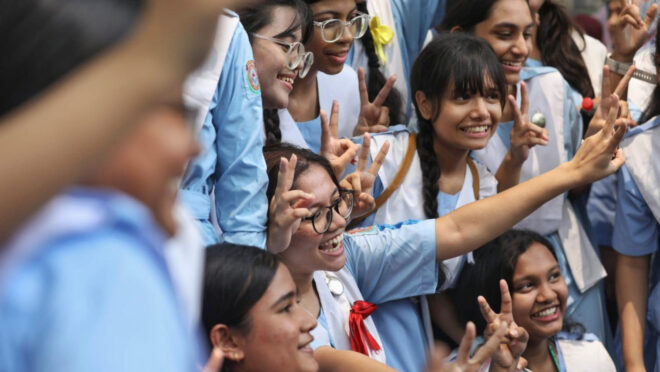
The government has planned to distribute laptops to 30,000 students who achieved a GPA-5 in the Secondary School Certificate (SSC) examinations, as part of a Tk900 crore initiative to expand digital skills and modernise secondary education.
A revision of the World Bank-funded Learning Acceleration in Secondary Education (LAISE) project also recommended scrapping the centralised procurement of books for secondary school libraries, and cutting library development grants, hoping to save over Tk213 crore.
The initiatives have been incorporated, with Tk300 crore proposed for laptop distribution. Each laptop has been priced at Tk1 lakh.
The Secondary and Higher Education Division (SHED) under the education ministry will approve specific policies or guidelines for selecting eligible students and distributing the laptops.
Officials at the Directorate of Secondary and Higher Education said the ongoing project was being revised to incorporate the new government’s priorities and policy decisions. Three new initiatives have been added to the revised Development Project Proposal: distributing laptops to SSC GPA-5 achievers, installing solar power systems at 2,000 educational institutions, and introducing 100 electric buses on a pilot basis.
The revised project proposal has already been sent to the Economic Relations Division (ERD) for its views on the expanded activities. ERD officials said a final decision would be communicated after obtaining the World Bank’s consent.
The first revision proposes increasing the project’s total cost to Tk3,659.75 crore from the original allocation of Tk3,304.08 crore, marking an increase of Tk355.67 crore.
Tk300cr for 100 electric buses
The revised proposal also includes Tk300 crore for procuring and operating 100 electric buses on a pilot basis to make school journeys easier, safer and more affordable for secondary-level students.
According to the proposal, the buses will be distributed among secondary schools and madrasahs at a ratio of 2:1. This means one madrasah will receive a bus for every two schools covered by the programme.
The SHED will formulate policies and guidelines to determine which institutions qualify for the buses and how they will be operated.
The main objective is to reduce students’ transport costs and travel-related barriers, improve regular school attendance and prevent dropouts.
The project proposal says the initiative will give students practical exposure to modern transport systems, smart technologies and environmentally friendly solutions.
Solar panels at 2,000 institutions
Another Tk300 crore has been proposed to install solar power systems at 2,000 secondary schools and madrasas to reduce their electricity costs.
Under the plan, each selected institution will receive a 10-kilowatt solar power system connected to the grid through net-metering. The installations will also be distributed between schools and madrasahs at a ratio of 2:1.
The systems are expected to significantly reduce institutions’ electricity bills.
The initiative is expected to lower operating costs while students will also gain practical knowledge of solar power generation, green technology and modern energy systems.
Centralised library book procurement dropped
While the revised project proposal recommends scrapping the centralised procurement of books, hoping to save Tk155.51 crore, the proposed allocation for library development grants will also be reduced from Tk118.48 crore to Tk60 crore, generating an additional saving of Tk58.48 crore.
According to the project revision proposal, centrally purchasing and distributing books to such a large number of institutions would be complicated. It would also be difficult to select books that meet the specific needs and requirements of individual institutions.
There is also a risk of duplicating activities under other secondary education projects, particularly the Secondary Education Development Programme (SEDP).
Instead, the project authorities believe that providing grants directly to institutions would allow them to purchase books according to their own needs and priorities, making library development more effective and sustainable.
Other reasons for revising the project include expanding the scope and duration of teacher training, upgrading multimedia classroom technology and reallocating budgets across different components.
The revised proposal places greater emphasis on building teacher-training capacity. Due to limited capacity at government training institutions, including Teachers’ Training Colleges and Higher Secondary Teacher Training Institutes, the project plans to increase the number of training venues and develop master trainers for each venue.
Changes are also being made to multimedia classrooms. While the original plan was to supply smart televisions to educational institutions, the project has now opted for Interactive Educational Panels (IEPs). This has required a fresh assessment of the technical specifications and estimated costs of the equipment.
Project targets improved learning outcomes by 2028
The Secondary and Higher Education Directorate is implementing the project under the administrative control of the SHED. Launched in October 2023, the project is scheduled to run until September 2028.
Its main objective is to raise the proportion of eighth-grade students achieving minimum proficiency in Bangla and mathematics to 65% and 90%, respectively, by 2028. It also aims to increase the student retention rate through Grade 10 to 74%.
To achieve these targets, teachers will receive subject-specific training as well as training in blended learning, student mental health counselling and climate resilience.
The project also plans to expand reading habit programmes and digital education across 29,621 educational institutions.
Under the project, 20,680 multimedia classrooms at 10,340 institutions will receive Interactive Educational Panels instead of smart televisions.
Technical courses are also being introduced at general secondary educational institutions, while the duration of practical training for trade teachers has been extended from 10 days to 14 days.
The World Bank’s International Development Association (IDA) is the project’s principal development partner, providing $300 million in credit assistance, equivalent to approximately Tk3,594.53 crore.
The remaining funding is expected to come from the government’s own resources.