What happens after 59 US universities say no?
Most students who successfully get a full ride to US colleges have a plan from the start. Sourav Das was not one of them. He wasn’t even thinking about studying abroad until 11th grade. And when he finally decided to go for it, his first attempt resulted in rejections from 59 universities out of 60.
What happens after 59 US universities say no?
Most students who successfully get a full ride to US colleges have a plan from the start. Sourav Das was not one of them. He wasn’t even thinking about studying abroad until 11th grade. And when he finally decided to go for it, his first attempt resulted in rejections from 59 universities out of 60.
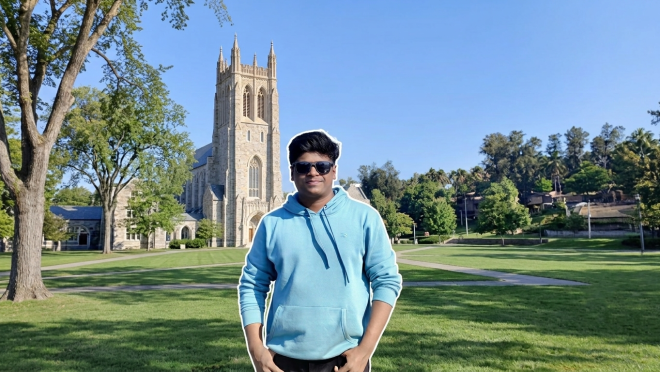
But somehow, after a year, a few more rejections, dengue fever just before HSC, and a GPA of 4.0, he landed at Connecticut College with a fully funded financial aid package.
His story is not a smooth one. It’s messy, and that’s most probably what makes the story so easy for normal students to relate to.
The turning point
Sourav had gotten a perfect GPA of 5 in his SSC. By any measure, that should have been a victory. Except he couldn’t get into any of the top colleges in Dhaka, and he couldn’t afford private institutions either. He ended up at what he saw as arguably the third-best government college in the city, and it devastated him.
“I was so depressed and thought I had missed out on a huge part of my life,” he explained.
What followed was a period of isolation. He went to class only about 10 or 12 days over two entire years, locked himself in his room, and cut off contact with his friends.
Around three months into 11th grade, he realised he needed to prove something.
“I needed to prove myself, and the next big stage was university,” he said.
He had zero interest in science or engineering, so the conventional paths like BUET or DU didn’t appeal to him. Then, one evening, he watched a video by Seeam Shahid Noor explaining how he’d gotten into Harvard on a full scholarship, even with flight tickets covered.
That was it. From that moment, Sourav decided he was going to apply to universities in the US and earn a full scholarship to a prestigious school.
The first attempt: A reality check
By the time he sat down seriously to prepare, he already had something most international applicants struggle to build: a genuine spiked profile. Years of work outside the classroom had given him solid extracurriculars. He’d played cricket for the Dhaka district, been involved in student government, written speeches for political leaders, and pushed social justice through community advocacy. But those weren’t enough.
He applied to roughly 60 universities in Fall 2025, during his 12th-grade year. He got rejected from 59 of them.
“I was rejected from 59. Yeah, I only got into one, and even that one left me with a $30k deficit per year, which was just impossible to cover.”
Three months before his HSC exams, he had to accept something he wasn’t prepared for: he had failed this cycle. And now he had an exam in three months that he’d barely prepared for. Then, ten days before the exam, he got dengue. He took the exams anyway and scored a 4.0.
The second attempt: The gamble
Now he faced a choice: play it safe and prepare for local admission tests, or gamble again on the US system. He chose to gamble.
“Since I had really bad prep for HSC, it was almost certain I would fail the admission tests anyway,” he said. “Also, thank God I have really, really supportive parents. They never doubted my choice, so yeah, it was an easy decision to make.”
This time around, he submitted his SAT score. He scored 1460 on the SAT, with a 780 in maths. He submitted it alongside his applications, despite being told by some that he should go test-optional. His reasoning was that, coming from an NCTB background, if admission officers had no sense of his academic credibility, he’d be at an even bigger disadvantage.
He improved his Duolingo English Test score from 125 to 135. He did a few more extracurriculars. But honestly, these were minor tweaks. He applied to about 30 universities and got rejected by 29.
Connecticut College said yes.
The aid package was nearly $90k per year: $38k from the Founders’ Scholarship, $48k in need-based aid, and about $4k from work-study. It was enough.
What actually changed
When asked what made the difference between rejection and acceptance, Sourav replied honestly that luck played a big part.
“I was just lucky this time,” he said.
But beneath the luck was something more intentional. His essays were genuinely strong, and they became that way because he found the right mentorship. Since he couldn’t afford paid consultancy services during his application cycle, he had to get creative about finding help.
He spent hours on r/ApplyingToCollege searching for posts where people offered free essay reviews. Then he messaged nearly everyone who commented that they were willing to review essays for free.
Hardly anyone responded. But one person did.
Her name was Leslie A. Zukor, a Columbia journalism graduate. She read his personal statement and liked it. After that, Sourav kept reaching out to her for feedback on other essays. Over time, she ended up helping him with everything: college list building, essay reviews, application strategy, every single step of the admissions process.
By the end, she had reviewed more than 80 essays for him, completely free of charge.
“Her normal essay-review rate was around $90 per hour, which was basically close to my dad’s monthly income at the time,” Sourav said. “So I can never be grateful enough for what she did. She treated my applications with the same level of care she would have given her own child.”
He had another mentor who helped him: a former Williams admissions officer. He found him through similar channels too.
His personal statement was exactly the same as the previous year, not changed by a single word. And his essay itself was the core of everything. It was political. He wrote about the July 2024 revolution, how that moment had affected him personally, how he’d advocated for student rights during that time, and how it had completely changed his perspective on life.
People had warned him. They said colleges wouldn’t accept someone with a political essay. They said admission officers would see him as a threat. He wrote it anyway.
“I was firm that I was going to be exactly who I really am,” he said.
For other Bangladeshi students going through this process, Sourav has some advice: stop faking. The US admissions world doesn’t require proof of extracurriculars upfront, and yes, you can slip through with a fabricated profile if you can afford $25k-30k in fees per year. But if you need a near full ride or a complete full ride, the work has to be real.
“Every single full-scholarship applicant I have seen had one thing in common: they had a strong indicator that their profile was real,” he said. For him, it was a video portfolio showcasing his extracurricular achievements, awards, and overall life. That credibility mattered.
He also wants students to understand what a full ride actually means. In Bangladesh, people have stretched the term to cover packages with $15k, $20k, or even $30k deficits. A real full ride means a $0 deficit. A real full ride is extraordinarily rare.
“Not even five people from our country get a real, actual full ride with a $0 deficit every year,” he said. “People calling their $15k to $20k deficit a ‘full ride’ is just betraying the community.”
On the mental toll
The process kills things in you, Sourav acknowledged. If you need near-full aid, the odds are less than 1 percent. Connecticut College’s overall acceptance rate is around 37 percent now, but its international acceptance rate sits at 2 to 4 percent. So you’re really competing for maybe two to five seats with the entire world.
“You need to keep going while remembering that it’s very likely you are going to end up with nothing,” he said.
His advice: have a backup country. Look at government-funded full scholarships in places like Japan, China, or Turkey. Apply to as many quality colleges as you can. Build in safety schools where you’re certain to get in. And understand that even if you get the acceptance, the F-1 visa interview is still uncertain. It’s not over until it’s actually over.
But there’s a line from Jack Ma that he held onto every single day for the last three years: “Today is hard, tomorrow is harder, but the day after tomorrow is beautiful. Most people die tomorrow evening.”
“This is exactly what US admissions is like,” Sourav said. “The life you want to lead, which is the reason you started all this, is worth every sleepless night. Never give up.”