Remembering Professor Abul Kashem Fazlul Haq
Professor Abul Kashem Fazlul Haq, one of the most enduring voices in Bengali public thought, died on Sunday afternoon at a hospital in Dhaka after suffering a cardiac arrest. He was 85.
Remembering Professor Abul Kashem Fazlul Haq
Professor Abul Kashem Fazlul Haq, one of the most enduring voices in Bengali public thought, died on Sunday afternoon at a hospital in Dhaka after suffering a cardiac arrest. He was 85.
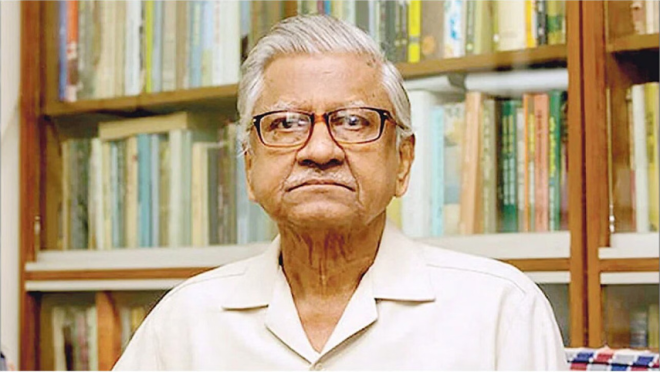
He was a great intellectual who definitely paved the way for social democracy and secularist ideology in this country. I got to know him through his book, Bishwayon O Shavyatar Bhabishyat, where he argued that imperialist and economic structures uproot local sovereign cultures and make wealth disparity even worse. Even if it’s a notion I would debate, I still got to know about him through this piece and have later contemplated it.
Surely, with him goes a rare kind of intellectual, one who spent nearly six decades inside a single discipline, the Bangla department of Dhaka University, and used that vantage point to think, write, and argue about almost everything else: language, politics, culture, the state of the nation. He was, by every account, a teacher first.
Generations of students who passed through his classroom, including some who would go on to hold public office, remembered him less for any single lecture than for a manner: patient, unhurried, willing to sit and talk long after the syllabus had been exhausted. One former student turned cultural affairs minister described conversations with him as akin to resting under a calm banyan tree. It is the kind of image that tends to survive a person because it is usually true.
Born on 30 September 1940 in Pakundia, Kishoreganj, Haq did his bachelor’s and master’s in Bangla at Dhaka University and never really left the department, teaching there for four decades and eventually chairing it.
He edited the literary magazines Sundaram and Lokayat, and wrote or edited more than twenty books, ranging across essays, literary criticism, and what he himself might have called political philosophy; among them Ekusher February Andolon, on the Language Movement, and Rajneeti Darshan, on political thought. In 1981, he received the Bangla Academy Literary Award, and in October 2024 was appointed president of the Bangla Academy itself, a rather fitting role close to a life spent in service of the institution and the language it exists to protect. He was also, for years, convener of the Rashtrabhasha Bangla Rokkha Komiti, the committee formed to safeguard Bangla’s status as the state language; a cause that had defined his intellectual generation and never stopped defining him.
He never stood for office and never joined a political party, but he was, in the truest sense, a political thinker, a columnist, and commentator who was regularly sought out for his reading of Bangladesh’s democratic health, its elections, its recurring crises of legitimacy. He would talk about philosopher kings.
He wrote and spoke with the frankness of someone who owed no party a debt, describing flawed elections going back to the Ershad era and lamenting what he saw as the hollowing out of political conviction in both major parties. He identified, without much hedging, as a progressive and a secularist, a man shaped by the Language Movement’s insistence that culture and identity could be a form of resistance. Colleagues and admirers, in the tributes pouring in since his death, have repeatedly reached for words like “enlightened” and “rare” to describe the shape of his convictions.
Those convictions were tested in the cruellest way possible in 2015. His only son, Faisal Arefin Dipan, ran Jagriti Prokashony, a publishing house that had brought out a book by the writer Avijit Roy, a secularist blogger hacked to death earlier that year at the Ekushey Book Fair. On 31 October 2015, Dipan was murdered in his own office, one of a string of machete attacks on secular publishers and writers carried out by Islamist militants that year. It was Haq himself who found him.
He broke open the locked door of his son’s office at Aziz Market and discovered him lying in a pool of blood, his throat cut. “I saw him lying upside down and in a massive pool of blood,” he told reporters at the time, in words that would be quoted around the world in the days that followed. “They slaughtered his neck. He is dead.”
There was no theatre in his grief, and there was no retreat from it either. In the years afterwards, Haq did not withdraw from public life; he continued teaching, writing, and appearing at memorial gatherings for his son and for the wider community of writers under threat, including at the first anniversary event organised by the Dipan Smriti Sangsad at Dhaka University, where speakers openly criticised the slow pace of the murder investigation. That he kept showing up, at lecterns, at memorials, in newsprint, said something about the man that no eulogy needs to embellish.
Haq is survived by his wife, Farida Pradhan, and his daughter, Professor Shuchita Sharmin of Dhaka University’s Development Studies department. His body was taken from the Bangla Academy to the Central Shaheed Minar for public homage, and later to Dhaka University’s Central Mosque for a second funeral prayer, before burial at the Mirpur Martyred Intellectuals Graveyard, again, a fitting ground for a man who spent his life defending the language and the intellectual freedoms his son died for.