The rise of the personalised internet and the walls we build
You finally control your feed. Welcome to the echo chamber you built yourself.
The rise of the personalised internet and the walls we build
You finally control your feed. Welcome to the echo chamber you built yourself.
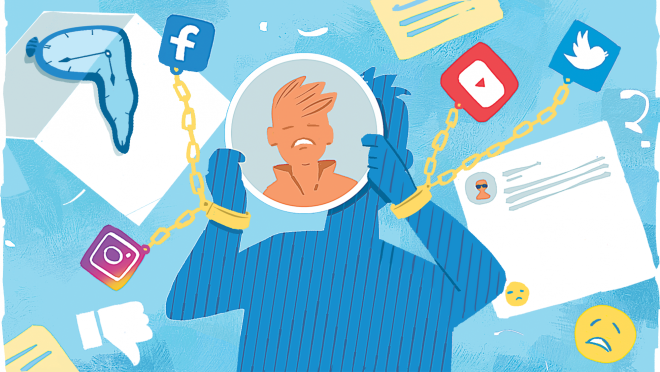
Most people don’t think about their Facebook feed as a designed experience. They just open the app, usually right after waking up or right before sleep, and let it happen to them. The accident footage.
The political argument that’s been running since yesterday. The wedding video from a relative they haven’t spoken to in three years. It arrives in no particular order and for no particular reason, and somewhere between the third and fourth scroll, something in the brain quietly switches off.
That numbness isn’t laziness. It’s just what happens when you’ve been asked to feel too many things before your morning coffee.
Platforms have started to notice, or at least, they’ve started to act like they notice, which may or may not be the same thing. While Facebook itself remains a chaotic, unfiltered town square in Bangladesh, its parent company and major competitors are quietly building a new template for the rest of the internet.
Threads recently rolled out a feature called “Your Algo”, an evolution of its earlier “Dear Algo” experiment. The difference is telling. Dear Algo was public, you posted a request and hoped the system listened. Your Algo is private, and it actually works. You can now tell Threads to show you more of a specific topic, less of another, and set a precise expiry on those preferences, one day, three days, or seven, so your feed doesn’t calcify around a mood you were in last Tuesday.
Instagram has followed a similar path. Its “Your Algorithm” feature launched on Reels first and is now expanding to Explore, giving users the ability to see which topics are shaping their recommendations and push back directly against ones they don’t want. Adam Mosseri, Instagram’s head, has been vocal about pushing greater transparency into how content gets recommended, a notable shift for a platform that spent years offering almost no explanation for why anything appeared in front of anyone.
TikTok, whose algorithm has long been considered the most aggressive in the industry, the one that could identify your interests faster than you could articulate them yourself, has also moved in this direction. Its “Manage Topics” feature lets users manually adjust how much content they receive across broad categories like sports, food, travel, and entertainment, using simple sliders in their settings. Beyond that, TikTok has expanded into AI-powered keyword filtering that goes further than simple word blocks. You can filter a word, and the system will also suppress synonyms and related terms, so blocking “accident” doesn’t just hide posts with that word, it catches the whole category of content around it. Which sounds like progress, until you realise you’re the one doing the censoring now.
Taken together, this is a genuine structural shift. For most of social media’s history, the recommendation engine was the invisible landlord, you lived in the feed it built, by rules you never saw. Now the tools exist to actually push back.
Pause on that for a moment. Consider who actually benefits from this arrangement, and the picture gets murkier.
When a user’s feed becomes a swamp of misinformation or communal provocation, a real and recurring problem in Bangladesh, where a single rumour can travel from a Facebook group to a street in under an hour, platforms used to carry some of that blame. The algorithm pushed it. The algorithm chose engagement over accuracy. There was at least someone to point at.
Now? This shift represents a masterclass in corporate absolution. You set your preferences. You trained your feed. You used the tools they gave you. By outsourcing moderation to the individual, the company steps back, hands clean.
This isn’t cynicism for its own sake. User control is a double-edged sword, and the sharper side genuinely matters. For people who have historically had the worst experiences on these platforms, the ability to filter is not a feature, it is a lifeline. For a user in Dhaka, whether a journalist working under pressure, a woman navigating harassment, or a religious minority dodging provocation, that control is an invaluable shield.
The problem is what most people will actually do with that freedom when survival isn’t the primary goal.
Give people the keys and tell them to drive, and the natural instinct is not to seek out challenge or complexity. It is to get comfortable. To confirm. To quietly build a digital neighbourhood where the news always makes sense, the politics are familiar, and nobody is saying anything that requires you to update a belief you’ve held for years.
A perfectly curated feed feels like clarity. But most of the time, it’s just a wall you decorated yourself.
Whether that wall makes you feel informed, or just makes you feel right, that’s the question worth sitting with for a while.