Talk to Me: From YouTube to the other side
Talk to Me is a horror film made by two Australian brothers who used to crash tractors and stage Ronald McDonald fights for the internet. It is also one of the best horror films of the year. These two facts are not in spite of each other.
Talk to Me: From YouTube to the other side
Talk to Me is a horror film made by two Australian brothers who used to crash tractors and stage Ronald McDonald fights for the internet. It is also one of the best horror films of the year. These two facts are not in spite of each other.
There is a specific kind of contempt that the film industry reserves for people who arrive from the internet. It lives in the imposter syndrome that Danny Philippou described feeling every night during production, the way he would spend the day believing in his cast and his script and his director of photography, and then go to sleep and hear a different voice entirely.
They’re YouTubers. They don’t know how to make a movie. He said the imposter syndrome was at a hundred when he stood on stage with A24 and felt, by his own account, like he had no business being there.
Where they came from is RackaRacka: an Adelaide-based YouTube channel that has, since 2013, been uploading sketch comedy, horror, and action videos featuring stunts, fights, special effects, and a recurring Ronald McDonald who is depicted as a psychopathic evil clown. Their first big video was Harry Potter VS Star Wars. It got seven million views in a week.
Talk to Me
It begins with a party and ends somewhere you were not prepared to go.
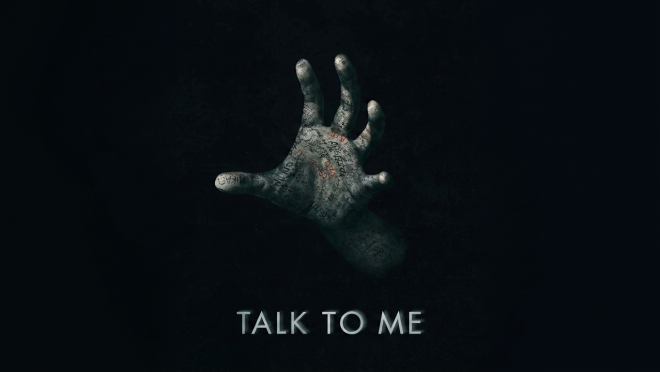
The premise is specific: a group of Australian teenagers discover a ceramic embalmed hand, rumoured to have belonged to a medium, that allows whoever holds it to be briefly possessed by a spirit from the other side. The possession is a rush. Everyone films it. The ritual is very particular and oddly funny in the room, contrasting heavily with the person holding the hand.
Mia, played by Sophie Wilde, is the film’s centre. She is grieving her mother, who died under circumstances the film reveals slowly. When she discovers that the hand might offer a channel to the dead, she cannot leave it alone. What she does next, and what it costs her best friend’s little brother Riley, is where the film stops being entertainment and becomes something that sits with you.
Wilde’s performance is the reason the film works as more than a horror exercise. Grief, in her hands, is not a performance of sadness. It is a behavioural distortion, the way a person makes decisions when a specific absence has reorganised their sense of what matters. When Mia makes choices that are plainly wrong, Wilde makes sure you understand exactly why she makes them. That is much harder than it looks.
The Philippous, who by their own admission spent years doing run-and-gun YouTube shoots, showing up to locations without a plan and making it up, had to learn, for this film, a different pace. Slower. More deliberate. More people in every department. But what the YouTube years had trained into them was something that formal film school cannot teach: the instinct for when an image is working and when it is not, built across thousands of hours of editing their own footage and watching the reaction in real time. Their DOP, Aaron McLisky, was a deliberate hire. So was their production designer. They knew exactly what they couldn’t do themselves and exactly who to find for it. That clarity of self-knowledge, in a first-time director, is not common.
The result is a horror film with a 97% rating on Rotten Tomatoes that uses its scares precisely: not as set pieces to be spectated from a safe distance, but as consequences. Every horror beat in the film is earned by what has come before it. The hand does not make things worse at random. It makes things worse because of specific choices made by specific people who wanted specific things. The film is merciless about this. It does not let Mia off the hook, and it does not let you off the hook for being on her side.
There is a generation of filmmakers who grew up making things for the internet and are now making things for theatres, and the critical establishment has not entirely decided what to do with them. Whether to treat the YouTube background as a pedigree or a liability. Whether the work stands on its own or needs to be explained in terms of the platform it came from.
Talk to Me answers this question by not asking it. It is not a YouTube film that made it to the cinema. It is a horror film, precise, devastating, and formally controlled, made by two people who spent ten years learning how to make exactly this.
The hand in the film is a portal to the other side.
So it turns out to be the channel too.