The hidden cost of being a woman in Bangladesh
Every month, millions of Bangladeshi women face an unavoidable expense that affects their health, education and livelihoods. As the cost of menstrual products continues to strain household budgets, the authors argue that affordable menstrual care should be treated as a public necessity, not a luxury
The hidden cost of being a woman in Bangladesh
Every month, millions of Bangladeshi women face an unavoidable expense that affects their health, education and livelihoods. As the cost of menstrual products continues to strain household budgets, the authors argue that affordable menstrual care should be treated as a public necessity, not a luxury
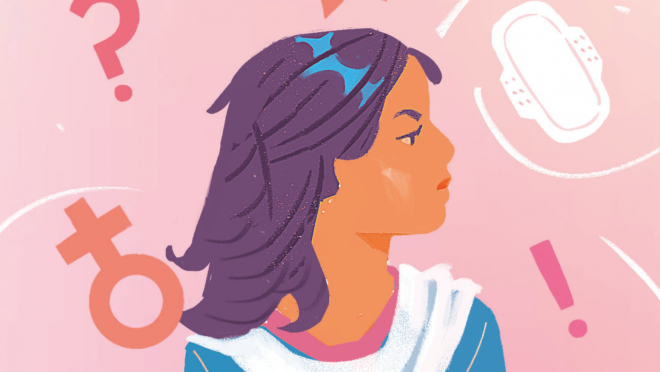
Rafia, an average university student in her early 20s with eyes full of dreams but a wallet stretched thin by tuition expenses, is one of the nearly 90.4 million (9.04 crore) women currently living in Bangladesh.
Her mother, Kulsum Begum, a housewife in her mid 40s who is financially dependent on her husband, and her sister, Samia, a government employee in her late 20s with her own source of income are also part of the same group that comprises roughly 50.85% of the country’s overall population.
Every month these women and around 50.58 million more women of reproductive age (15–49 years) start their period not only with pain but also with a monthly budgeting calculation. They ask themselves, “Can I afford a pack of pads with my tuition money this month?” “Should I buy cheaper pads and risk discomfort, but save the money for food, rent, or other expenses?” “Will eight pads be enough to cover five to seven days?”
Even though menstruation has remained a natural part of women’s life since the beginning of human existence on earth, its management in Bangladesh is still being shaped by income. Particularly for women from marginalised and low-income communities, 7 days of bleeding often means choosing between missing school or work and spending their day at school or work in fear of leaks or embarrassment.
Sanitary pads or other menstrual hygiene products are not like ordinary luxury consumer goods. They are linked to a woman’s health, dignity, mobility, and education. Admittedly, some policy measures have already been taken in Bangladesh. UNICEF Bangladesh, as part of a collaborative endeavour with the then Government of Bangladesh, developed the National Menstrual Hygiene Management Strategy in 2021 and is currently working to make menstrual products accessible and affordable for all. In the proposed FY2025-26 budget, locally produced sanitary napkins were made VAT-exempt while VAT exemption on imported raw materials for sanitary napkins and diapers was extended till June 30, 2030.
However, according to the proposed FY2026-27 budget, Total Tax Incidence (TTI) for imported sanitary napkins increased from 127.72% in FY2025-26 to 132.36% in FY2027 with no change in import duties. This begs the question: what measures can be taken to adequately help improve the menstrual health of millions of women, who are constantly and disproportionately affected by poverty, extreme wage disparities, and high rates of unpaid domestic work, without making them worry about product affordability?
Conversations with two female cleaners, Inu (23) and Taslima (25), at a well-known private organisation suggest that the answer is possibly no. These are the women whose experiences reflect the everyday burden many working women face. Both said they cannot afford high-quality pads every month. It takes them almost one day’s salary to purchase a packet of eight locally manufactured pads, which is not enough to sustain for five to seven days. This monthly cost imposes a serious financial burden on women who are already managing rent, food, transport, and the financial pressure of family.
Surely, demand for menstrual products is increasing as is evident from a report by The World Bank that found Bangladesh’s sanitary napkin market is growing by around 20 percent annually, showing both business potential and rising awareness. However, growth in the market does not always or necessarily indicate equitable access.
As per findings from various studies, poor women might buy low-quality sanitary pads if safer ones are too costly, use pads less often and instead use clothes as an alternative, or miss school or work altogether during their periods. According to a 2025 roundtable report citing the National Hygiene Survey 2018, 35.1 percent of Bangladeshi schoolgirls were absent during menstruation.
The two female cleaners who were interviewed for this article shared that their workdays often begin at 7 AM and stretch until 9 PM. To them, managing periods at work is not simply about comfort; it is also about completing a day of twelve hours away from home without worrying about leakage, discomfort, and the expense of changing pads. Both workers recommended that workplaces offer discounted pads to the female working staff if they are expected to devote long hours to workplace commitments during their monthly cycle.
This is, by no means, an impossible demand but a small and feasible step. Subsidised pad corners, emergency supplies, or vending machines, particularly for lower-income women, could be implemented in universities, offices, and hospitals. Because if we expect women to contribute to the workforce, their basic health requirements need to be acknowledged as well.
The government should also establish or subsidise low-cost menstrual products for women in underprivileged and lower-income groups. These can be delivered via schools, community clinics, garment factories, and local government offices. Providing subsidised pads in schools would contribute to girls’ retention in school while in workplaces, it will potentially lead to less absenteeism and higher worker productivity among female staff.
At the end of the day, menstrual products come with a cost that is tied to gender. This is an ongoing expense that is incurred by women of reproductive age every single month. Until and unless these products are considered essential goods and not ordinary goods for the market, women’s health will continue to be subject to unfair impositions of tax and insufficient allocations of resources in the national economy.
Therefore, Bangladesh’s tax policy should actively help reduce the prices of sanitary products for female consumers. Trying to make sanitary pads affordable is not a charity for women. Rather, it is an investment into public health, education, and ultimately, our country. A small hygiene product should not cost a woman her school day, her workday, or her dignity.

Sketch: TBS
Nadia Afroze Disha is a Lecturer at BRAC Business School, BRAC University.

Sketch: TBS
Maria Jannat Ahmed is an undergraduate student of the Department of Economics and Social Sciences at BRAC University.
Disclaimer: The views and opinions expressed in this article are those of the authors and do not necessarily reflect the opinions and views of The Business Standard.