Scientists may have discovered alien infrastructure
A new study by Amirnezam Amiri of the University of Arkansas explores how these hypothetical “Dyson swarms” would appear through modern telescopes and identifies the types of stars most likely to host them.
Scientists may have discovered alien infrastructure
A new study by Amirnezam Amiri of the University of Arkansas explores how these hypothetical “Dyson swarms” would appear through modern telescopes and identifies the types of stars most likely to host them.
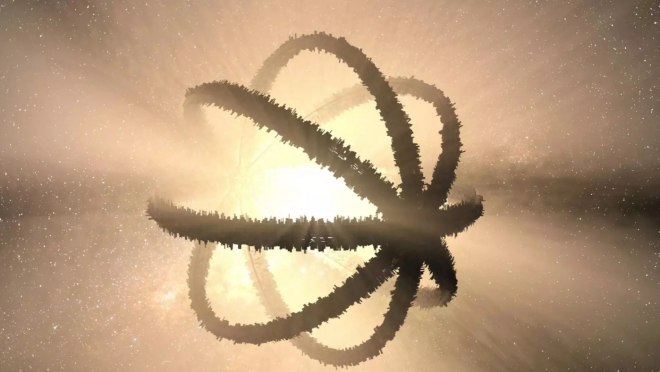
Scientists searching for signs of intelligent extraterrestrial life say some of the coldest objects in the Milky Way may not be stars at all but massive energy-collecting structures built by advanced alien civilizations.
A new study by Amirnezam Amiri of the University of Arkansas explores how these hypothetical “Dyson swarms” would appear through modern telescopes and identifies the types of stars most likely to host them.
The research is currently available as a preprint on arXiv and is scheduled for publication in the journal Universe.
The idea of a Dyson sphere was first proposed by physicist Freeman Dyson in 1960.
Rather than a solid shell surrounding a star, scientists now believe an advanced civilization would more likely build a “Dyson swarm”—a vast network of orbiting structures that captures most of a star’s energy.
According to the study, red dwarfs are among the best places to search for such megastructures. These small, cool stars are the most common in the Milky Way and can continue producing energy for trillions of years, making them long-lasting power sources.
Their small size would also make it easier to build a Dyson swarm, requiring much less material than one surrounding a larger star like the Sun.
White dwarfs—dense remnants of Sun-like stars that have exhausted their fuel—could be even better candidates. Since they are much smaller than ordinary stars, a Dyson swarm could orbit very close to them while still collecting large amounts of energy over billions of years.
The study says such structures would significantly change the way a star appears to astronomers.
Instead of allowing visible light to escape, a Dyson swarm would absorb nearly all of the star’s energy and release it again as infrared heat. As a result, the object would appear much cooler than a normal star while producing the same overall amount of energy.
Researchers estimate that while a typical red dwarf has a surface temperature of around 3,000 Kelvin, a surrounding Dyson swarm could appear as cold as 50 Kelvin.
No naturally known stars occupy that part of the Hertzsprung-Russell (H-R) diagram—a chart used by astronomers to classify stars by temperature and brightness. Any object found there would immediately attract scientific attention.
Another possible sign would be an unusually “clean” infrared spectrum. Unlike ordinary stars, which are often surrounded by dusty disks that produce silicate emissions, a Dyson swarm made of artificial structures would lack such dust signatures.
The study also notes that constructing a solid Dyson sphere would likely be impossible because of the enormous amount of material required. Instead, an advanced civilization would probably build a swarm of many independent orbiting collectors.
As these structures move around the star, they could create unusual and irregular changes in the star’s brightness—patterns that differ from those produced by natural astronomical processes.
The study highlights the role of the James Webb Space Telescope, which is designed to observe the universe in infrared light, making it well suited to search for these hypothetical megastructures. Earlier missions, including WISE, have also contributed to the search.
In May 2024, researchers from Project Hephaistos identified seven possible Dyson swarm candidates around red dwarf stars after analyzing about five million stars.
One of those candidates was later explained by a distant supermassive black hole aligned with the star, leaving several others that still warrant further investigation.
Although no Dyson swarm has yet been confirmed, the new study offers additional clues that could help astronomers distinguish possible signs of advanced alien technology from natural cosmic objects.
Future infrared observations may determine whether such megastructures exist somewhere in the Milky Way.