Does Bangladesh need its own Count Binface?
Somewhere in Essex right now, a seven-foot man dressed as a sentient wheelie bin is preparing to run for a seat in the British Parliament, again!
Does Bangladesh need its own Count Binface?
Somewhere in Essex right now, a seven-foot man dressed as a sentient wheelie bin is preparing to run for a seat in the British Parliament, again!
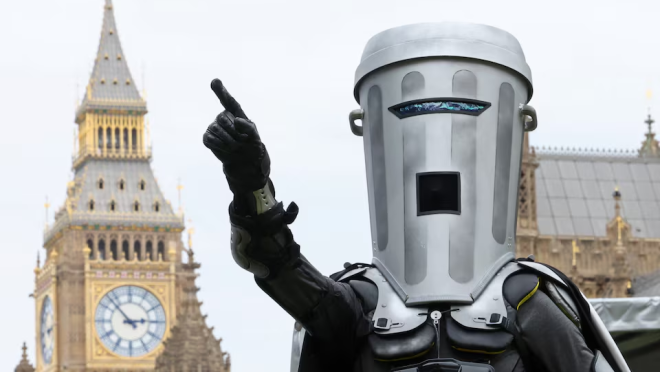
Count Binface’s opponent is Nigel Farage, the most consequential politician of Britain’s Brexit era, who has just resigned the very parliamentary seat he is now trying to win back, reportedly to buy himself time before scrutiny catches up with him over an alleged £5 million undeclared “gift”.
Every serious party has looked at this contest and quietly walked away. Labour, the Conservatives, the Liberal Democrats; all boycotting, all unwilling to dignify what the outgoing prime minister called a circus.
This is not new. Binface, the alter ego of a British writer who previously ran a similar act called Lord Buckethead before a trademark dispute forced a rebrand, has now stood against two prime ministers, a London mayor, and assorted grandees of the political class, on a platform that includes capping the price of a Flake ice cream and abolishing the House of Lords.
He loses, every time, by design. That is rather the point. What he offers voters is not power. It is a place to put their disbelief.
Which brings me, by the scenic route, to Bangladesh.
We have just been through the most consequential political stretch in a generation: a student uprising, a fallen government, an interim administration, a landmark election in February that finally buried the old order and installed a new one.
The BNP took power in a landslide. The Awami League, banished from the ballot entirely, is a court verdict away from being a historical footnote (dare I say, Neo-Nazi). Jamaat-e-Islami being the loyal opposition. A national referendum on a raft of institutional reforms, the July Charter, passed with the public’s blessing.
On paper, we have done something Britain has not managed in decades: we have actually changed the furniture.
And yet. Ask yourself honestly what happens, in this new Bangladesh, when a citizen wants to say something that fits in neither column, not BNP, not Jamaat, not nostalgia for a banned party, just plain disbelief in the whole apparatus.
Where does that vote go? Where does that voice go? In Britain, it goes to a man in a bin costume who gets invited onto Newsnight and gently needled by MPs in a parliamentary committee hearing about broadcast impartiality. In Bangladesh, it currently goes nowhere at all, or worse, it goes onto a Facebook post that a lawyer somewhere flags under whatever this decade’s version of the old cyber laws turns out to be.
That is the actual argument for a Bangladeshi Binface, and it has very little to do with bins. A joke candidacy is a stress test for how much confidence a political culture has in itself. Britain can let a man in a costume stand against its most feared populist because the system is secure enough to survive being laughed at.
The joke is not a threat to the state; it is proof the state can take one. Bangladesh, barely twenty-three months removed from a government that answered dissent with live ammunition, has not yet had the luxury of finding out whether it can take a joke. We are still, understandably, in the business of finding out whether it can take an election.
So let me be precise about what I am and am not proposing. I am not suggesting that what this country needs, mid-transition, with a fragile new upper house still being negotiated and a war crimes verdict still working its way through the system, is a man in a wheelie-bin suit crashing a BNP press conference. That would be tone-deaf at best. The stakes here are not Clacton’s stakes. Nobody in Essex is worried about a return to mass arrests.
What I am suggesting is smaller, and more useful: that the permission structure for absurdity is worth building deliberately, in the low-stakes arenas where it can’t do damage, student union elections, city corporation races, the endless churn of local by-polls that nobody outside the constituency ever watches.
Let a joke candidate lose spectacularly in a union hall in Rajshahi before anyone dreams of trying it in a real constituency.
Let cartoonists get their laugh lines back one panel at a time rather than all at once. A country does not go from prosecuting satire to hosting it on a national debate stage in a single leap; it builds the muscle in small rooms first.
Because the alternative is not silence, silence is not actually on offer. The alternative is that disbelief simply finds a rougher outlet than a bin costume. Anger unable to laugh at itself tends to curdle into something with sharper edges.
A functioning democracy needs an escape valve for its own absurdity, and right now Bangladesh’s is set to “off.”
Count Binface will very likely lose to Nigel Farage in a few weeks, as he has lost to everyone he’s ever run against. That is not the failure of the project. The win was always the fact that he could stand there in the first place, in a bin costume, in front of the cameras, and nobody had to arrest anybody. We should want that problem.
We are not there yet. But it would not hurt to start practising. Isn’t that the beauty of democracy?