Spain won the World Cup. "Cu Cu Cucurella" won the internet
While football fans celebrated Spain’s triumph, millions of people who had never watched a full match found themselves scrolling through the chant everywhere: “Cu… Cu… Cucurella!”
Spain won the World Cup. "Cu Cu Cucurella" won the internet
While football fans celebrated Spain’s triumph, millions of people who had never watched a full match found themselves scrolling through the chant everywhere: “Cu… Cu… Cucurella!”
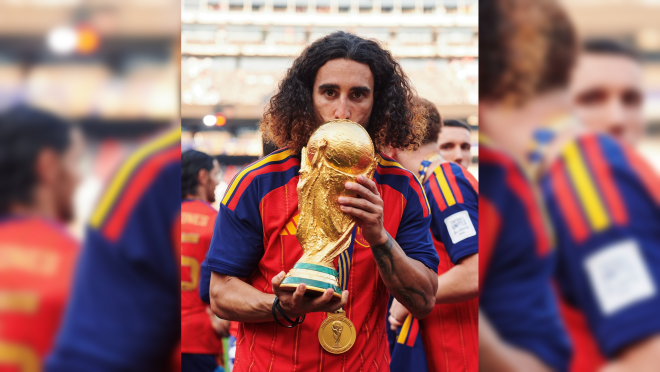
How did a simple football chant become one of the most viral sounds of 2026?
To someone scrolling through Instagram or TikTok today, one of the well-known football defenders of the Spain national football team is chanting a sound while celebrating the 2026 World Cup championship. With this, the chant also went viral with his previous celebration.
In reality, it started as a football terrace chant, a tradition deeply rooted in European football culture, where supporters make songs to celebrate, tease, or immortalise their favourite players.
Back in the time when Marc Cucurella completed his prestigious move from Brighton and Hove Albion to Chelsea in the summer of 2022 for around £62 million, expectations were tremendous. Chelsea supporters welcomed their new Spanish defender in the most football way possible by giving him a chant.
Instead of producing an entirely new melody, fans referenced the tune of “La Bamba”, one of the most recognisable folk songs in the world. Reusing well-known melodies is common in football because thousands of supporters can immediately join in without learning a new rhythm.
The lyrics they created were playful rather than serious:
“Cucurella, he eats paella,
He drinks Estrella,
His hair’s f*ing massive.”
Every line reflected something associated with him.
“He eats paella” refers to Spain’s world-famous national dish.
“He drinks Estrella” references Estrella, one of Spain’s best-known beer brands.
“His hair’s f*ing massive” celebrates what had already become Cucurella’s trademark: his unmistakable long, curly hair that makes him instantly recognisable on the pitch.
The chant wasn’t about celebrating goals or trophies. It celebrated personality. Fans often connect more deeply with players who have unique traits, and Cucurella’s energetic style, unwavering work rate, and unforgettable hairstyle made him an easy fan favourite.
From Chelsea chant to European sensation
For nearly two years, the song remained largely within English football. Chelsea supporters sang it at Stamford Bridge and away matches, but it wasn’t globally known outside football circles.
That changed dramatically during UEFA Euro 2024.
Cucurella became one of Spain’s standout performers as they progressed through the tournament. His aggressive defending, constant overlapping runs, and consistency earned praise from pundits and supporters alike.
As his profile grew, Spanish fans embraced the chant and began creating their own versions. Social media creators started uploading videos of supporters singing it in fan zones, stadiums, bars, and celebrations.
One lyric quickly became famous and viral:
Haaland tiembla, que viene Cucurella (Haaland, tremble, because Cucurella is coming).
The line made little sense in footballing terms because Erling Haaland’s Norway had failed to qualify for Euro 2024. That paradox became part of the joke. Internet culture often lives on distortion, inside jokes, and references that don’t need to be logical to be entertaining.
The chant was no longer just a football song; it had become a meme.
Adding another layer to the story, a widely shared video from Spain’s celebrations appears to show Marc Cucurella’s wife, Claudia Rodríguez, pointing towards a fan with long, curly hair who closely resembles her husband. In the clip, she seemingly identifies him as the creator of the famous “Cu Cu Cucurella” chant. Now, Mrs. Cucurella’s top playlist song is Cu Cu Cucurella.
Why did it explode during the 2026 FIFA World Cup?
By the time the 2026 FIFA World Cup arrived, the chant already had momentum.
As Spain progressed through the tournament, the chant echoed before kick-off, after every victory, and throughout post-match celebrations. TV broadcasts captured thousands of supporters chanting together while clips spread rapidly across Instagram, TikTok, YouTube Shorts, and X, reaching millions within hours.
When Spain defeated Argentina in the final to lift the World Cup, the chant reached its biggest audience yet.
Millions of people who had never watched Chelsea or even followed European football suddenly associated one sound with Spain’s victory:
“Cu… Cu… Cucurella!”
The internet then did what it always does with memorable audio: it repurposed it. Many users had no idea who Marc Cucurella was, yet they knew the chant by heart.
It thrives because of social media algorithms. Once a sound begins trending, creators reuse it to boost visibility, exposing it to ever-larger audiences. Every new video reinforces its popularity, creating a self-perpetuating cycle that carries the chant far beyond the football community.
Even Marc Cucurella couldn’t resist joining in
One of the reasons the chant became even more viral was that Marc Cucurella embraced it himself.
Rather than simply listening as fans sang his name, the Spanish defender was repeatedly seen joining in during Spain’s post-tournament celebrations. Videos captured him singing the chant on stage with teammates as thousands of supporters chanted along, while in other clips across social media, Cucurella was seen standing on the dining hall table during team celebrations.
Instead of keeping himself distant from the viral trend, Cucurella became part of it, helping transform “Cu Cu Cucurella” from a football terrace chant into one of the defining cultural moments of Spain’s World Cup celebrations.