Beyond borders: The traditions that unite South Asia
When I was little, the word “heritage” meant the stories my Nanu used to tell me. She’d tell me about how my great-grandmother taught her to cook without ever using a measuring spoon, or how her own grandmother showed her how to hold a needle while sewing.
Beyond borders: The traditions that unite South Asia
When I was little, the word “heritage” meant the stories my Nanu used to tell me. She’d tell me about how my great-grandmother taught her to cook without ever using a measuring spoon, or how her own grandmother showed her how to hold a needle while sewing.
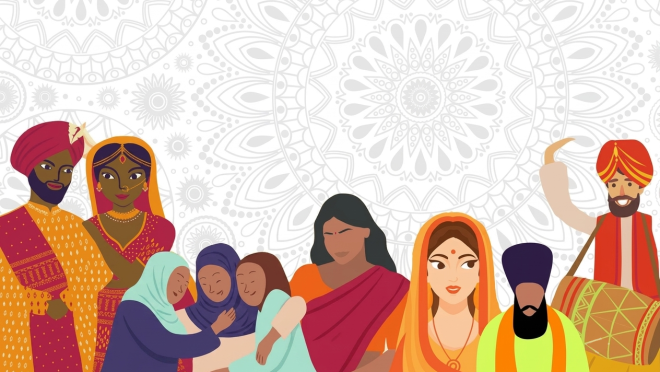
I spent half my childhood watching her put on her sarees with such meticulous precision, I had presumed there was some secret adult exam I’d have to pass just to wear one properly. Then came the parties. Nanu would unlock the glass cupboards and bring out the “good china”, yes the same set that your grandmothers also only took out during big family parties.
I used to sit right next to her, watching her move. Her hands followed a rhythm that defied music, as if she was following habits far older than the house we were sitting in.
Back then, my world stayed small. Heritage lived inside one room filled with the smell of betel nut and hot black tea. Everything tied back to a single family tree in one corner of the map. I thought our culture belonged strictly to our household: the whole family gathering in the living room amongst the collection of faded photos and the exact way Nanu salted her fish curry.
Growing up, I started noticing things about my family, just little habits, really. But after a while, I realised those habits were connecting us to something much bigger than just our own house.
That’s what it feels like to be from South Asia. You realise you share a home with millions of total strangers who run their lives almost the exact same way you do. You see it in the quick side-eyes people exchange across a crowded room. You see it in the strict rule about taking off your shoes at the front door or in that instant, automatic urge to feed anyone who steps foot inside your home.
Take food, for example. Go anywhere in this region, and nobody starts a conversation with “How are you?” They ask, “Have you eaten?”
Look at India on a rainy afternoon. You’ll see a whole family packed onto some tiny balcony, squeezing together just to share a single pot of tea while rain pours off the roof.
It’s the same thing up in the cold mountains of Nepal, where everyone crowds around a low table, passing hot plates of momos and dal bhat just to keep warm.
In Sri Lanka, people sit outside eating spicy coconut curry off banana leaves with their hands, sharing food with whatever neighbour happened to walk by. Walk through Old Lahore late enough, and the smell of slow-cooked nihari practically forces total strangers to sit together.
And then there’s the noise.
If you’ve ever stood near a big drum during New Year celebrations in Dhaka, you know that loud, heavy beat. It shakes your chest and makes the whole street feel alive. But you hear that same energy in the music coming out of a Pakistani back garden, or in the drums playing across the beaches in the Maldives as the sun goes down. You might not know the exact song, but you know the feeling right away.
Go to Kanchipuram or Dhaka and you’ll find weavers working wooden machines for hours, carefully counting out silk and muslin threads by hand, in the exact same steps their great-grandparents used back before electricity even existed. West in Herat, that same patience shows up in handmade rugs and blue tile work that has outlasted decades of war. In Bhutan, people wear hand-woven clothes to normal office jobs, carrying their past right into their daily work lives.
If you look closely enough, country borders never made any sense at all, but that’s a conversation some of us aren’t willing to have. We share the exact same habits: the habit of saving plastic butter containers to store leftover curry, the loud fight over who gets to pay the bill at a restaurant, the strict rule that a guest gets treated like royalty, even if you don’t particularly like them.
Here’s the thing about roots: they couldn’t care less about maps.
Looking back, I realise something I wish I’d understood years ago: I don’t need to have visited every single one of these places to carry them with me.
Our culture lives right in our own kitchens. It lives in the recipes we memorise without writing them down, and in the idea that no matter how crowded the house gets, there is always room at the table for one more person.
Whether we’re folding paan on a street corner in Bangladesh, drinking kahwa in Kabul, or bringing out the fine china for guests, we are keeping the past alive simply by loving each other the way our elders taught us to.